Amit Shah’s badla, Jairam Ramesh says on wave of defections
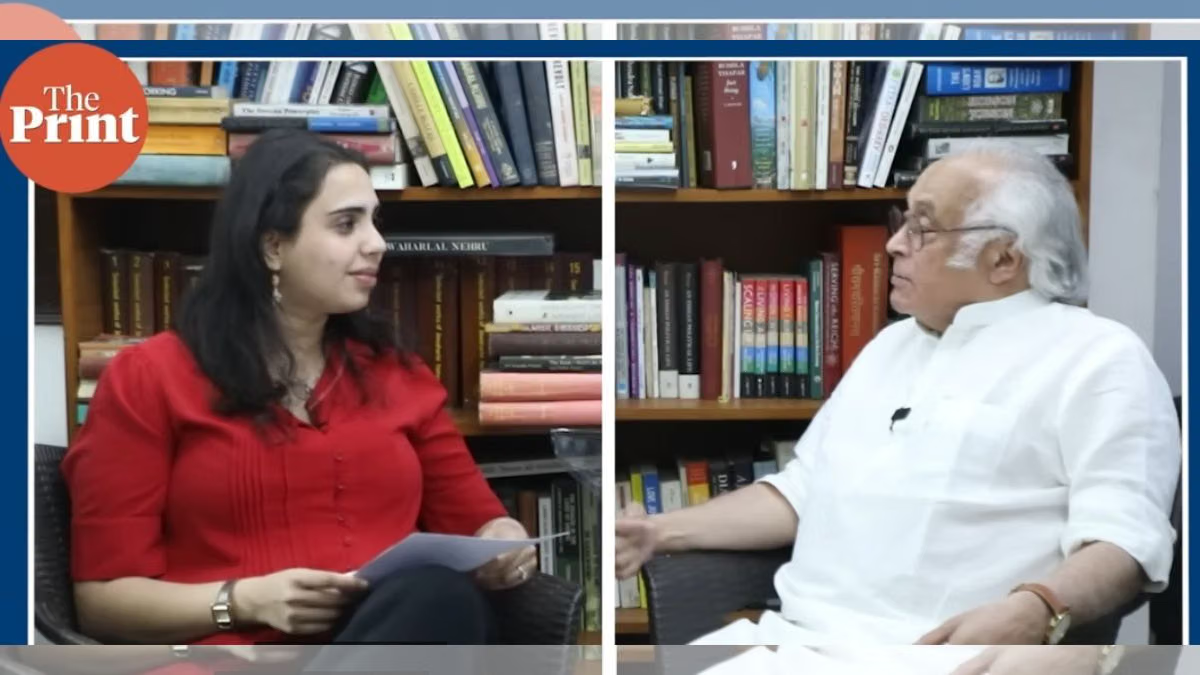
“One person who’s broken the consensus in foreign policy is Mr Modi. And the telling example is our blind devotion to Israel,” Ramesh told ThePrint.
“After Operation Sindoor, which was undoubtedly a significant military achievement, the government allowed itself to be arm-twisted by President Trump into halting operations on 10 May 2025,” he added.
“This has led to Pakistan’s gain and it being embraced by Trump on the world stage,” said Ramesh, who is also a Rajya Sabha MP. “Pakistan’s international standing has improved. That represents a major setback for Indian foreign policy.”
Ramesh also spoke about the BJP’s alleged push to engineer defections, the Congress party’s stand on EVMs, the INDIA bloc, delimitation, Shashi Tharoor’s remarks, Rahul Gandhi’s education campaign and the party’s roadmap ahead.
Also Read: Did armed forces, Rajnath try to hide Op Sindoor military casualties? What timeline suggests
‘This is Amit Shah’s revenge’
Ramesh linked what he alleged was the BJP’s recent success in engineering defections to what he described as Union Home Minister Amit Shah’s “badla” after the government failed to secure the numbers needed to pass the Delimitation Bill.
According to him, the BJP needed 352 votes but managed only 298, making it the first time in 12 years that the Modi government failed to get a bill through Parliament.
“The humiliation he suffered was unprecedented…What you’re seeing now is revenge—the badla that the home minister is taking on political parties,” Ramesh said.
He said the BJP’s moves against the Trinamool Congress, Shiv Sena and the Aam Aadmi Party were part of the same strategy.
“First, there was a surgical strike on the TMC, then a surgical strike on the Shiv Sena. I’m sure there was a surgical strike on the Aam Aadmi Party as well,” he said.
Ramesh maintained that even after the recent defections, the BJP remained well short of the two-thirds majority required for constitutional amendments.
Defections are ‘like the mutual fund industry’
Ramesh also took a swipe at the BJP over the recent wave of defections, saying leaders who switch parties are rewarded in different ways.
“Some are immediately rewarded. Some get deferred rewards. Some join in anticipation of rewards. Some get prepaid rewards,” he said, likening it to the “mutual fund industry”.
He maintained that anyone leaving a political party should first resign from the seat won on that party’s symbol before seeking a fresh mandate.
“If you’re a member of the Rajya Sabha, resign. If you’re a member of the Lok Sabha, resign. If you’re an MLA, resign. After that, do whatever you want,” he said, calling the current trend a violation of both the letter and the spirit of the anti-defection law.
‘Shashi Tharoor is a learned man’
Asked about senior Congress leader Shashi Tharoor’s remarks and the party’s hot and cold approach, Ramesh described Tharoor as “very learned”, “articulate” and “a wonderful writer”, adding that the two have shared a long association.
At the same time, he stressed that every political party runs on discipline and collective responsibility.
“As the communications in-charge of the Congress party, I hope all our leaders are a little more careful while making public remarks, because they make headlines,” he said.
‘Modi has appeased Trump’
Ramesh accused Modi of taking a soft line with Trump, saying India had ceded diplomatic space instead of engaging Washington from a position of strength.
Asked whether a Congress government would have dealt with Trump differently, he called the question hypothetical, noting that Trump’s current term is constitutionally limited.
He said the Congress has traditionally followed an independent foreign policy guided by India’s strategic interests rather than personal equations between leaders.
“The real issue is that Mr Modi has not dealt with President Trump. He has appeased him. First, there was ‘Howdy Modi’ in September 2019. Then there was ‘Namaste Trump’ in Ahmedabad in February 2020. I was recently reading a book by two New York Times journalists titled Regime Change, about the first year of Trump’s second administration. It notes how eager Mr Modi was to meet President Trump in early 2025,” he said.
“Even the framework agreement we’ve signed for the bilateral trade agreement is heavily tilted in favour of the United States. We’re making concession after concession, while the Americans are merely promising tariff reductions that remain uncertain. At the same time, they continue threatening us with additional tariffs whenever we don’t align with their policy preferences,” he added.
“Mr. Modi hasn’t simply dealt with Mr. Trump. He has appeased him. And the more he has appeased him, the more President Trump has embraced Field Marshal Asim Munir,” he said.
Congress stand on EVMs
Ramesh rejected the criticism that the Congress questions elections only after losing them, saying the party’s concerns go well beyond Electronic Voting Machines (EVMs).
“It’s not just about the EVMs. It’s also about the electoral rolls,” he said.
He alleged that elections are increasingly being “doctored”, pointing to electoral rolls, delimitation and the functioning of the Election Commission.
According to him, the BJP resorts to such tactics only in states where it is electorally competitive.
Referring to Haryana, Maharashtra, Assam and West Bengal, he claimed that since the 2024 Lok Sabha elections, the Opposition has effectively been fighting “the alliance of the BJP and the Election Commission of India”.
Why Lok Sabha gains didn’t translate into assembly wins
Asked why the Congress failed to carry its improved Lok Sabha performance into subsequent Assembly elections, Ramesh dismissed suggestions that the party had simply lost momentum.
Instead, he accused the BJP of changing its strategy after the 2024 general election and manipulating subsequent state polls.
He pointed to Haryana, Maharashtra and West Bengal, alleging that electoral rolls and delimitation played a decisive role in shaping the outcome.
“They put the Election Commission into fast forward,” he said.
He added that the party, which had 16 chief ministers in 2002, is now down to four.
Congress revival plan
For Ramesh, the road back begins at the grassroots.
He said the Congress has to strengthen its booth-level organisation, build a stronger local presence and invest in workers on the ground instead of relying only on national campaigns.
“Our 24×7 presence on the ground, particularly at the booth level, has to improve significantly,” he said.
He also admitted that the Congress needs to win the states and increase its vote share.
“Nationally, we have around 21 percent of the vote, while the BJP has grown to roughly 35 percent. That reflects the magnitude of the challenge before us,” he said.
“We have to begin winning states again. Upcoming elections will be held in Uttar Pradesh, Uttarakhand, Punjab, Manipur and Goa. We face significant challenges in each of these states,” he added.
INDIA bloc ‘was never meant for state elections’
Ramesh rejected the suggestion that the INDIA bloc lacks coherence because several allies contest against each other in Assembly elections.
“The INDIA alliance was created to fight the national election,” he said, adding that state politics has always followed its own dynamics.
That, he said, is why the Congress contests against the Trinamool Congress in West Bengal and the CPI(M) in Kerala while working with them in Parliament on national issues.
Asked whether the INDIA bloc was weakening, Ramesh said the real test would come during the Monsoon Session.
“Let’s wait. Wait for the Monsoon Session. You may be surprised,” he said, adding that he remains in regular touch with Opposition parties.
‘Not a mistake-dumping DMK’
Ramesh also played down recent friction with the DMK over Parliament seating arrangements, saying the BJP was trying to create the impression of divisions within the Opposition.
He rejected suggestions of a rift within the INDIA bloc after the DMK raised objections over seating arrangements in Parliament following the Congress party’s decision to go with the TVK in Tamil Nadu.
He said political alliances change over time, noting that the Congress and DMK had also fought the 2014 Lok Sabha polls separately before coming together again.
Defending the Congress decision to join the TVK government in Tamil Nadu, Ramesh said parties that support a government should also be willing to be part of it instead of offering outside support.
He added that the Congress remained in regular touch with all Opposition parties and said the Monsoon Session would show the alliance was intact.
Delimitation and the Constitution
Ramesh said the BJP’s plans are not limited to the Delimitation Bill.
According to him, the party’s larger objective is to secure the two-thirds majority required for constitutional amendments.
He claimed the BJP was trying to create conditions for a new constitutional framework and warned that reservations could come under pressure.
Ramesh, however, said he was “quietly confident” that the Opposition would once again prevent the BJP from securing the numbers it needs.
Ram Mandir trust row
Describing the Ram Mandir donation row as a “gigantic scam”, he alleged that contributions had been collected through coercive means and said those responsible should be held accountable.
“The fact remains that thousands of crores were collected in the name of faith. People donate to temples out of faith. I’ve done it myself in the past, but that’s a private decision. I don’t publicise it. The issue is how those donations were collected and how those resources were used,” Ramesh said.
“There is a trust, and people appointed by this regime—people who are part of the RSS-BJP ecosystem—have indulged in conduct that I find completely unacceptable. There has been a great deal of arm-twisting; what we are seeing is a gigantic scam,” he added.
Rahul Gandhi’s education campaign
Ramesh said Rahul Gandhi’s outreach to students is not confined to the NEET controversy; the campaign is aimed at drawing attention to deeper problems in the education system, including privatisation, commercialisation and centralisation.
He also pointed to the rapid growth of coaching centres, saying families today spend more on private coaching than the government spends on public education.
“The focus is, of course, exam reform because that’s the immediate challenge that we face—the aspirations of lakhs of youth. But the larger issue that he’s trying to raise, and which he raised in Kota, is the reform of the education system,” Ramesh said.
“When we talk about reforms in this country, we think of trade policy reforms, industrial reforms or fiscal reforms. But there are fundamental issues relating to the education sector. One very telling comparison that Mr Gandhi made in Kota—which should really invite much greater attention than it has so far—is that he compared what private families spend on coaching centres with what the Central government spends on education. There’s no comparison between the two,” he added.
Cockroach Janta Party
On the Cockroach Janta Party movement, Ramesh said he had nothing against citizen-led campaigns, but on the question of why he didn’t feel the need to extend political support, he said lasting political change had to come through recognised political parties.
He said the movement reflected the frustration of young people but added that issues such as education reform would ultimately have to be taken up by mainstream political parties and pursued both inside and outside Parliament.
(Edited by Sugita Katyal)
Also Read: Capt Amarinder, Bahuguna, Ravneet Bittu: Amid TMC exodus, a look at fate of Congress defectors to BJP
 20
20 584226
 20
20
 20
20