AI-Powered Smart Traffic Signals Go Live Across City
Nagpur: In a major step towards transforming urban mobility and strengthening road surveillance, the Nagpur Traffic Police and civic authorities have accelerated the rollout of the ambitious Intelligent Integrated Traffic Management System (IITMS) across the city.
The high-tech project, designed to modernise Nagpur’s ageing traffic infrastructure, has already become operational at 32 major intersections, while installation work is currently progressing at nearly 80 more junctions. Around 40 intersections, however, will continue functioning with the existing traffic signal network.
Gold Rate
May 11- 2026 – Time 10.30Hrs
Gold 24 KT
₹ 1,51,900 /-
Gold 22 KT
₹ 1,41,300 /-
Silver/Kg
₹ 2,60,200/-
Platinum
₹ 88,000/-
Recommended rate for Nagpur sarafa Making charges minimum 13% and above

The ambitious initiative is expected to redefine the way traffic is monitored and controlled in the city by introducing Artificial Intelligence (AI)-powered signals, automated surveillance, and real-time enforcement systems.
The IITMS project was originally scheduled for completion by February 14, but only 10 junctions had become operational by the deadline. Following the delay, authorities extended the target timeline till June, after which work gathered pace across several major traffic corridors.
Before the launch of the project, Nagpur depended on nearly 171 traffic signals, many of which were over two decades old and increasingly ineffective amid the city’s rapidly expanding road infrastructure.
Recognising the urgent need for modernisation, the State Government sanctioned a massive Rs 198 crore upgrade aimed at creating a smart and technology-driven traffic ecosystem.
AI-based signals to replace traditional timers
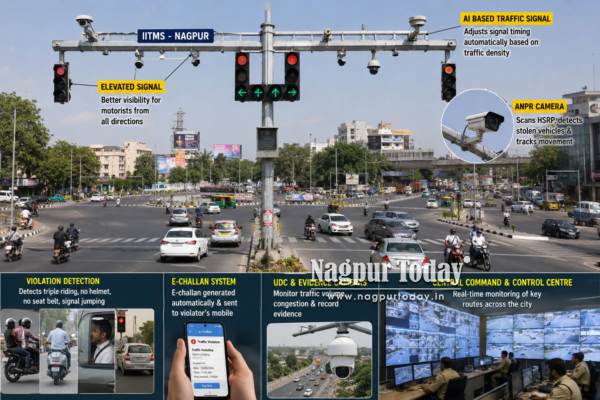
One of the biggest changes under the new system is the replacement of conventional timer-based signals with AI-enabled adaptive traffic control.
Unlike older roadside traffic lights that were often difficult for motorists to notice, the newly installed signals are positioned at elevated central points over intersections, significantly improving visibility for commuters.
The advanced system will no longer rely on fixed signal timings. Instead, intelligent cameras and sensors will analyse vehicle density at junctions in real time and automatically adjust green signal duration depending on traffic flow.
This dynamic mechanism is expected to reduce long traffic queues, minimise waiting time at intersections, and improve overall travel efficiency across Nagpur.
At the heart of the IITMS project will be a sophisticated central control and monitoring centre directly linked with traffic police authorities. Officials will be able to monitor movement across critical roads and junctions through a network of high-resolution surveillance cameras installed throughout the city.
The system is also expected to play a crucial role in crime detection and vehicle tracking.
ANPR cameras to track stolen vehicles
The upgraded infrastructure includes Automatic Number Plate Recognition (ANPR) cameras capable of scanning High Security Registration Plates (HSRP) of vehicles passing through intersections. Once scanned, the system can instantly retrieve vehicle details, ownership records, and movement history. If a stolen or suspicious vehicle is detected, the control centre will immediately generate an alert for enforcement agencies.
Authorities believe the technology will significantly strengthen policing and help crack down on criminal activities involving vehicles.
Automated detection of traffic violations
Apart from traffic management, the smart surveillance system will automatically identify multiple traffic violations, including:
• Triple riding on two-wheelers
•Riding without helmets
• Driving without seat belts
•Jumping traffic signals
Once a violation is detected, the system will generate e-challans automatically, which will be sent directly to the violator’s registered mobile number. In addition to ANPR cameras, evidence-recording cameras will continuously capture activities at intersections, while UDC cameras will analyse congestion levels and traffic volume.
According to Rajendra Rathod, NMC Executive Engineer, the city’s rapidly changing road infrastructure made the old traffic system obsolete. “Due to the construction of cement roads, flyovers and ring roads, the height and visibility of old traffic signals had become inadequate. The new system will greatly improve traffic management and road monitoring in Nagpur,” Rathod said.
The IITMS project is being implemented by Keltron, the agency entrusted with executing the smart traffic upgrade.
Once fully operational, officials believe the AI-driven network will not only ease congestion and improve commuting time but also make Nagpur one of the technologically advanced cities in traffic management and urban surveillance.
Advertisement

Advertisement

Advertisement
 20
20 584226
 20
20
 20
20