Water Dept in dock over ‘invisible’ illegal connections
Advertisement

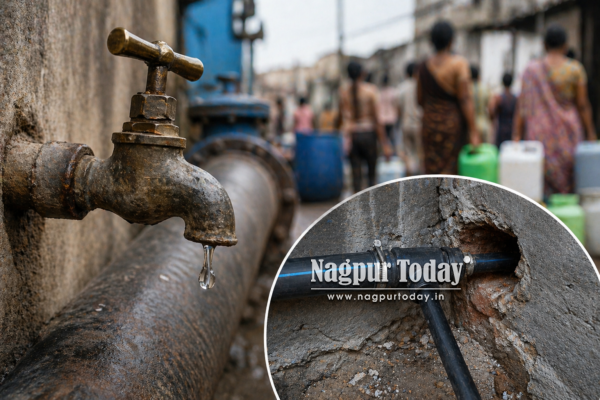
Nagpur: The Water Supply Department of the Nagpur Municipal Corporation (NMC) has come under sharp scrutiny for what appears to be a staggering administrative failure, its complete inability to account for illegal water connections in the city.
In a revelation that exposes the hollow core of civic accountability, information obtained under the Right to Information Act, 2005 by RTI applicant Abhay Kolarkar shows that the department has no year-wise data, no estimates of financial losses, and no classification of illegal connections across sectors. In multiple instances, the official response bluntly reads “NA,” a telling indicator of either gross incompetence or deliberate opacity.
Gold Rate
Apr 29- 2026 – Time 10.30Hrs
Gold 24 KT
₹ 1,50,500 /-
Gold 22 KT
₹ 1,40,000 /-
Silver/Kg
₹ 2,42,300/-
Platinum
₹ 90,000/-
Recommended rate for Nagpur sarafa Making charges minimum 13% and above

While the department boasts meticulous records of authorised connections and rising revenue, it has conveniently drawn a blank on the parallel shadow network of illegal usage. Its only defence, a vague claim that unauthorised connections are cut “as and when identified,” rings hollow in the absence of any verifiable figures. No data on detection drives, no penalties, no accountability.
When confronted, officials failed to provide answers. Instead, Deputy Engineer and PRO Prakash Yemde reportedly asked the local newspaper to file another appeal, effectively pushing the burden of transparency back onto citizens. This evasive stance not only undermines the spirit of the RTI Act but also raises uncomfortable questions about what the department is trying to hide.
The contrast is glaring. NMC’s water revenue has climbed from Rs 178 crore in 2021–22 to Rs 234 crore in 2025–26, suggesting aggressive billing of legitimate consumers. Yet, there is zero clarity on how much water, and money, is being lost to theft. The message is unmistakable: honest citizens are being squeezed, while illegal consumption thrives in the shadows.
More alarming is the systemic nature of this data vacuum. Without any sector-wise breakup—be it slums, commercial establishments, or industries, there is no way to assess whether enforcement is fair or selectively applied. The absence of such critical data is not a minor lapse; it is a governance breakdown.
In a city already grappling with water stress, this blind spot borders on negligence. If the civic body cannot even measure the scale of illegal usage, it cannot hope to control it. And when a public utility fails to track its own leakages, the cost is inevitably passed on to the law-abiding public.
This is no longer just about missing data, it is about a system that refuses to see what it does not want to fix.
Advertisement

Advertisement

 20
20 584226
 20
20
 20
20