Seven years, three rejections: How an IPS officer took his fight to quit his job all the way to Supreme Court | Mumbai News
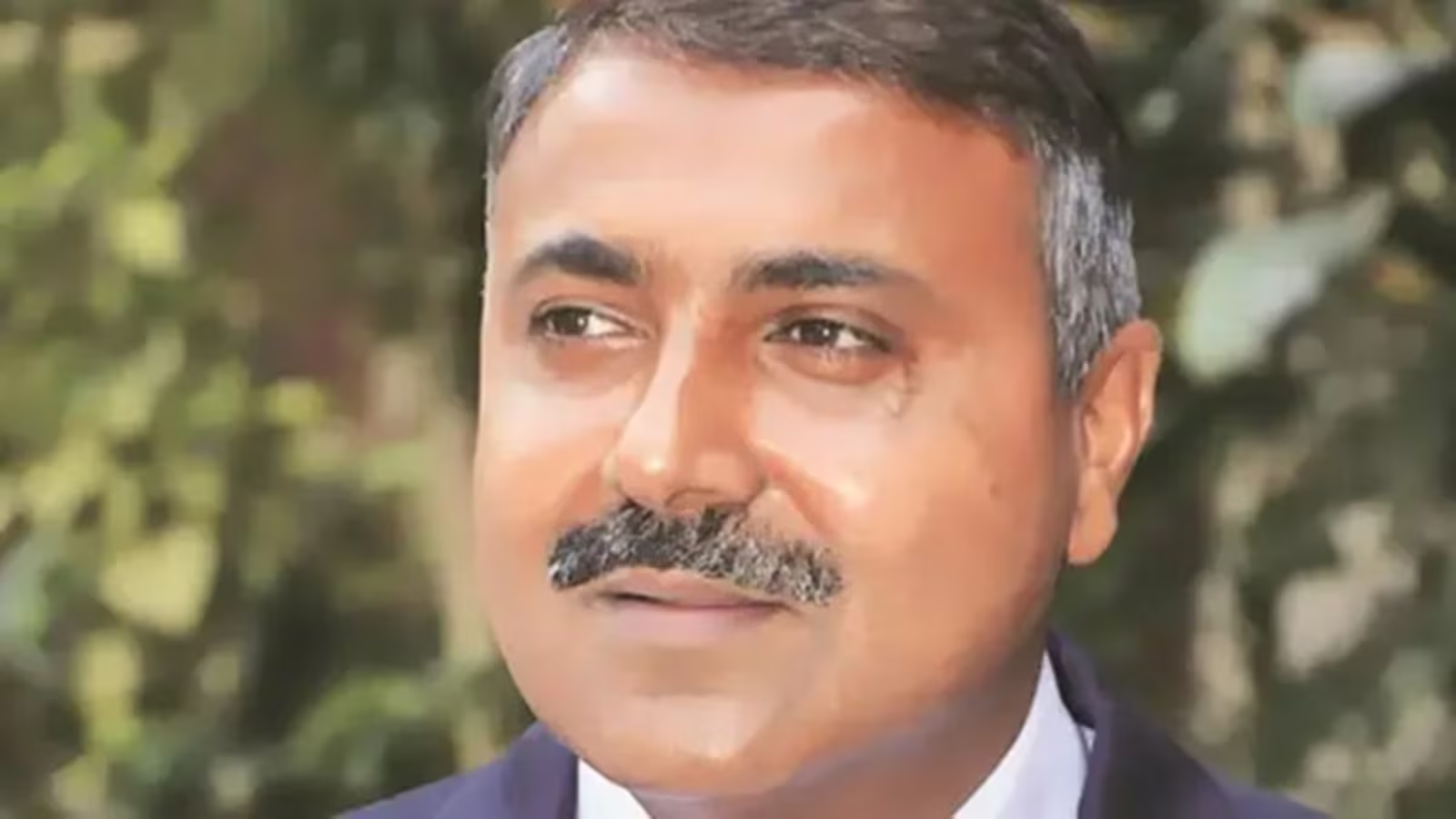
After a nearly seven-year-long legal and administrative battle, Maharashtra-cadre IPS officer Abdur Rahman, 53, may finally be able to take voluntary retirement from service (VRS). On Wednesday, the Supreme Court set aside a Central government order of 2019 rejecting Rahman’s plea for VRS, which cited pending disciplinary action against him, including over participation in protests against the CAA.
The apex court held that the government’s refusal of the IPS officer’s application suffered from “a non-application of mind”. It directed the Union Home Ministry to re-examine Rahman’s VRS notice afresh and pass appropriate orders within three months.
“No government should force an unwilling officer to continue working. Even when I moved applications stating that I did not wish to continue, the state kept manufacturing small issues to drag the matter,” says Rahman, a 1997-batch officer and an IIT-Kanpur graduate in civil engineering.
Originally from Bihar, Rahman has served in several senior administrative positions across Maharashtra, including as Assistant Superintendent of Police in Latur, Superintendent of Police in Dhule, Additional Commissioner of Police (Administration) in Pune City, and Inspector General of Police in the Maharashtra State Human Rights Commission.
Rahman, who briefly explored entering politics before deciding against it ahead of the 2024 Lok Sabha elections, believes the Centre’s resistance to his VRS plea stemmed solely from his opposition to the CAA. “It was my anti-CAA statements that made me a target.”
However, it is not the first time Rahman filed for VRS. His first application was in 2017, two years after he wasn’t made Special Inspector General of Police and felt he was overlooked. But, soon after, Rahman decided to pursue the matter with the Central Administrative Tribunal (CAT), and withdrew his VRS plea.
Then in March 2018, Rahman submitted a second VRS application. The Union Home Ministry rejected it on the ground that he didn’t have Vigilance clearance, citing disciplinary proceedings going back to 2007. These proceedings stemmed from delay in providing RTI information on a FIR registered during Rahman’s tenure as Yavatmal Superintendent of Police. Rahman maintained the information sought had been supplied twice through post, and that failure to communicate this was a clerk’s lapse and not evidence of any misconduct on his part.
Story continues below this ad
He also alleged that the ‘major penalty chargesheet’ against him in the matter, in November 2015, was “manufactured” solely to block his promotion to Special Inspector General in 2017.
The RTI-related proceedings were eventually closed and Rahman was promoted in 2019.
His third VRS application, submitted on August 1, 2019, was cleared by the Maharashtra government in October 2019. The state government said it had reviewed the complaints pending against him, and added: “… it is seen that chargesheet is not issued in any case & disciplinary proceedings are only contemplated. Also it seems to be (that) no major penalty will be imposed on the Officer.”
But, nine days later, the Centre again blocked VRS for Rahman, citing the disciplinary proceedings despite Maharashtra’s go-ahead – over alleged violation of service rules in a family matter, and over a speech delivered by Rahman in March 2019 at the launch of his book ‘Denial and Deprivation: Indian Muslims after the Sachar Committee and Rangnath Mishra Commission Reports’.
Story continues below this ad
Even as these matters were pending, Rahman publicly announced his decision to quit government service after the CAA was passed by Parliament in December 2019, calling it “against the basic features of the Constitution”. He also participated in anti-CAA protests leading up to the passage of the Bill.
This led to the third chargesheet against Rahman, in April 2022, pertaining to allegedly unauthorised absence from duty, publishing information related to his VRS application on social media, and participating in protests against the CAA.
Rahman first approached the CAT against the denial of VRS, but his plea was rejected in December 2023, with the tribunal citing pending complaints and possible disciplinary proceedings against him. He then moved the High Court, which also dismissed his challenge in July 2024, ruling that the Centre had the final authority to accept or reject VRS applications and that departmental proceedings against him were already under contemplation at the time.
Rahman then approached the Supreme Court. In its order asking the Centre to clear his application, the apex court observed that when it rejected VRS for Rahman, there was no formal chargesheet against him, meaning no disciplinary proceedings were actually pending at the time. The Court also said that of the three complaints cited against him, only one was validly under contemplation and that the Centre had failed to properly consider the Maharashtra government’s view that the complaint was unlikely to result in a major penalty.
Story continues below this ad
At the same time, the Court said that the authority to accept or reject VRS applications of IPS officers remained with the Centre.
Rahman says he doesn’t regret his actions, and intends to continue working on issues concerning the socio-economic condition of Muslims and other marginalised communities. “My emphasis is to create awareness among socially downtrodden groups, including Muslims.”
While he is relieved after the Supreme Court order, Rahman adds, he will rejoice only once his VRS is formally approved. “Life was comfortable in service, but at times you realise you can do far more for people outside the system. I am happy with the Supreme Court verdict asking the government to reconsider my VRS application. I would have been happier had the Court directly granted me VRS,” he says.
 20
20 584226
 20
20
 20
20