‘Peddi’ movie review: Ram Charan and AR Rahman power a weakly-written sports drama
Pudathama enti malli? (Will we be born again?), Ram Charan’s character Peddi asks at several points in his new Telugu film directed by Buchi Babu Sana. More statement than question, the line underscores the protagonist’s belief that life comes only once, and his determination to stop at nothing to achieve his goal. Buchi Babu frames Peddi’s fight for his own identity and that of his village like a sports biopic, powered by Ram Charan’s performance, A.R. Rahman’s music and R. Rathnavelu’s evocative visuals.
The 189-minute film travels back to the 1990s. When a member of the Indian Olympics Association, played by Boman Irani, witnesses an extraordinary spectacle in and around Vizianagaram, Andhra Pradesh, he is drawn into Peddi’s story. At its core, the film is centred on the struggles of sugarcane field labourers in the region. Yet, its storytelling borrows liberally from sports dramas across languages, evoking everything from Sarpatta Parambarai to Chandu Champion and Bhaag Milkha Bhaag.

Peddi begins as a coolie who channels his prodigious batting talent into local cricket matches, largely for money. Every towering six, often sailing beyond neighbouring grounds, fuels both the crowd’s frenzy and his own momentum. Ram Charan convincingly inhabits the rustic, combustible energy of a man for whom cricket is far from a gentleman’s game. Here, predators wait to injure batsmen, and a labourer must win not just matches but also respect from those who wield power over him.
Peddi (Telugu)
Director: Buchi Babu Sana
Cast: Ram Charan, Janhvi Kapoor, Shiva Rajkumar, Jagapathi Babu
Run time: 189 minutes
Storyline: Sports is the only hope for identity for a daily wager in a remote hamlet. Can he win for himself and his people?
The two cricket matches, one played during the day and the other at night, gradually help to unmask the region’s deep-rooted social inequities. The story brings into focus the plight of Peddi’s village, a nameless settlement with no road or rail connectivity, whose residents have no voting rights and are left to fend for themselves in life and death.
Buchi Babu Sana, who has written the story, along with screenplay writers Nagendra Kasi, Vara Prasad Toleti, Krushna Hari, Venkata Prasad Gandhi and Sri Raman Ch, unfolds this reality through visuals of daily wage workers trekking through forests, interspersed with references to the absence of healthcare and educational facilities. A village elder, Appala Suri (Jagapathi Babu), relentlessly campaigns to get trains to halt at the village, but his efforts prove futile.
Yet, much of this material does not land strongly enough to make us invest in the village’s fate. Had these portions been written and executed with greater emotional depth, Peddi’s struggle for identity would have resonated far more powerfully.
Despite Jagapathi Babu’s earnest performance, Appala Suri’s arc remains emotionally distant, largely because the film falls back on familiar tropes that mainstream cinema has long used to depict rural hardship. While several supporting actors look convincing in their parts, a sense of déjà vu lingers throughout.

A romance track involving Janhvi Kapoor as a local politician’s daughter further impedes the narrative. Remove her portions and little would change. The overt sexualisation of the character, coupled with some of the dialogues and situations, feels crass. It’s 2026, and Telugu cinema can do better.
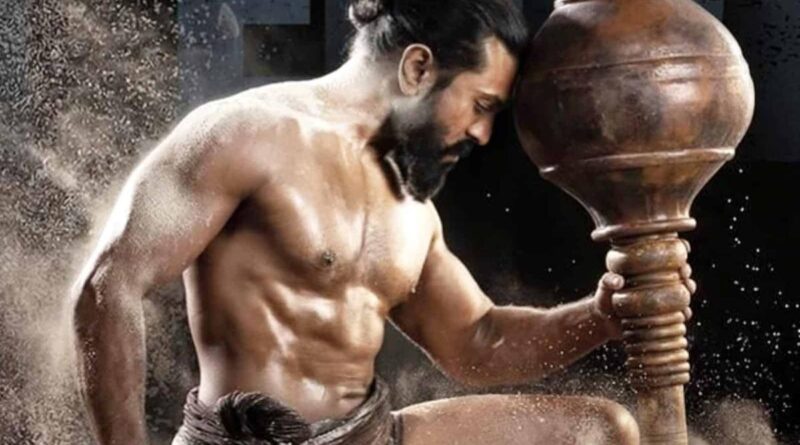
The sports sequences, thankfully, bring the film back on track. Rathnavelu and his team establish a convincing vintage visual aesthetic for the rustic sports drama, while Ram Charan excels as the carefree cricketer who later transforms into a wrestler driven by purpose. The wrestling portions may briefly evoke memories of Dangal or Sarpatta Parambarai, but thanks to Ram Charan and Shiva Rajkumar, the comparison does not linger.
This transformative phase also benefits immensely from A.R. Rahman’s score, which shifts seamlessly from the rousing energy of the cricket matches to more emotionally resonant territory as the narrative evolves. Even when the envy, politics and power struggles of the sporting arena feel familiar, Ram Charan and Rahman make the uneven stretches watchable.
The film also assembles actors from different industries in a bid to appeal to a pan-Indian audience. However, barring Shiva Rajkumar, few are given enough material to make an impression, their roles often bordering on caricature. The inconsistent lip-sync further distracts.
In the latter portions, the visual effects used to recreate the village and railway tracks dilute the story’s realism. In contrast, the Delhi sequences, shot on film cameras, stand out for their rich and authentic texture.
Towards the end, a major plot twist functions more as a shock tactic than the culmination of a well-earned character arc. Once again, the problem lies in the writing. For viewers familiar with mainstream cinema, the reveal is also easy to anticipate. Buchi Babu Sana employed a similar device in his debut film Uppena, but there it felt organic to the emotional rhythms of the story.

It is also difficult not to think of Sukumar’sRangasthalam, starring Ram Charan, for which Buchi Babu Sana was part of the writing team. That film established its social hierarchies with far greater clarity, making the audience deeply invested in the protagonist’s journey and rebellion. Here, we hear a lot about inequality but rarely feel its weight.
And yet, if the film’s final sporting moments still manage to move us, much of the credit belongs to A.R. Rahman and Ram Charan. After Rangasthalam and RRR, this is another defining performance from the actor. Charan fully internalises Peddi’s journey and makes every sporting triumph feel earned.
If only Peddi had matched its ambition with sharper writing, it might have been truly memorable. Instead, it remains a messy, uneven drama held together by a committed lead performance and a stirring musical score.
Published – June 04, 2026 03:16 pm IST
 20
20 584226
 20
20
 20
20