25 transfers in 20 years: Meet Tukaram Mundhe, the IAS officer Mumbai’s restaurants fear | Mumbai News
Every working day between 4 and 5 pm, the door to the commissioner’s office at Maharashtra’s Food and Drug Administration (FDA) headquarters in Bandra Kurla Complex opens to anyone who walks in. On the afternoon The Indian Express visited, the owner of Noor Mohammadi, the century-old Mohammad Ali Road institution, was there with his son, the restaurant’s fourth-generation custodian. Days earlier, the FDA had suspended their licence. They had come to understand how to get it revoked. Many who arrive with that question end up going to the commissioner himself.
Getting an audience with Maharashtra’s FDA Commissioner, Mumbai’s food industry has learnt, is easy. Getting leniency is not. In his first official press note after taking charge, Mundhe declared: “No leniency whatsoever will be shown by the administration to any person or establishment that plays with the health of the public.” In the weeks since, the department’s enforcement drive has sought to demonstrate exactly that.

Since taking charge on May 25, the FDA has carried out 1,131 inspections across Maharashtra, averaging more than 20 a day. It has seized food stock worth Rs 49.57 crore, including 1.6 lakh litres of allegedly adulterated milk, invoked the Maharashtra Control of Organised Crime Act (MCOCA) against organised gutkha networks, and suspended the licences of 56 restaurants.
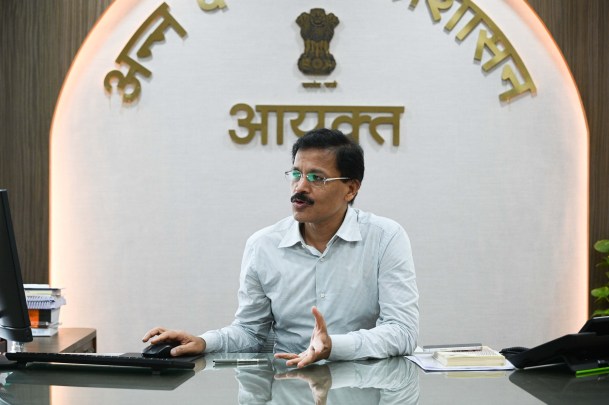 Tukaram Mundhe, commissioner of Maharashtra’s Food and Drug Administration, at his office at BKC in Mumbai. (Express photo by Sankhadeep Banerjee)
Not just any restaurants.
Among those facing action were the 73-year-old K Rustom & Co., Noor Mohammadi, Shalimar, Aditya Birla New Age Hospitality’s Waarsa and Flint, run by chef Rahul Akerkar and most recently the 110-year-old Parsi Dairy Farm. The crackdown has also prompted statewide protests by pan shop owners, who allege indiscriminate use of stringent criminal laws against small retailers.
But for Mumbai, the arrival of its new FDA Commissioner was first visible not through inspections, but through WhatsApp.
An almost-silent FDA media group suddenly began buzzing with a steady stream of press notes, photographs and videos documenting raids across Maharashtra. The first press note under Mundhe’s charge issued on May 28, three days after he assumed office, announced a statewide drive against food adulteration. It referred to him as “Shri Tukaram Mundhe”. Both details would prove telling.
Story continues below this ad
In less than two months, Mundhe has turned one of Maharashtra’s most obscure regulatory departments into one of its most closely watched, and found himself in a familiar place — at the centre of public admiration, political unease and institutional debate.
Mundhe declined to be interviewed for this profile.
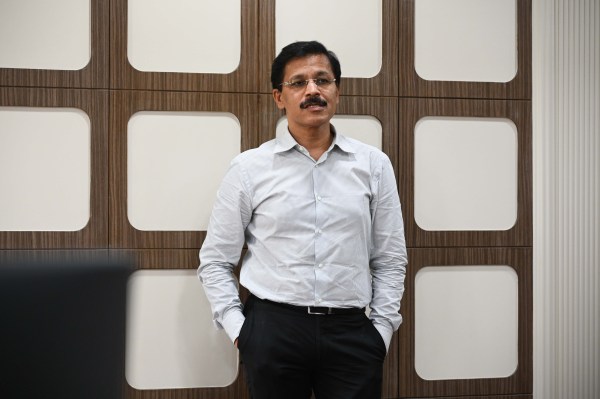 Tukaram Mundhe, commissioner of Maharashtra’s Food and Drug Administration, at his office at BKC in Mumbai. (Express photo by Sankhadeep Banerjee)
The village and the making of Mundhe
Long before he became one of Maharashtra’s most recognisable bureaucrats, Mundhe was a farmer’s son in Tadsonna village in Beed district, one of the state’s most drought-prone regions.
Mundhe has spoken of working in the fields, helping sell vegetables in weekly markets and studying in a Zilla Parishad school. He joined the IAS in 2005, and credits his father, whom he describes as honest and hardworking, for the values guiding his public service.
Story continues below this ad
Over the next two decades, his career came to be defined as much by frequent transfers as by the offices he held. The FDA is, by some counts, his 25th transfer.
Over more than 16 major assignments, he built a reputation for surprise inspections, strict enforcement and an uncompromising style. Supporters see the transfers as the price of refusing to bend. Critics see them as evidence of a style that leaves little room for consultation or compromise.
His career reflects both views.
As Solapur Collector, Mundhe’s work under the Jalyukt Shivar programme helped make hundreds of villages tanker-free, earning him the moniker “Water Man of Maharashtra”. During the 2015 Ashadhi Wari, he enforced strict traffic and security protocols, leading to a public confrontation with then Revenue Minister Eknath Khadse over the movement of the minister’s convoy. Ajit Pawar later accused him in the Assembly of not respecting elected representatives.
A year later, as Commissioner of the Navi Mumbai Municipal Corporation, Mundhe launched demolition drives, tightened property tax recovery, acted against unauthorised hoardings and introduced early morning “Walk with the Commissioner” inspections. Resident groups welcomed the crackdown, but corporators across party lines accused him of bypassing elected representatives and functioning in an autocratic manner. The confrontation culminated in a no-confidence motion against him in 2016 by the NCP, Congress and Shiv Sena. Then Chief Minister Devendra Fadnavis intervened to stay the resolution, arguing that an officer should not be penalised for exposing irregularities. Even within the BJP, however, support was not universal, with MLA Manda Mhatre later emerging as one of his sharpest critics.
Story continues below this ad
His brief stint as Health Commissioner in 2022 followed a familiar pattern. Surprise hospital inspections, biometric-linked attendance and action against doctors allegedly engaged in private practice won public support, but when he was transferred within weeks, citizens launched petitions seeking his continuation.
Inside the fourth floor office
The transformation is visible long before one reaches the FDA Commissioner’s office.
A year ago, officials say, the ground floor of the FDA headquarters in Bandra Kurla Complex wore a deserted look. Today, it is crowded with complainants, restaurant owners and food business operators. At one end sits a grievance cell, where complaints received through letters, calls, social media and the online portal are logged and forwarded for action. Officials estimate between 500 and 1,100 complaints now reach the department daily.
The department has been instructed to address each complaint. “Say if there are four complaints from one zone, we would go one day and inspect all of them,” said a food safety officer.
Story continues below this ad
The rhythm of the office, officials say, is set from the fourth floor. Mundhe arrives at 9.40 am and leaves around 6.15 pm. “Even those who were coming till 11 am earlier now come by 10-10.30 at the latest,” one officer said, adding: “Earlier, officers would come late and stay late and expect us to stay back till they left. Now there’s no such expectation, only expectation is that we get the work done.”
For many officers, that expectation has meant significantly longer days. “There is a lot of work,” is a refrain heard across the department. “He works at a very fast pace and we have to follow along,” said a senior official. Food Safety Officers described days that begin before 10 am, stretch through inspections across the city and often end late at night after completing police formalities to register cases.
The change is reflected in the laboratories as well. Officials said about 15,000 samples were tested through all of last year, against around 8,700 between July 1 and 15 this year alone, after the department shifted to batch testing and two shifts using the same workforce.
Officers attribute the surge to three factors. The recent recruitment of nearly 200 Food Safety Officers, stronger administrative backing and new standard operating procedures for inspections and licence suspensions.
Story continues below this ad
Communication, too, has become part of the strategy. Where inspections rarely reached the public domain earlier, the FDA now issues press notes almost daily, with photographs, videos and cumulative data. Officers have also been instructed to respond to media queries instead of avoiding them. Within days of taking charge, Mundhe held an informal interaction with journalists. Four press conferences have followed.
Officers, speaking anonymously, said the commissioner places considerable emphasis on public communication. They pointed to a series of official press notes that initially referred to him as “Shri Tukaram Mundhe” and later as “Honorable Commissioner Shri”. Some also said employees tend to keep a low profile on social media because they believe Mundhe prefers the department’s messaging to remain centred on the Commissioner’s office.
‘The debate has always been about his methods’
“Nobody questions his honesty or his commitment to work. The debate has always been about his methods,” said a former colleague. “If he believes a decision is right for citizens, he goes ahead with it irrespective of who gets upset,” said a retired bureaucrat. Another former official put it differently: “He looks at the rule book before he looks at the politics.”
The criticism, however, comes in two layers. The first is his style of administration.
Story continues below this ad
“Administration is not only about implementing rules. It is also about taking people along,” said a former municipal official. “Every issue has stakeholders. If everyone becomes your opponent, implementation becomes difficult,” said former public representative. “There is always space for discussion in administration. Strict action and dialogue can go together,” said a former minister.
Some former colleagues described him as impatient once he had decided. “He listens, but often after he has already made up his mind,” said one.
“No one opposes action against adulteration or unhygienic food practices,” said a former official familiar with food regulation. “The question is whether enforcement alone can solve the problem.” The official argued that if milk producers are struggling with low procurement prices, those concerns also need attention. Another questioned whether the department had the manpower to sustain such inspections across thousands of small eateries and vendors. “You cannot solve every problem only through enforcement,” said a retired bureaucrat. “Awareness and participation matter as much as action.”
For several former colleagues, this is where Mundhe’s approach falls short. “He struggles to take stakeholders into confidence,” said one former employee. “People may comply because they fear action. That is different from believing in the reform.” Another summed it up: “Getting attention and solving problems are not always the same thing.”
‘We are just hoping they don’t come’
Story continues below this ad
If bureaucrats debate Mundhe’s methods, Mumbai’s food industry debates his standards.
Most restaurateurs The Indian Express spoke to called the crackdown overdue. Their concern was whether perfection was becoming the benchmark. “They shut that 70-plus years old K Rustom and then century-old Noor Mohammadi and Parsi Dairy Farm,” said the owner of one South Mumbai restaurant, before conceding: “But the photos and videos show that it was very dirty.”
He added: “But no matter what you do, and how much you take care of, there is bound to be some lapse that they can catch if they come here. We are just hoping they don’t.
Others questioned whether enforcement was falling evenly across the industry. “They are targeting all the iconic eateries and big restaurants,” one restaurateur said. “It is not like only South Bombay has unhygienic eateries. Why are they not going to other areas? Because iconic eateries, big restaurants make better headlines.”
Another pointed to the practical challenges. “Say there’s a dead rat on the premises — that’s negligence. But what do we do about the rats on the street?” he asked. “A five-star hotel on an elevated floor can keep rodents out more easily than a ground-floor restaurant in a low-lying area,” he said.
The trade largely agrees food safety standards need to improve. The disagreement is over where enforcement ends and practical compliance begins.
‘No proposal to transfer him’
The crackdown has already followed Mundhe into the Maharashtra Assembly.
NCP (SP) MLA Jitendra Awhad urged the government not to transfer him for at least three years, alleging vested interests were seeking his removal and claiming Mundhe and his family had received threats in Pune. BJP MLA Sudhir Mungantiwar also backed him. FDA Minister Narhari Zirwal told the House there was no transfer proposal and the security concerns would be examined. Police have since registered cases over threatening messages.
Those close to Mundhe say such episodes have recurred through his career — frequent transfers have meant his children repeatedly changing schools, and public controversies spilling into family life.
People close to Mundhe say he has never measured success by popularity. Whether admired or criticised, they say, he sees his role simply as enforcing the law.
Perhaps fittingly, the man leading Maharashtra’s campaign against adulterated milk drinks his coffee black.
 20
20 584226
 20
20
 20
20