
Would you pay £650 for a 50-course meal? Inside dining’s most extravagant trend
Fine dining used to mean white tablecloths, suited waiters and hushed dining rooms. Communication with the front of house team during your meal wouldn’t go much beyond, “Would sir like another bottle?” Now, a meal at some of the best restaurants around the world is more like a fully catered TED Talk. A multi-course meal that could easily cost you £500 a head comes complete with a narrative arc that communicates the chef’s culinary heritage, philosophy and precise provenance of ingredients. You could leave the restaurant smarter than when you arrived, if you’ve managed to absorb all the information as well as the alcohol in your £200-a-pop wine pairing.
In an opinion piece for Restaurant, hospitality industry expert Ted Schama wrote that “the brands that are winning today are not simply those that deliver a meal, but those that make you feel something… that create theatre, scarcity and emotional connection.”
So, how did fine dining move from food to emotion, from indulgent to edifying? I first encountered immersive dining in the early 2000s at The Fat Duck, Heston Blumenthal’s groundbreaking restaurant in Bray-on-Thames. I marvelled at the green tea and lime mousse ‘poached’ tableside, with great theatre, in billowing liquid nitrogen. Smoke puffed out of my nose as I bit into the crisp, frozen ball of foam. Blumenthal was famously inspired by the work of Ferran Adrià at elBulli in northern Spain, where a five-hour meal of up to 50 courses was packed with mindbendingly inventive, playful dishes – like savoury tiramisu with freeze-dried tofu, concentrated soy sauce, sake and tofu foam – that encouraged the diner to engage on an intellectual level with the meal, as well as with all their five senses.
Chefs like Adrià and Blumenthal laid the foundations for the next generation of chefs to take immersive dining one step further. At elBulli alumnus Grant Achatz’s restaurant Alinea in Chicago, guests are blindsided by being welcomed to a shared table for their first course and, after eating the second course in the kitchen, are returned to a completely reconfigured dining room with separate tables. The meal ends with an edible helium-filled balloon that tastes of green apple.
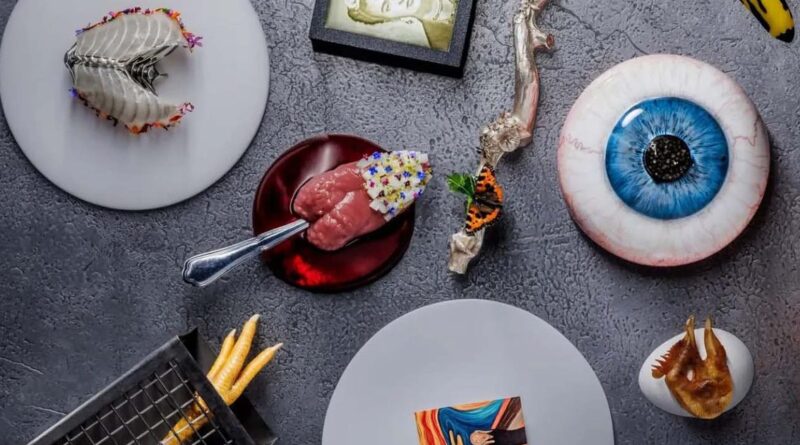
Alchemist, set in a huge converted warehouse in Copenhagen, replicates elBulli’s marathon format, with 50 courses over six hours, but ramps up the interactive, immersive aspects with enveloping audiovisual displays projected onto the restaurant’s domed ceiling that change for each course. Thousands of disembodied eyeballs stare down, for example, as ‘1984’ is served: a spookily realistic representation of Big Brother’s eye fashioned from lobster tartare, caviar and cod’s eye gelée.

From The Alchemist Instagram. ‘Burnout Chicken’, ‘Hunger’, ‘The Scream’, ‘Tongue Kiss’, ‘Lithophane’, ‘Butterfly’, ‘What Came First?’, ‘1984’, ‘Andy Warhol’
Such lavish presentation means Alchemist can demand serious money – £650 just for the menu. But, it’s not just about the big bucks: in chef Rasmus Munk’s Holistic Cuisine Manifest, he claims that Alchemist “initiates and partakes in debates on social and ethical issues.” For example, ‘Burnout Chicken’ features a boned and stuffed chicken wing chained to a metal cage, prompting diners to consider animal welfare issues.
At Tresind Studio in Dubai, the world’s first three-Michelin-starred Indian restaurant, chef Himanshu Saini (who also just launched Tresind Mayfair in London) has a very particular reason for serving the immersive 15-course ‘Rising India’ menu, which represents a journey across the subcontinent: “Indian cuisine, at its core, is storytelling. Every dish carries memory: of regions, of homes, of rituals, of time. Our interactive format allows us to explain not just what a dish is, but why it exists. A server presenting a course is not simply describing ingredients; they are sharing context, emotion, and intent.”
Saini points to a course inspired by the Keralan festive dish sadya. For it, a procession of a dozen members of staff each add one element to the plate – which includes grilled spiced pineapple, coconut ice cream, blossom flowers and a tomato broth – and a server then explains that the dish reflects the elements of the traditional vegetarian feast served on a banana leaf. “It’s not about adding complexity, but about adding meaning, making each moment memorable and significant for our guests,” says Saini.
Michelin-trained chef Jozef Youssef has been working in the field of experiential dining for the last 15 years and working alongside scientists – including Charles Spence, who helped develop some of Blumenthal’s dishes. He calls Kitchen Theory – a stylish 18-seat dining space in the basement of a mews house in Bloomsbury – a “multi-sensory gastronomy design studio”, and draws inspiration from pioneering multi-sensory restaurants, such as Sublimotion in Ibiza and the now-closed Ultraviolet in Shanghai. Although he works for corporate clients around the globe, he also stages regular supper clubs for the public that combine elements of exhibition, lecture, theatre and audio-visual presentation.

Kitchen Theory
“There’s been a rise in interest in multi-sensory experiences that go beyond the norm, be it projected art exhibitions or life-size Monopoly. Back in its day, The Fat Duck was what was considered immersive or experiential, but now the bar’s constantly being pushed higher.
“Technology has come on further, so we can do things that are a bit more focused on lighting and projections that you can’t do in a Michelin-starred restaurant, which doesn’t allow for that format.”
Kitchen Theory is a wild ride. At various points in the evening, I found myself fondling a cube with rough and smooth edges to see if it affected the taste of the English sparkling wine I was drinking, watching pasta-making as a staged theatrical performance complete with dramatic orchestral soundtrack, tucking into jellyfish (delicious) while wearing headphones and being bathed in a sea-themed projection, and eating Putin’s face off a plate (actually a stencilled presentation of it made with beetroot) – all while Youssef acted as a cross between emcee, learned professor and chef.
With restaurants like Eatrenalin in Germany – where guests take a floating chair ride from course to course – and Krasota in Dubai, that combines fine dining with elements of visual art and theatre, it seems that experiential dining will continue to challenge the definition of eating out. But, is there a risk of pushing it too far? “People don’t want a gimmick,” says Youssef. “People who are going out for fine dining and spending £250-plus for a meal are not looking for some kind of a joke. What they’re looking for is a great meal and also a great experience. And, that’s exactly what we’re trying to provide without compromising either of those areas.”
More restaurant guides
Best food markets in London
Best pasta restaurants in London
The best restaurants to eat in London
The best pizza in London
The best food festivals in the UK
 20
20 584226
 20
20
 20
20