Why BJP picked Samrat Chaudhary as its first Bihar CM. ‘Luv-Kush’ equation isn’t the only reason
New Delhi: On 30 October last year, days before Bihar voted in the first phase of assembly elections, at a rally in Munger’s Tarapur, Union Home Minister Amit Shah asked people to vote in large numbers for the local BJP candidate.
“If Samrat Chaudhary wins,” he told the crowd, referring to the deputy chief minister, “Modi will make him a very important person”. The voters obliged. Chaudhary returned as MLA, and retained his deputy chief ministership.
Campaign rhetoric doesn’t always carry beyond the rally stage. This time, it did though. On Tuesday, the BJP named him the chief minister of Bihar, the first leader from the party to hold the top post in the state. “A very important person”, indeed.
The 57-year-old is set to take oath on Wednesday. Chaudhary joined the BJP in 2017 after starting his political journey with the Rashtriya Janata Dal (RJD) in 1999, and switching to the Janata Dal (United) in 2014.
As an RJD leader, he served as a minister in the Rabri Devi government in 1999, the period often described by the BJP as ‘jungle raj’ to attack the Lalu Prasad-led party.
An OBC face of the BJP, Chaudhary won the Tarapur seat last year with a sizeable margin of 45,843 votes. Many within the BJP term his rise “meteoric”.
“Look at how leaders sweat it out for years and still are not able to even get a ticket. In barely nine years, he has risen to the position of chief minister in a cadre-based party like the BJP,” said a senior BJP leader.
Explaining the political rationale behind the move, political analyst and senior journalist Shekhar Iyer said the BJP leadership wants to avoid any drastic changes in the existing arrangement of castes and posts.
“The BJP wants to continue with its approach of giving prominence to castes associated with the ‘Luv-Kush’ (Kurmi-Kushwaha) political equation in the state,” he told ThePrint.
It is important for the BJP, he said, to retain the loyalty of the non-Yadav backward castes. “One of the deputy CMs will certainly be a Kurmi, and another from the general category will get the number 2 slot. There is also a possibility of a Dalit or a Yadav becoming deputy CM too. Samrat belongs to the Kushwaha (also known as Koeri) caste.”
Choudhary was appointed the state BJP’s Bihar unit chief in March 2023, months after Nitish Kumar had once again parted ways with the NDA and joined hands with the RJD-led alliance in August 2022.
The BJP’s move to appoint Samrat Chaudhary as its Bihar state president was widely seen as aimed at consolidating the OBC support for the party.
आप जानते हैं कि 24 नवंबर, 2005 को राज्य में पहली बार एन०डी०ए० सरकार बनी थी। तब से राज्य में कानून का राज है और हम लगातार विकास के काम में लगे हुए हैं। सरकार ने शुरू से ही सभी तबकों का विकास किया है चाहे हिंदू हो, मुस्लिम हो, अपर कास्ट हो, पिछड़ा हो, अति पिछड़ा हो, दलित हो,…
— Nitish Kumar (@NitishKumar) April 14, 2026
“As the state president, he worked hard to strengthen the party and while many do not like his way of functioning, he managed to keep the unit together,” added the party leader quoted above.
Dwelling on the significance of making Chaudhary as the face of the BJP, a senior party leader said that the Kurmis and Koeris are the two largest OBC castes in Bihar.
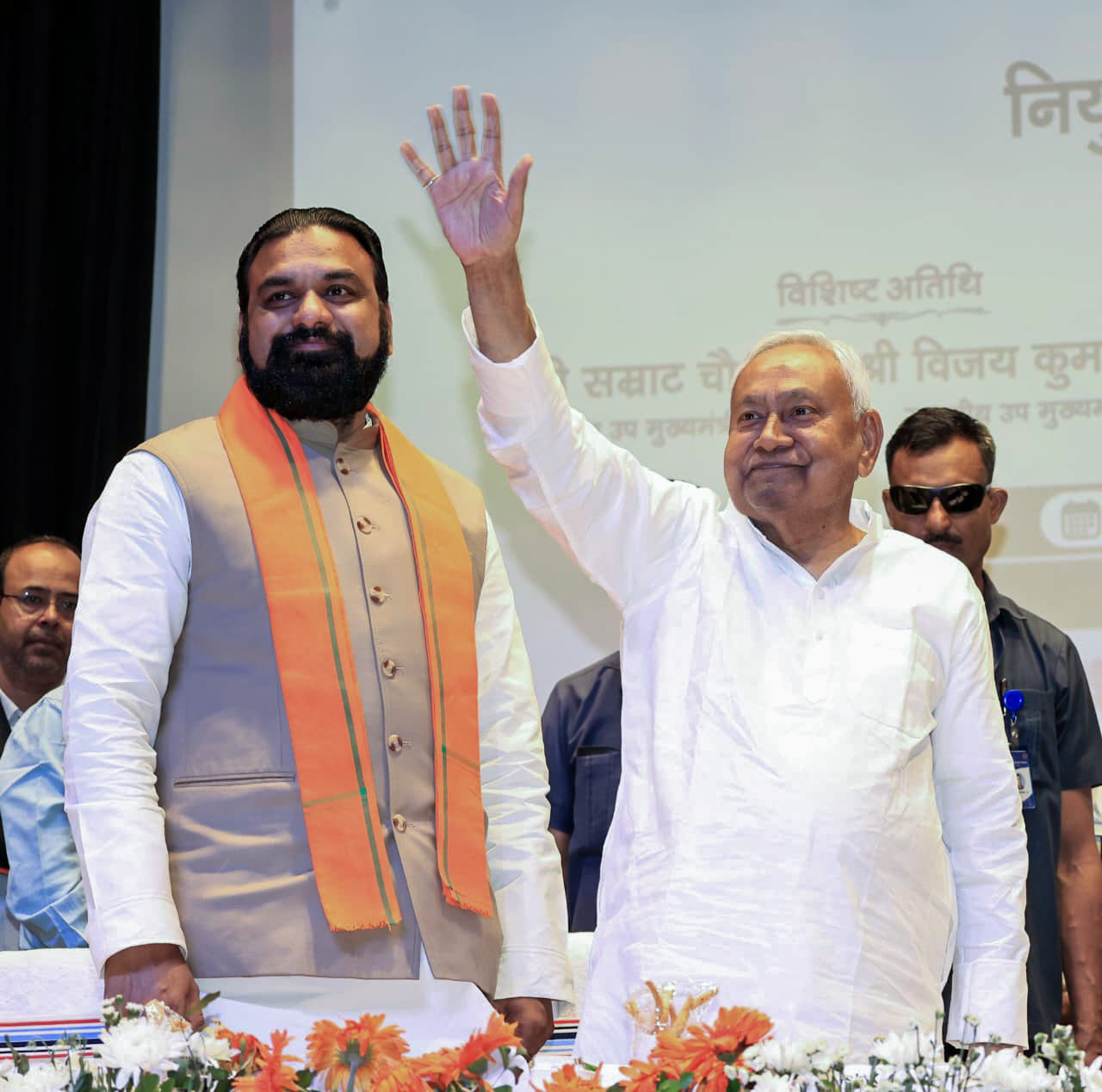
While Nitish Kumar belongs to the Kurmi caste, Samrat Chaudhary comes from the Koeri community, long seen as central to Kumar’s support base since he challenged Lalu Prasad Yadav’s Muslim-Yadav (MY) caste arithmetic in the 1990s.
A number of BJP leaders said Chaudhary’s position as one of the key contenders to succeed Kumar was strengthened also by the fact that the outgoing chief minister favours him and appears comfortable with his style of functioning.
‘One has to understand that Nitish Kumar is also aware of the ‘Luv-Kush’ equation that he and Chaudhary enjoy,’ says a BJP leader.
“One has to understand that Nitish Kumar is also aware of the ‘Luv-Kush’ equation that he and Chaudhary enjoy and after his stepping down from the CM post, he does not want to disturb that equation. So keeping that in mind Chaudhary fits perfectly into this equation,” said one of the leaders.
Also Read: ‘Going to jail is not a crime’—Samrat Choudhary says Anant Singh’s case not like Shahabuddin’s
The caste calculation
As per the 2023 Caste survey in Bihar, the Kushwaha community constitutes 4.2 percent of the state’s population. Combined together, the Kurmis and Kushwahas make up about 7.08 percent of the state’s population, while Yadavs account for 14.26 percent, said a different BJP leader.
Another senior BJP leader added, “Chaudhary is the OBC face of the party and the Bihar results showed that the Kurmi-Koeri political alliance (collectively referred to as the ‘Luv-Kush’ vote) has taken over in the state. Considering the kind of support we received in the Bihar elections and the way Chaudhary has managed things, the party did not wish to disturb the continuity.”
What also sets apart Chaudhary from many other chief ministerial hopefuls is the fact that he is among the few senior leaders in the BJP who do not have an RSS background.
His father Shakuni Choudhary was one of the founding members of the Samata Party, and served several stints as MLA and MP. His mother, Parvati Devi, once represented the Tarapur constituency.
‘Considering the kind of support we received in Bihar elections & the way Chaudhary managed things, party did not wish to disturb continuity,’ says a BJP leader.
Choudhary won two assembly elections in the past (2000 and 2010) while he also lost twice (in 2005 and 2015). During his time, Shakuni Chaudhary was in fact considered close to former chief minister Lalu Prasad Yadav apart from Nitish Kumar.
भाजपा प्रदेश कार्यालय में आयोजित ऐतिहासिक बैठक में, पर्यवेक्षक एवं माननीय केंद्रीय मंत्री श्री @ChouhanShivraj जी की गरिमामयी उपस्थिति में भाजपा विधानमंडल दल का नेता चुने जाने का सौभाग्य प्राप्त हुआ। सभी साथियों द्वारा सर्वसम्मति से मुझ पर व्यक्त किए गए इस विश्वास के लिए हृदय से… pic.twitter.com/UJnjRpTaDE
— Samrat Choudhary (@samrat4bjp) April 14, 2026
After Nitish Kumar rejoined the mahagathbandhan in 2022, Chaudhary had pledged to wear a turban until he “dethroned” him from office. After Kumar rejoined the NDA alliance in 2024, he went to Ayodhya and tonsured his head before taking a dip in Saryu river and removing his turban.
The controversy
The BJP leader has also had his fair share of controversies.
Eyebrows were raised within the party, when the BJP named him as its legislature party leader in the assembly last year, as he had earlier served as a minister in the Rabri Devi-led RJD government—a tenure the BJP routinely attacks as “jungle raj”.
Not only this, in the run-up to the assembly elections last year, a controversy erupted over his educational qualifications. Prashant Kishor of Jan Suraaj Party claimed that Choudhary, who claims to have a PhD, had not even cleared the matriculation exam. Kishor also accused him of lying about his age in his election affidavit. Choudhary denied the charges.
Aditya Raj, associate professor, IIT Patna, told ThePrint, “You see, the BJP has been grooming him for quite some time as it entrusted him with one responsibility after another. He is relatively young, quite vocal against the Lalu family and he fulfills the Luv Kush factor too, which has a certain percentage of voters.”
He further said that Chaudhary’s appointment will also ensure a degree of control from the Centre.
“He is also someone who will be able to keep the team intact and at the same time he is considered close to Amit Shah. His equation with Nitish Kumar also improved significantly over a period of time and he also seems quite comfortable with him. So all these factors have helped his case,” he added.
(Edited by Ajeet Tiwari)
Also Read: BJP’s ‘Luv-Kush’ powerplay: Why it chose to continue with Samrat Chaudhary as Bihar Dy CM
 20
20 584226
 20
20
 20
20