Why Amit Shah’s visit to Karnataka shows just how much BJP needs Yediyurappa – ThePrint – Select
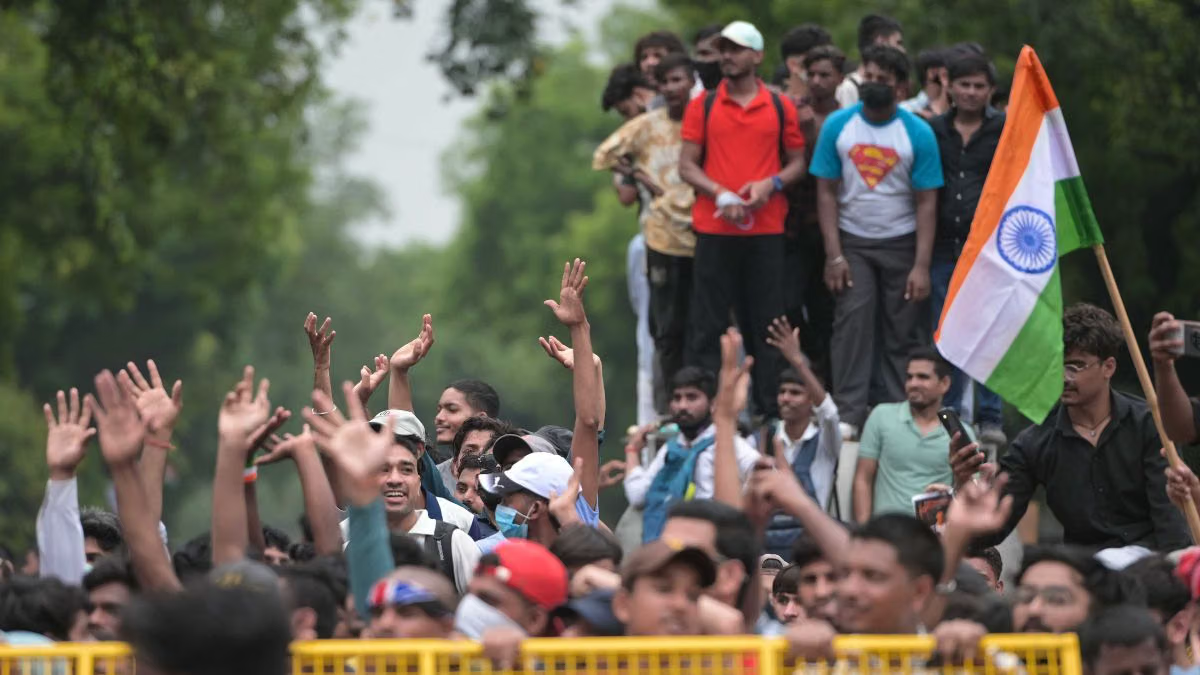
Bengaluru: Lakhs of supporters. Two events to release biographies. And Union Home Minister Amit Shah flying in directly from a swearing-in ceremony in West Bengal. When the Bharatiya Janata Party marks B.S. Yediyurappa’s five decades in public life in Chitradurga Saturday, the scale of the occasion will carry a message that no amount of official spin can obscure: the party needs the octogenarian.
“The BJP needs to go back to him to lift the party from the low morale they have been passing through for some time. This shows that the BJP have been unable to find an alternative to Yediyurappa,” said A. Narayana, political analyst and faculty at Azim Premji University, Bengaluru.
“They are coming back to Yediyurappa possibly because of desperation,” he added.
The festivities began Friday, when the four-time chief minister was escorted through the streets of Chitradurga in a grand procession—crackers burst, loudspeakers blaring songs in his praise and folk artists among the marchers. Senior party leaders, including D.V. Sadananda Gowda, C.T. Ravi and B. Sriramulu rode alongside.
Yediyurappa’s younger brother and state BJP president B.Y.Vijayendra had described the occasion as a “cultural festival”, and Saturday’s main programme will continue in the same vein.
It has been scheduled post noon to ensure Shah—who arrives at 3:45 pm after attending the BJP’s swearing-in ceremony in West Bengal, the party’s maiden government there—does not miss it.
“One speciality about the respect for Yediyurappa is that our Home Minister will wrap up the swearing in ceremony in West Bengal and participate in this event. The prominence of the programme can be understood when he (Shah) is participating in the event despite the many ongoing political developments in the country,” B.Y. Raghavendra, BJP MP from Shivamogga and Yediyurappa’s older son, told reporters Friday.
Also Read: ‘Insult to Hindus’: BJP slams Karnataka govt’s Rs 600 crore allocation for developing minority colonies
The calculus of need
Shah’s attendance underscores a reality the BJP in Karnataka has long struggled to escape. The party has twice formed the state government without ever winning an outright majority. With zilla panchayat, taluka panchayat and Greater Bengaluru Authority elections imminent, and a shot at a genuine majority in 2028 on the high command’s mind, the party has calculated that it needs its 83-year-old mobiliser.
It is a relationship with a long, bruising ledger. Yediyurappa was jailed in a corruption case (acquitted years late) in 2011 and removed from office at least twice. The BJP saw him walk out of the party in 2012 to launch his political outfit–Karnataka Janata Party (KJP)— a rupture that reduced the BJP’s seat count from 110 in 2008 to just 40 in 2013 assembly polls. He was reinstated soon after.
In July 2021, the BJP high command allegedly forced him to step down as chief minister, replacing him with Basavaraj Bommai. He was back on the BJP’s Parliamentary Board Committee by August 2022. The party also broke its own 75-year age bar to allow him to hold an administrative position, and had announced him as CM candidate a full year ahead of the 2018 assembly elections.
Karnataka is the only state south of the Vindhyas where the BJP has a meaningful footprint. The 2024 Lok Sabha elections have added further complexity: having forged an alliance with H.D. Deve Gowda’s Janata Dal (Secular), the BJP now has Gowda’s son—and former Karnataka chief minister—H.D. Kumaraswamy serving in Prime Minister Narendra Modi’s cabinet as Union Minister for Steel and Heavy Industries.
Yediyurappa’s political identity was forged precisely in opposition to Kumaraswamy’s betrayal of a power-sharing agreement in 2007. His ability to navigate this new dispensation is, observers say, yet another reason the party cannot afford to sideline him.
Karnataka goes to the polls next in 2028.
The Santosh thaw
The week before the Chitradurga celebrations, on 2 May, Yediyurappa sat down to lunch with his long-time bête noire, BJP General Secretary (organisation) B.L. Santosh, at his home. The meal had all the hallmarks of a peace brokered at the party high command’s insistence.
Yediyurappa heaped praise on Santosh, saying he was managing the party with “utmost efficiency” and that Santosh’s “skills and acumen” served as an inspiration to every party worker.
The warmth sat uneasily against recent history. Yediyurappa had targeted leaders considered close to Santosh—C.T. Ravi, Nalin Kumar Kateel and Prathap Simha. Former chief minister Jagadish Shettar had openly accused Santosh of targeting the Lingayat community. And Yediyurappa’s willingness to give a long leash to Santosh critic Basanagouda Patil Yatnal had been a chronic irritant in the relationship.
ಆತ್ಮೀಯರಾದ ಶ್ರೀ @blsanthosh ಜೀ, ಭಾರತೀಯ ಜನತಾ ಪಾರ್ಟಿಯ ರಾಷ್ಟ್ರೀಯ ಸಂಘಟನಾ ಪ್ರಧಾನ ಕಾರ್ಯದರ್ಶಿಗಳಾಗಿ ಇಡೀ ದೇಶಾದ್ಯಂತ ಪಕ್ಷದ ಸಂಘಟನೆಯನ್ನು ಅತ್ಯಂತ ಸಮರ್ಥವಾಗಿ ನಿರ್ವಹಿಸುತ್ತಿದ್ದಾರೆ.
ಇಂದು ನಮ್ಮ ಮನೆಗೆ ಸೌಹಾರ್ದಯುತ ಭೇಟಿ ನೀಡಿ ನನ್ನೊಂದಿಗೆ ಉಪಹಾರ ಸೇವಿಸಿದರು. ಸದ್ಯ ನಿರೀಕ್ಷೆಯಲ್ಲಿರುವ ಪಂಚರಾಜ್ಯಗಳ ವಿಧಾನ ಸಭಾ… pic.twitter.com/dWCA7j4n2q— B.S.Yediyurappa (@BSYBJP) May 2, 2026
The Lingayat strongman
Born Bookanakere Siddalingappa Yediyurappa in Shikaripura on February 27, 1943, he began his working life in 1965 as a first-division clerk in the social welfare department. He soon quit, returned to Shikaripura, and took up a clerkship at Veerabhadra Shastri’s Shankara rice mill.
In 1967, he married Mythradevi, daughter of a rice mill owner; he later set up a hardware shop in Shivamogga. He has two sons—Raghavendra and Vijayendra—and three daughters: Arunadevi, Padmavathi and Umadevi.
His association with the Rashtriya Swayamsevak Sangh (RSS) began in his early years, but his formal entry into public life came in 1970, when he was appointed secretary (karyavaha) of the Shikaripura RSS unit. He entered the town municipality in 1972, the same year he became president of the local Jana Sangh taluk unit. By 1975, he was president of the Shikaripura Town Municipality. The BJP’s Shikaripura taluk unit fell under his charge in 1980; the Shivamogga district unit followed in 1985.
In 1988, he became state president of the BJP in Karnataka.
He first entered the Karnataka Legislative Assembly in 1983, alongside K. Vasanth Bangera, and has represented Shikaripura six times since. But he had to wait 24 years for his first taste of power.
It arrived in November 2007, after a month of President’s Rule in Karnataka, and lasted exactly seven days. The BJP under Yediyurappa had allied with H.D. Kumaraswamy’s JD(S)—with an agreement that both would take turns governing as chief minister. Kumaraswamy had already ruled for over 20 months when, after just seven days of Yediyurappa’s tenure, he pulled his support.
It was, in retrospect, the making of Yediyurappa.
“Yediyurappa was clever and crafted the narrative that a Vokkaliga (Kumaraswamy) had denied the Lingayats a chance at power,” said a Bengaluru-based political analyst who asked not to be named.
The Vokkaligas—a land-owning agrarian community concentrated in southern Karnataka and the traditional electoral base of Deve Gowda’s JD(S)—had handed Yediyurappa a grievance he would deploy with lasting effect. The Lingayat community, one of Karnataka’s largest and most electorally decisive, consolidated firmly behind him, and the BJP swept to 110 seats in 2008 assembly polls.
Yediyurappa’s stature within the BJP has always coexisted with significant personal and legal controversy. He faces an ongoing POCSO case and allegations of corruption against both him and members of his family. The circumstances surrounding the death of his wife Mythradevi in 2004 have continued to surface in political discourse. In January 2022, his granddaughter—daughter of Padmavathi—died by hanging in Bengaluru. She was 30.
In 2011, he spent approximately 20 days in judicial custody over his alleged role in a land denotification scandal, which had previously forced his removal as chief minister. He has also been accused of having profited from an iron ore mining “scam” allegedly involving Ballari’s ‘Reddy Brothers’.
The BJP’s stated opposition to dynastic politics sits conspicuously alongside Yediyurappa’s conduct in office.
Yediyurappa’s long-time aide K.S. Eshwarappa has publicly criticised what he calls the “appa-maklu (father-children)” culture, alleging that committed party workers and Hindu leaders are being sidelined to clear a path for Yediyurappa’s younger son Vijayendra—now state BJP president and MLA from Shikaripura.
Between 2019 and 2021, party seniors also accused Vijayendra of running a parallel government at his father’s behest. In early 2020, an open letter, purportedly from a section of BJP leaders and ministers, surfaced in the public domain flagging Vijayendra’s interference in day-to-day administration.
Despite it all, Yediyurappa retains firm control over the state’s BJP MLAs and exercises significant influence over key appointments, including that of Leader of the Opposition. He is not, as Narayana notes, in the limelight right now because he has done anything to demand it. He is in the limelight because the party requires him to be.
Also Read: The making of ‘super CM’: How Yathindra Siddaramaiah went from introverted pathologist to political heir
 20
20 584226
 20
20
 20
20