What happens behind a Pochampally Ikat saree? Telangana wants tourists to see for themselves

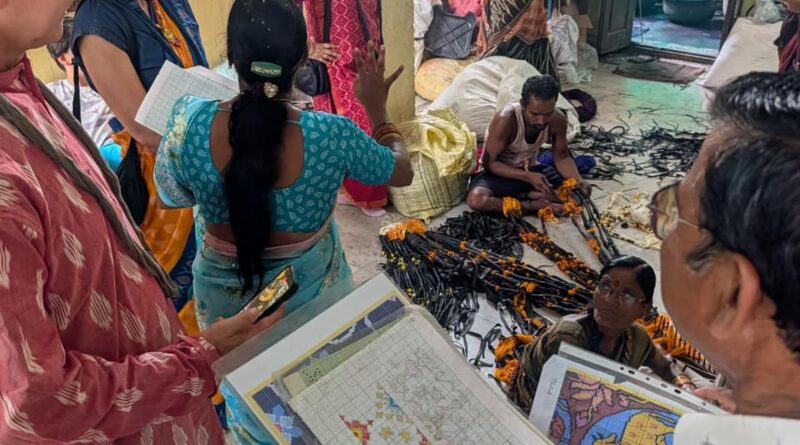
Tourists get a close look at the intricate process of tying and dyeing threads, one of the many painstaking steps behind Pochampally’s famed Ikat weave.
| Photo Credit: Special Arrangement
It is a bright, sunny day in Pochampally village of Yadadri Bhuvanagiri district in Telangana, and one by one, vehicles carrying tourists pull into the Telangana Tourism Park. But this is no ordinary sightseeing trip. The visitors have arrived to experience Pochampally beyond its famous Ikat sarees, through its looms, weavers, temples, homes and the people who have kept the craft alive for generations.
The visitors are part of a pilot ‘Experience Pochampally’ Cultural Walk and Immersive Village Experience organised to explore how the village’s rich weaving traditions can be presented as a tourism experience. The welcome itself sets the tone. Instead of the customary flower garland, the tourists are greeted with garlands made of Ikat threads.
From there, the group heads to the Ikat Museum inside the tourism park. A five-minute video introduces visitors to the history of Ikat, tracing the journey of the distinctive resist-dyeing and weaving tradition and how it travelled from one part of the world to another.
Ikat sarees and handlooms are placed on display, while information about the different aspects and varieties of the craft is written across the walls. But what catches the visitors’ attention most is not a display panel or a photograph. It is a weaver working on a loom right in front of them. Narsingh, who is manning the loom, demonstrates how an Ikat saree takes shape, thread by thread. “This is a set of seven sarees being woven at the same time. It takes six to seven days to complete,” he says.
A pit loom in another room offers another glimpse into the traditional methods of weaving. Built partly below ground level, the loom draws curious visitors, many of whom pause to watch how the weaver works the threads and pedals from the lowered seating area.
The tourists then visit the homes of weavers, where weaving is not an exhibit but a part of everyday life. Inside one such home, visitors get to see Ikat sarees being woven on handlooms in the same spaces where the weavers live. “We are given the raw material, and we just weave the handloom and then hand it over to the distributor, who sells it in the market. We are given a fixed salary, so we don’t know how much the saree is being sold for,” says Kavitha, a weaver whose home the tourists visit.

A tourist gets a close look at an Ikat saree being woven on a handloom during the pilot ‘Experience Pochampally’ cultural walk in Yadadri Bhuvanagiri district.
| Photo Credit:
Special Arraqngement
From the weavers’ homes, the group heads to Markandeshwara Swamy Devasthanam, an ancient temple dedicated to Lord Shiva and sage Markandeya. The temple is the main deity shrine for Pochampally’s local Padmashali weaving community.
In another pocket of the village, workers are engaged in the painstaking preparatory stages of weaving. Threads are tied and dyed before being separated, thread by thread, and prepared to be attached to the loom. The process gives visitors a glimpse of just how much work goes into an Ikat saree before it reaches a loom, let alone a showroom. The finished product may be instantly recognisable, but the preparation involves a series of painstaking steps carried out largely by hand.
For the district administration, the day is not the end of a tour; it is a test run. “This is the pilot walk we conducted and we are trying to test the waters on what activities can be done for tourists who arrive here. Based on a few more such pilot activities, we will soon start the ‘Experience Pochampally’ tourism initiative,” said Yadadri Bhuvanagiri Collector Anuraag Jayanthi.
Published – August 09, 2026 06:48 pm IST
 20
20 584226
 20
20
 20
20