‘Went hungry for two days’: How the LPG price spike paralysed India’s biggest container port | Mumbai News
At a container yard near Jawaharlal Nehru Port (JNPT), India’s largest container port, 25-year-old trailer driver Rakesh Kumar points to a line of parked trailers and recalls why he left work in March.
“Everything became so expensive. Initially, I stayed hungry for two days, just on water, because dhabas shut down and the ones that were open charged a lot,” said Kumar, who is from Mirzapur in Uttar Pradesh and has been driving heavy vehicles for the past five years. “I left in mid-March because I couldn’t sustain myself anymore.”
Three months later, Kumar is back, transporting containers between the port and warehouses. But many of his colleagues have not returned, setting off a crisis that has choked container movement at JNPT, stranded perishable cargo and forced a high-level government response.
At its peak, the backlog of import containers waiting to be evacuated had grown from around 17,000 in mid-April to 40,000 by the second week of May, according to Girish Thomas, Chief General Manager (Traffic) at JNPA. “If 11,000 containers were discharged from a ship, only around 5,000 would move. The backlog kept increasing every day,” he says. By the third week of May, Union Ministers Piyush Goyal and Sarbananda Sonowal were holding meetings with the export-import community. Rail services were pressed into service, trailer pools were created, charges were waived. The numbers have since come down to around 24,000, Thomas says, and are expected to stabilise at around 20,000 in the coming days.
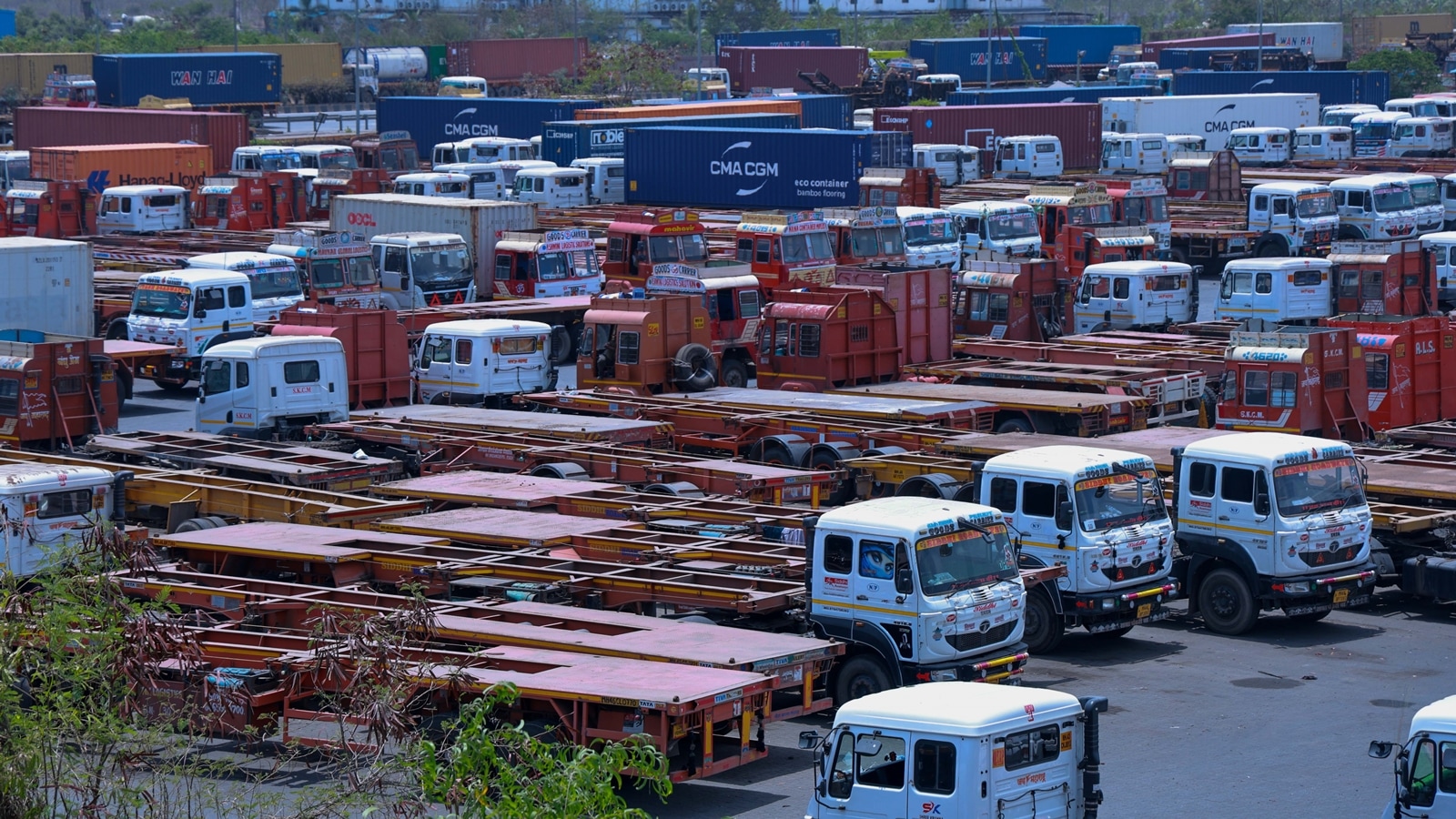 Trailers lie idle at a parking yard at JNPT amid a shortage of drivers. (Express photo by Narendra Vaskar)
While port authorities say the situation has stabilised, drivers, transporters and exporters told The Indian Express that manpower shortages continue to affect operations at India’s busiest container gateway.
The trigger was the West Asia conflict. When it disrupted LPG supply chains, prices spiked and the small cylinders that migrant drivers depend on to cook their meals in parking yards near the port became unaffordable. Dhabas (or local eateries) shut or shrank their menus. Drivers, most of them from Bihar, Jharkhand, Uttar Pradesh, Assam and West Bengal, who send nearly 90 per cent of their earnings home and live on what’s left, did the math and left.
At the peak of the crisis, between March and May, around 50-60 percent of drivers were absent, according to Sanjay Potdar, chairman of the Nhava-Sheva Container Operators Welfare Association. Even now, after a partial return, the shortage stands at around 40 per cent, he said.
Story continues below this ad
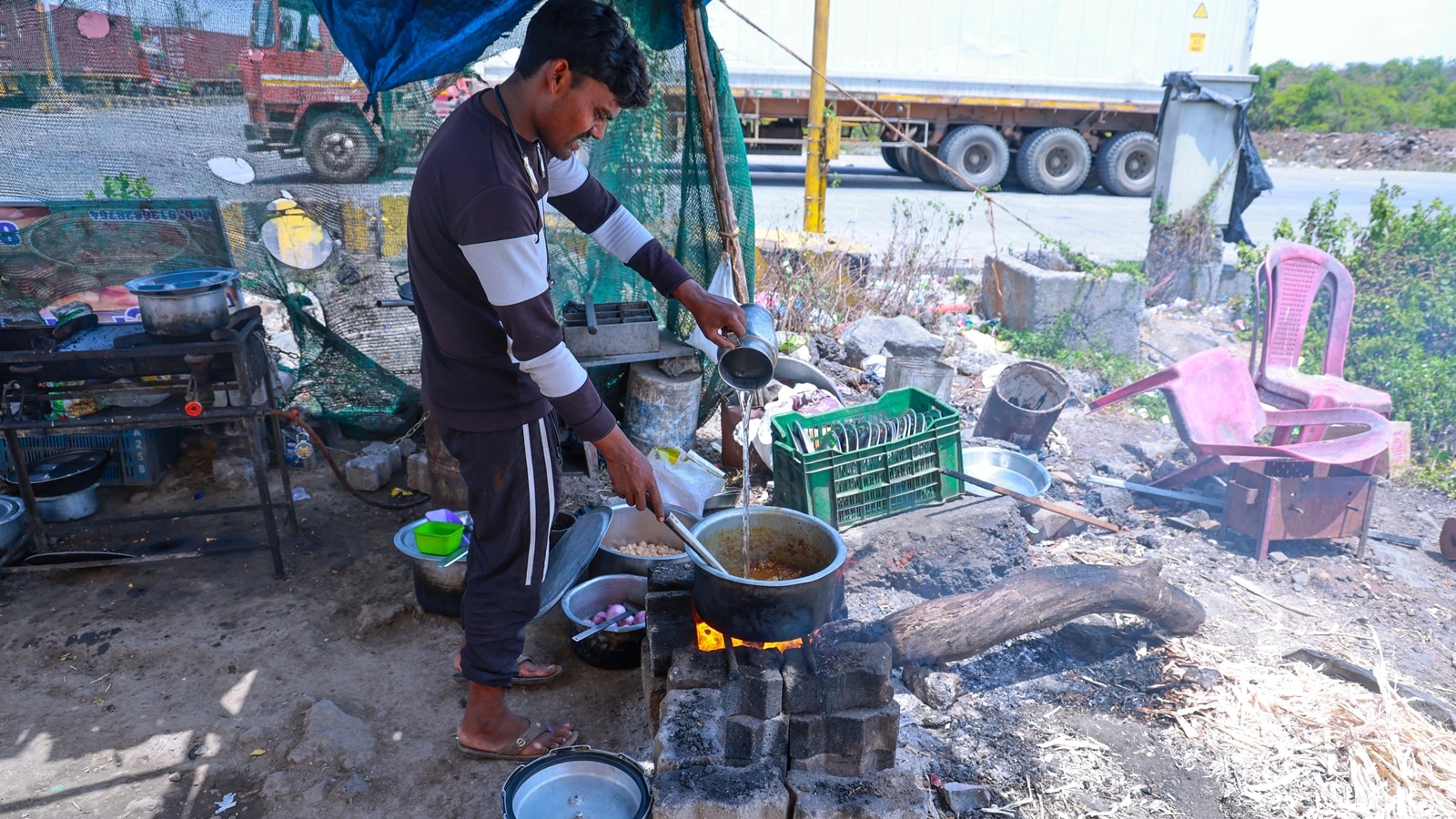 At ‘Suresh Da Dhaba’, the only eatery along the entire stretch lined with parked trailers near JNPT, workers are cooking chicken over a wood fire. An LPG cylinder sits nearby, secured with a chain and lock. (Express photo by Narendra Vaskar)
The yards go quiet
Kumar is back now, three months later, but not because things improved. “A few like me have returned because we don’t have savings left. How long can we stay home on meagre savings?” he says. He has two sisters and ageing parents dependent on him and earns Rs 12,000 a month. “Our company has around 200 vehicles. Many trailers are standing because there are still no drivers to take them to the port or move containers that arrive there,” he added.
Pradeep Sharma, 24, also from Uttar Pradesh, returned just days before, after three months in his village. “Earlier we would get four or five items on a plate for Rs 50 or Rs 60. Now the same food costs Rs 120 to Rs 160. We can’t afford it. Earlier I could cook on a small LPG cylinder with a stove attached. That option does not exist now,” Sharma said. He earns Rs 8,000 a month plus trip-based incentives and supports his wife, child, parents and siblings back home.
At Suresh Da Dhaba, one of the few eateries operating along a stretch lined with parked trailers, workers cook over a wood fire. An LPG cylinder sits nearby, secured with a chain and lock. Laxman Sonkar, who works there and is from a village near Lucknow, says they switched to wood collected from nearby forests after the gas crisis hit.
Story continues below this ad
“Since March, the menu has shrunk and prices have risen. Earlier there were more options, chicken fry, egg fry, dal tadka, tandoor items, parathas. Now we only cook chicken curry, boiled eggs, rice and rotis. One roti used to cost Rs 8, now it’s Rs 15. Chicken was Rs 80-100, now it’s Rs 120. The shortage of drivers has also affected our business,” he says. Only one or two dhabas are open now. Earlier there were several, he said.
Nearby, two drivers from Malda in West Bengal debated whether to eat lunch or wait until dinner to save money. Nur Fasiai, 20, and Mohammad Sajahan, 24, returned from their villages only this week after spending nearly three months at home. “We went home for the elections and around the same time the LPG issue happened. Earlier we cooked wherever the truck was parked. Since March, that has become difficult because refilling the small LPG cylinders we use became expensive and uncertain,” Fasiai said.
How the crisis built
Thomas says the labour shortage developed gradually from the end of March as multiple factors converged. “People started going home by the end of March. There was the LPG issue, the food issue, elections, and then Eid. Normally many workers go home during May and return, but this time most decided to stay back longer,” he told The Indian Express.
The consequences were soon visible inside the country’s busiest container gateway. Imported cargo unloaded from ships is typically moved by trailers operated by container freight stations. As drivers disappeared, that chain slowed dramatically.
Story continues below this ad
Many who left did not immediately return because food arrangements remained uncertain after dhabas shut and cooking gas became difficult to obtain.
Sunil Mulik, secretary of the Reefer Container Transporters Welfare Association, says the annual pattern of drivers going home in May is normal, but this year it spiralled. “When LPG availability became uncertain, many chose not to return after going home, and some shifted to farming or other occupations. The usual seasonal shortage escalated to nearly 40 per cent.” He adds that migration from northern states has reduced over the years as local employment opportunities have improved, giving the shortage a structural dimension beyond the immediate crisis.
Transporters continue to pay loan instalments and fixed costs on fleets where a significant share of vehicles sit idle. Importers are facing delays in receiving cargo, and the entire supply chain is under stress, he says.
Special trains were also organised by JNPT in May at no cost to bring back drivers, but very few returned.
The government steps in
Story continues below this ad
By the third week of May, the scale of the disruption had reached cabinet level. On May 22, Union Ministers Piyush Goyal and Sarbananda Sonowal sat down with exporters and importers to review the situation. The immediate problem at that time was around 25,000 import containers were stuck at the port, unable to move out because there weren’t enough drivers to transport them to warehouses.
The government has maintained that port operations themselves remained unaffected and that the bottleneck lay in evacuating containers from terminals to container freight stations.
Several measures were rolled out quickly. Goods trains were pressed into service to carry containers to nearby warehouses that had railway connections, bypassing the need for trailers entirely. A pool of nearly 100 trailers was put together by warehouse operators to clear containers that had been buried deep in congested yards. To reduce the financial burden on traders, the government waived fees that are normally charged when containers are moved between terminals by rail, and also scrapped charges that apply when the mode of transport is changed midway. Individual port terminals also offered reductions on the daily fee charged for storing containers in the yard, decided case by case.
A separate advisory issued by JNPA on May 24 gave importers another option. Instead of waiting for their containers to be transported to a warehouse first and then collecting them from there, they could apply to Customs to collect their cargo directly from the port yard itself, cutting out one step from the chain entirely.
Story continues below this ad
“Train movement started around the first week of May. By around May 10 we were able to stabilise the numbers. The backlog has since come down to around 24,000 containers,” Thomas says, from a peak of around 40,000.
Looking further ahead, JNPA will soon start a training programme to bring new drivers into the system, with the port bearing the cost of training. There are also plans to tie up with NGOs to provide food and water to drivers at affordable rates, a direct acknowledgement that it was the breakdown of basic living arrangements that drove so many away in the first place.
Perishables caught in the crossfire
Amol Jadhav, 38, from Satara, has been driving since 2006. He moved back home during the crisis and returned only this month. When this reporter met him, he had been waiting in traffic with a loaded container of fruits for over seven hours. “Due to the shortage of drivers, most trailers are not moving and containers with perishable food items stand on the port road. This is a refrigerated container and it can work for 24 hours. Once I get inside the port, I’ll get a plug point to maintain the temperature,” he says.
The anxiety is sharpest among exporters of fresh produce. Vikas Singh, Vice-President of the Horticulture Produce Exporters Association of India, cites a recent case of around 70 containers of onions that missed a scheduled sailing. “The onions had started rotting. There was a smell coming from the containers. Exporters feared the cargo would no longer be fit for export,” he says. Each container holds produce worth around Rs 6 lakh.
Story continues below this ad
Exporters are struggling to assess the full extent of losses because compensation claims and quality assessments often happen only after cargo reaches overseas destinations. The association has raised concerns with Agricultural and Processed Food Products Export Development Authority (APEDA) and port authorities.
Temperature is the core problem. “For onions, we load at around plus one degree Celsius. But if a container stands outside the port for two or three days, temperatures can rise to 30 or 40 degrees. Even if you refrigerate it again, the chemical composition has already been affected. Fruits lose their shelf life, moulds start to form,” Singh says. He cites a consignment bound for London that remained stranded outside the port for several days after being loaded before the vessel cut-off. “Until the cargo reaches London after more than a month, we won’t know what condition it is in.”
Detention charges run to around Rs 5,000 per day for containers waiting outside ports. Storage and ground rent charges kick in once containers are inside but vessels are delayed. June adds urgency. Pakistan’s new crop arrives in international markets this month. “Buyers will go where quality is good and prices are competitive. If quality suffers because of delays, customers shift elsewhere,” Singh says.
He also points to a demand unmet for over a decade. “In 2014, we demanded a green lane for perishable goods. We were told it would be done. It is still not there.”
Story continues below this ad
Thomas said terminals had taken steps to address concerns around refrigerated containers and plug points. “Terminals expanded capacity by bringing in generators when demand increased,” he said.
Mulik says delays have hit imported fruit too. Apples, kiwis, dragon fruit and avocados have seen delayed deliveries affecting payments, inventory cycles and market supply. “Apples imported from countries such as Iran, Turkey, New Zealand and Chile have become costlier because the supply chain remains disturbed,” he says.
Back at the container yard, Amol Jadhav is still waiting. Seven hours in traffic with a container of fruit, watching the clock. His reefer unit can hold temperature for 24 hours. After that, the cargo is on its own.
 20
20 584226
 20
20
 20
20