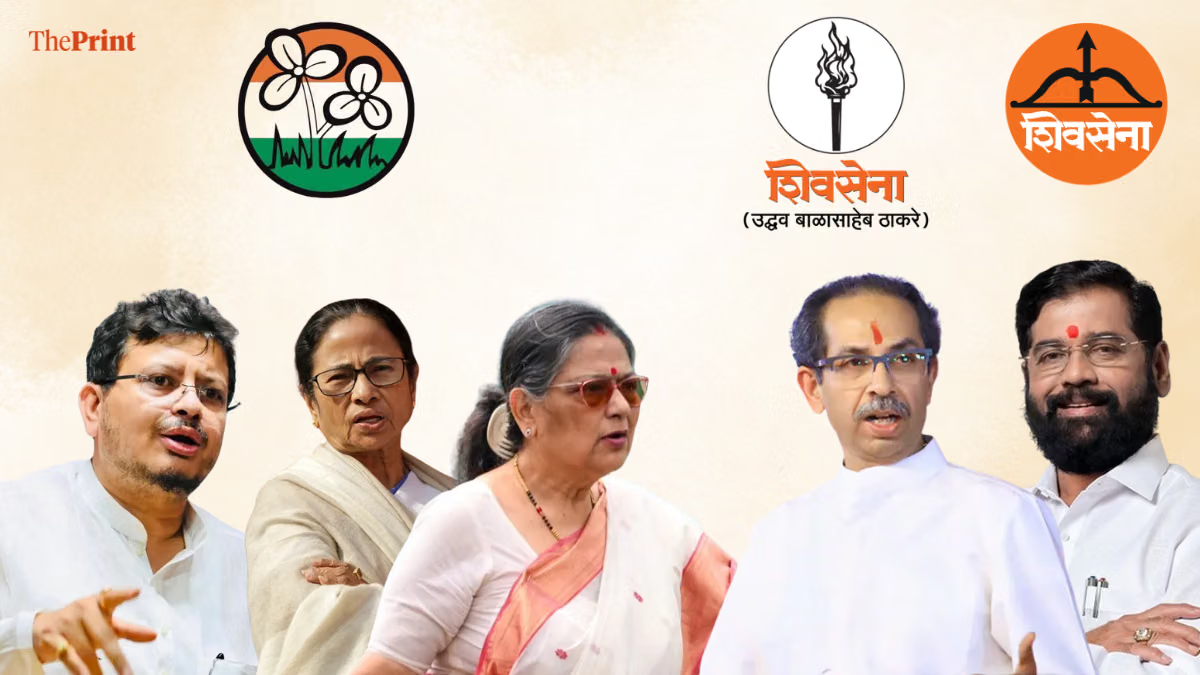
Trinamool: SC ruling in Sena case could play spoiler for rebels
Shinde was sworn in as the CM on 30 June 2022, and 19 days later, he approached the ECI with a petition to allot them the “bow and arrow” symbol of the party. The ECI allotted the symbol to the Shinde faction in February 2023, and the Speaker also rejected disqualification petitions filed against 30 Shiv Sena MLAs from both factions.
Appeals challenging both these orders are currently under challenge before the Supreme Court and the Bombay High Court in separate cases.
As for Trinamool, the rebel factions of the political party have gone different ways—with the Lok Sabha MPs announcing their intent to merge with the little-known Nationalist Citizens Party of India (NCPI), while the West Bengal Speaker has recognised expelled TMC leader Ritabrata Banerjee as the Leader of Opposition for the West Bengal Assembly, after he claimed the support of 58 out of 80 Trinamool MLAs in the West Bengal Assembly. The Calcutta HC has also refused to stay the LoP appointment.
A significant difference between both the cases is that there wasn’t any merger in Shiv Sena’s case, but in the TMC case, the rebel factions seem to be taking different routes, instead of a singular, united course of action.
However, with regard to any attempts at claiming the party symbol or in disqualification proceedings arising out of the rebellion, the five-judge bench judgment of the Supreme Court from 2023 would apply to the Trinamool case.
Among other things, the judgment had asserted that looking at the ‘legislative majority’ is not enough for the faction claiming to be the real party, and that the ECI “must look to other tests in order to reach a conclusion” on who should get the party symbol. In fact, the court observed that in cases such as the Shiv Sena case, “it would be futile to assess which group enjoys a majority in the legislature”. The other tests, it said, may include an evaluation of the majority in the organisational wings of the political party, an analysis of the provisions of the party constitution, or any other appropriate test. With regard to disqualification proceedings before the Speaker as well, the court had observed that the Speaker must not base their decision only on the basis of majority in the legislative assembly.
Organisationally, beyond the Lok Sabha and the Assembly, Mamata Banerjee seems to be in control.
Therefore, it is this judgment which may come to her aid.
Also Read: Capt Amarinder, Bahuguna, Ravneet Bittu: Amid TMC exodus, a look at fate of Congress defectors to BJP
‘More than a game of numbers’
Under the anti-defection law in the Tenth Schedule of the Constitution, voluntarily giving up the membership of a party or voting against the whip can be treated as defection. Members indulging in such practices face disqualification.
There are five defences to such disqualification, including the party’s merger with another party. Prior to 2004, there was another defence to disqualification. It was a split in a party, with no less than one-third of the legislators forming a faction and breaking away. Nobody faces disqualification in such a situation—neither the members who decide to merge, nor those who stay behind with the original party.
However, an amendment notified in 2004 removed the ‘split’ defence.
The Supreme Court, in the Shiv Sena judgment, had opined that the consequence of the deletion of the defence of a split from the Tenth Schedule is that this defence is no longer available to members who face disqualification proceedings.
It observed that when deciding disqualification proceedings, the Speaker might be called upon to determine the “real party” when the party has split into two or more factions. This is because it is necessary to know which faction constitutes the political party to determine which party members have voluntarily given up membership of the political party under the tenth schedule and faces disqualification.
However, the court asserted that the Speaker “must not base their decision as to which group constitutes the political party on a blind appreciation of which group possesses a majority in the Legislative Assembly”.
“This is not a game of numbers, but of something more. The structure of leadership outside the Legislative Assembly is a consideration which is relevant to the determination of this issue,” the court observed.
While Ritabrata Banerjee has consistently claimed to have support of over two-thirds of the MLAs elected on the Trinamool symbol, these observations of the court may play out if and when they face disqualification proceedings.
Trinamool MPs’ merger playing spoiler
Paragraph 15 of the Election Symbols (Reservation and Allotment) Order, 1968 defines the power of the ECI in relation to splinter groups or rival sections of a recognised political party.
Para 15 says that when the ECI is satisfied that there are rival sections or groups of a recognised political party each of whom claims to be that party, the Commission may decide that one such rival section or group or none of such rival sections or groups is that recognised political party. ECI can do so after taking into account all the available facts and circumstances of the case and hearing such representatives of the sections or groups and other persons who want to be heard.
The ECI’s decision shall be binding on all such rival sections or groups.
In order to decide which group is entitled to the symbol, it is necessary for the ECI to adjudicate which group is that political party, or the “real” political party instead. The apex court held that the substance of the ECI’s decisions in such cases is the “lifeblood of the recognised political party”.
In a landmark judgment on splits, Sadiq Ali v. Election Commission of India, the court had considered three tests for deciding such cases. They were, a test analysing the provisions of the constitution of the party, a test assessing which of the two rival groups adhered to the aims and objects of the party as incorporated in its constitution, and a test evaluating which of the two rival groups enjoyed a majority in the legislature—that is the Houses of Parliament as well as the Legislative Assemblies of States— and in the organisational wing of the party.
In the Sadiq Ali case, the court applied the test of majority, but the Supreme Court clarified in the Shiv Sena case that this is not the only or even the primary test to be applied while determining disputes under Paragraph 15.
The ECI is free to apply a test suitable to a particular dispute.
In the TMC case, the rebel MLAs may approach the ECI to replicate the Shiv Sena episode, but in that case, they would also have to show that they enjoy the majority with respect to support in the legislative as well as the organisational wing of the Trinamool. To support their case, they would not be able to show such a majority in the Lok Sabha at the least, since the 20 MPs have written to the Speaker that they are merging with another party.
Also Read: Shiv Sena (UBT) split buzz gets louder as 6 of its 9 Lok Sabha MPs skip party meet
‘No coordination, lots of confusion’
Experts say that with their merger claim, the Trinamool MPs may have completely washed their hands off the claim for ownership of the party.
Former Supreme Court judge Justice M.B. Lokur calls this a “very strange situation”. “This is completely opposed to constitutional morality and with respect, quite strange,” he told ThePrint.
Former Lok Sabha Secretary General P.D.T. Achary asserted that the MPs cannot claim to be a part of the faction seeking to claim the TMC symbol anymore. “Once they merge with another party, they are supposed to become members of that party. Therefore, they cannot say that we are the real Trinamool and so we should get the symbol of the party,” he said.
He told ThePrint that the MLAs can still go to the ECI to claim ownership of the TMC, if they are sure that the party has split and they have a majority on their side. “But they will have to show that they have the majority in the organisational wing of the party as well, not just in the number of MPs or MLAs. That includes the whole structure of the party, right from the top to the booth-level.”
He called it “really curious” that the MPs have decided to merge with the party, while the MLAs are behaving differently. “There is no coordination and a lot of confusion here,” he said.
Swapnil Tripathi, lead at Charkha (Centre for Constitutional Law) at Vidhi Centre for Legal Policy, also pointed out that the situation in TMC’s case is materially different from the Shiv Sena episode, since no merger was claimed in that case.
“Although the prevailing judicial position looks at legislative strength as one of the factors in determining which group constitutes the ‘real party’, that approach may not be directly applicable here. Once the MPs merge, they effectively cease to function as members of the TMC and, therefore, prima facie cannot be relied upon to support a claim that the rebel faction represents the ‘real’ TMC,” he explains.
Tripathi said that the Shiv Sena route could play out in the State Legislative Assembly where the rebel MLAs may argue that they constitute the real TMC. However, if they seek to rely on the legislative strength of the MPs who have merged with the NCPI, an additional complication may arise, as the merger itself may be characterised as a “colourable exercise”.
“It could be argued that the merger exception was invoked merely to avoid disqualification rather than to effect a genuine political realignment, which may render the very merger constitutionally suspect,” he added.
The future of the MPs
However, experts seem split on whether the TMC MPs, who have announced their merger, would be able to avoid disqualification with this merger.
Justice Lokur asserted that the MPs “stand a very good chance of being disqualified”.
He explained that the anti-defection law requires fulfilment of two conditions: firstly, the political party must merge with another political party. Secondly, not less than two-thirds of the elected members of that party must agree to the merger.
In the TMC’s case, he said that the second condition has been met, but not the first condition. “So, the merger is not complete and therefore the anti-defection law will operate,” he told ThePrint.
Lokur also asked a pertinent unanswered question in relation to the NCPI. He pointed out that the anti-defection law is silent on the question whether the NCPI should have some elected members.
“Otherwise 20 MPs will be merging with zero MPs. What kind of a merger is this? Also, the anti-defection law does not employ the expression ‘recognised’ political party. Theoretically therefore, to get over the ‘merger’ with zero MPs, a single independently elected MP can constitute a political party (need not be recognised) and get 20 MPs to join him or her to get over the second condition,” he said, adding that he has no doubt that the anti-defection law needs an overhaul.
Tripathi, however, told ThePrint that on a strict reading of the Tenth Schedule, the merger would likely be valid.
He explained that Paragraph 4(1) of the Tenth Schedule recognises a merger between the ‘original political party’ (in this case, the TMC) and ‘another political party’ (in this case, the NCPI) as a defence to disqualification. However, Paragraph 4(2) says that such a merger shall be deemed to have taken place “if, and only if”, not less than two-thirds of the members of the legislature party agree to it.
Tripathi asserted that while there is a debate on whether Paragraphs 4(1) and 4(2) have to be read conjunctively or disjunctively, judgments passed by the Bombay High Court and Punjab and Haryana High Court say that where the two-thirds threshold is satisfied, the merger is deemed to be complete for the purposes of the Tenth Schedule.
He also pointed out that the Tenth Schedule does not define or prescribe any characteristics for the beneficiary party with which the merger takes place, and merely refers to “another political party”.
“Hence, the fact that the Nationalist Citizens Party of India is a Registered Unrecognised Political Party (RUPP) and does not presently have MPs or MLAs is not, by itself, fatal to the merger. So long as it qualifies as a political party, the requirements of Paragraph 4 may arguably be satisfied,” he told ThePrint.
Also Read: Why TMC MPs may still face disqualification even if 20 or two-thirds form a bloc
Trinamool LoP question
The 2023 Supreme Court verdict also makes it clear that it is the “political party” and not the legislature party that appoints the Whip and the Leader of the party in the House.
In TMC’s case, this issue is already playing out in the Calcutta High Court.
Earlier this month, the West Bengal Speaker recognised expelled TMC leader Ritabrata Banerjee as the Leader of Opposition for the West Bengal Assembly. Banerjee had written to Assembly Speaker Rathindra Bose, staking claim to the post of the Leader of Opposition in West Bengal Assembly and claiming to have the backing of 58 TMC MLAs. The development came days after TMC national general secretary Abhishek Banerjee wrote to the Speaker to recognise Sobhandeb Chattopadhyay as the LoP, citing “practice and procedure and precedent”.
In a press conference held after the meeting with the Speaker, Ritabrata said more than two-thirds of the MLAs elected on the Trinamool Congress symbol submitted their claim to the Speaker, “and the claim has been accepted”.
The Speaker’s decision was challenged in the High Court by Chattopadhyay.
For now, the Calcutta high court has refused to stay the appointment. It relied on Section 3 of the Bengal Legislative Assembly (Members’ Emolument) Act 1937, which has an explanation saying that the ‘Leader of Opposition’ means “that member of the West Bengal Legislative Assembly who is for the time being the Leader in the State Assembly of the party in opposition to the State Government having the greatest numerical strength in the said Assembly”.
Relying on this explanation, the court said that the 58 members of the rebel faction “secured greatest numerical strength by submitting their joint request and appearing before the Speaker in person”.
What worked in Shiv Sena’s favour
The ECI order on the Sena symbol came three months before the Supreme Court pronounced its judgment in 2023.
In its order deciding that the Shinde camp will be recognised as the real Shiv Sena, the ECI had applied the ‘test of majority’, examining which group enjoys the majority with respect to support in the legislative as well as the organisational wing of the Shiv Sena. The organisational wing comprises the totality of party members.
The ECI did not apply the ‘test of the party constitution’—which checks whether the faction followed its own party’s constitution—accepting the Shinde faction’s claim that the constitution of the Shiv Sena, as amended in 2018, was “undemocratic” and subverted inner-party democracy.
While the Thackeray faction submitted that there was only a split in the legislative party and not the party itself, the ECI felt that “for any dispute involving a recognised political party, where the dispute primarily revolves around the claim over a recognised symbol of the concerned political party, the legislative wing of the Party cannot be viewed in isolation”.
In Shiv Sena’s case, the numbers of seats and the percentage of votes secured by the members of the Shinde faction tilted the scales in Shinde’s favour.
Similarly, the Speaker, while deciding the disqualification petitions, also recognised Shinde’s faction as the ‘real Shiv Sena’, based on legislative majority. He noted that the Shinde faction had an overwhelming majority of 37 out of 55 MLAs when the rival factions emerged.
The Speaker opined that the leadership structure in the party as brought in 2018 was not in conformity with the constitution of the Shiv Sena and therefore, it cannot be relied upon to determine which faction is the real political party. It, therefore, relied on the legislative majority test.
While the numbers played a huge role before the ECI and the Speaker, both the authorities refused to rely on the Constitution of the party for various reasons. However, it is unclear if the same parameter will be relied on in TMC’s case.
Challenging both these orders in the Supreme Court, the Thackeray faction has cited the 2023 Supreme Court judgment. The Shinde faction has also challenged the Speaker’s decision not to disqualify 14 Shiv Sena (UBT) legislators, in the Bombay High Court.
(Edited by Amrtansh Arora)
Also Read: ‘Operation Tiger’ in the making? With MPs reaching Delhi, denouement approaches for Uddhav’s Shiv Sena
 20
20 584226
 20
20
 20
20