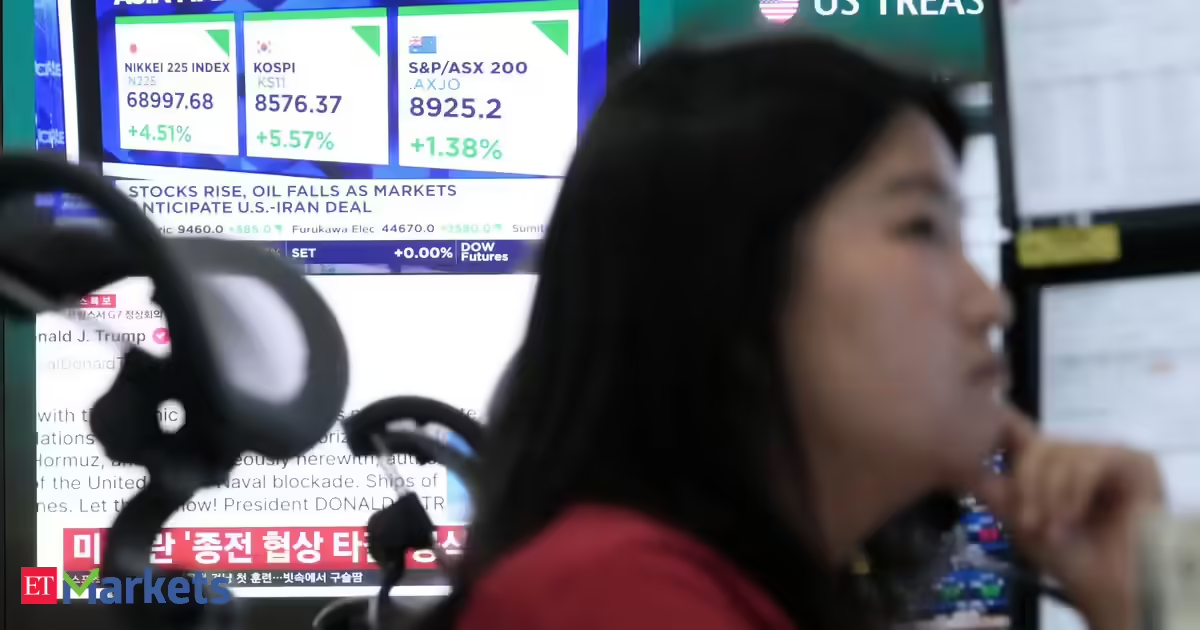
South Korea’s share market losses deepen as leveraged AI bets take a heavy toll
The selloff highlighted mounting investor anxiety over a market increasingly driven by leveraged bets on AI chipmakers. Once a peripheral market for global investors, South Korea has become a key barometer of enthusiasm for the AI boom, and is now feeling the downside as sentiment turns.
The benchmark KOSPI fell as much as 4.7% as traders returned after a long weekend. It was trading down 3.8% at 6,565 points as of 0240 GMT. The chipmaker-heavy gauge has now fallen 28% from its June 22 record-high, extending a four-week losing streak that has brought a dramatic halt to this year’s historic rally.
A sidecar trading curb was triggered on both the KOSPI and the junior Kosdaq indexes, halting programme trading for five minutes.
Volatility has been amplified by heavy inflows into single-stock leveraged funds, which have drawn waves of retail investors while leaving them exposed to outsized losses when momentum reverses.

Citi on Sunday cut its recommendation on South Korea to a tactical neutral from overweight after keeping the market in its preferred category for a year, citing heightened volatility rather than any deterioration in fundamentals.
“While Korea still screens as the top market in our allocation model, we downgrade to neutral on a tactical basis given ongoing volatility,” said Citi analysts, who maintain a KOSPI target of 10,000. That represents a gain of about 50% from current levels.
Markets were also on edge as an escalating conflict in the Gulf lifted oil prices and reignited inflation concerns. A packed week of major tech earnings is expected to further test investor faith in the AI trade.
Shares of SK Hynix, the world’s leading AI memory chipmaker, and those of its rival Samsung Electronics , fell nearly 6% each. The two stocks make up just over half of the benchmark KOSPI gauge.
Hyundai Motor tumbled 7% to its lowest since mid-January this year as a union began a four-hour strike. Sister automaker Kia Corp’s shares also fell 7.5%.
Market breadth was overwhelmingly negative, with 778 stocks falling versus 114 gainers among 912 traded issues. Foreign investors were net buyers of 415.1 billion won ($280.3 million) worth of shares.
In the currency market, the won was fetching 1,481.1 per dollar on the onshore settlement platform, 0.33% higher than its previous close at 1,486.0.
The most liquid three-year Korean treasury bond yield rose by 5.8 basis points to 3.910%, while the benchmark 10-year yield rose by 4.7 basis points to 4.341%. ($1 = 1,480.9000 won)
 20
20 584226
 20
20
 20
20