Protesters tear down posters of Vijay film as Cauvery row deepens
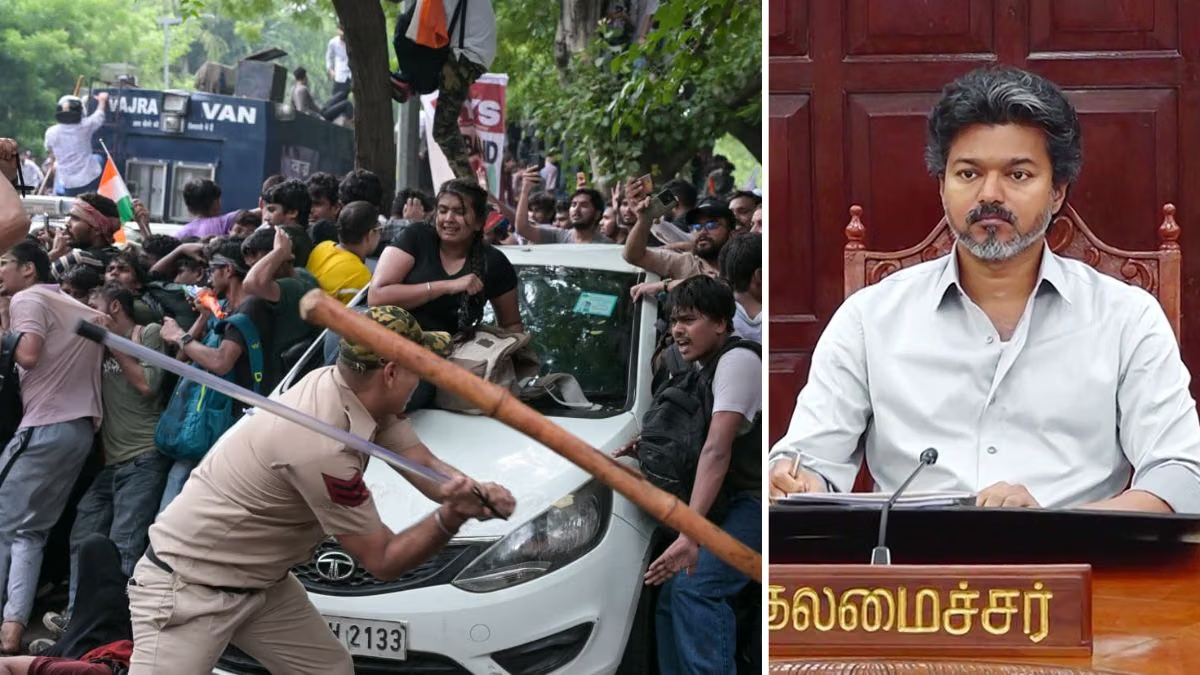
Bengaluru: Pro-Kannada organisations Friday tore down posters of ‘Jana Nayagan’, the latest film of Tamil Nadu Chief Minister Vijay Joseph, as protests over the Cauvery river water sharing intensified.
Dozens of protesters stormed theatres, tearing down posters and raising slogans against the Cauvery Water Regulation Committee’s (CWRC) decision to release 3,500 cusecs of water daily to Tamil Nadu.
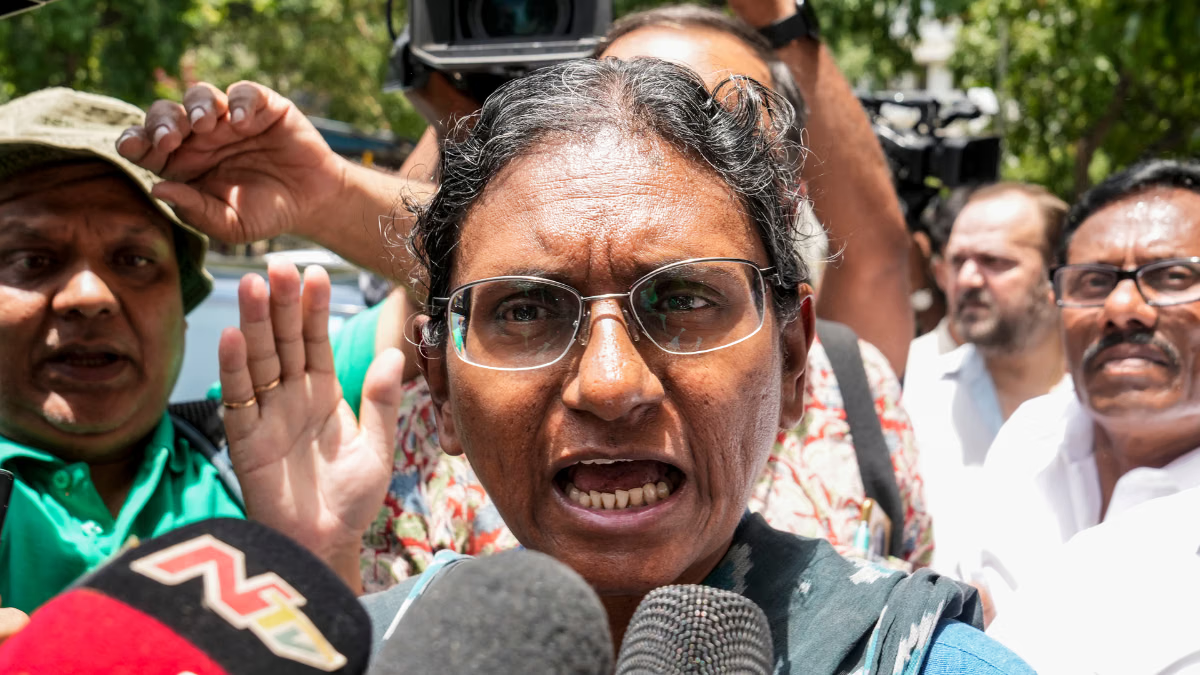
“The CWMA has ordered a death sentence for Karnataka. To teach them a lesson, we have stopped any screening of ‘Jana Nayagan’ featuring Karnataka’s villain and Tamil Nadu’s Hero, (Joseph) Vijay. This is the only way to teach Vijay a lesson who is playing with our lives,” Hallikerehundi Bhagyaraj, a farmer activist from Chamarajanagar, told reporters Friday.
The Bharatiya Janata Party (BJP), led by former Chief Minister B. S. Yediyurappa and his state president son, B. Y. Vijayendra, participated in the ongoing protests in Mandya district, about 100 km from Bengaluru.
Protesters have blocked several state and national highways in the southern district of Karnataka. Similar protests have been held in Tamil Nadu, with groups there demanding that water be released at the earliest.
Pro-Kannada organisations and farmer groups have even said that they will march to the airport if the Tamil Nadu Chief Minister visits Bengaluru later in August.
The sudden turn in events forced Karnataka Chief Minister D. K. Shivakumar to even postpone the meeting with his counterpart, scheduled on 3 August.
“Tamil Nadu’s chief minister’s office wrote to our chief secretaries asking if the CM could visit Karnataka to discuss many issues. We agreed and set 3 August originally, but now we are thinking of postponing since the atmosphere is not right,” Shivakumar told reporters Friday.
The Karnataka Chief Minister Friday held meetings with opposition leaders, the state’s legal team and others to draw up a plan to contest the CWMA ruling.
The Karnataka government has declared 26 of its 31 districts as drought-hit this year as failing rains have added to the acute water shortage.
The Karnataka government argues that it has released more than the prescribed amount of water to Tamil Nadu in the last three years when the state had adequate rain.
Shivakumar said that last year, Karnataka released 400 tmcft (thousand million cubic feet) of water as against the prescribed 177 tmcft.
The Cauvery water dispute has become a litmus test for both Shivakumar and Vijay, who have just entered the top office.
Mekedatu project
The Karnataka government Thursday submitted a review petition to the CWMA, asking it to amend its order.
“We asked for a reduction in the release amount, a delay in the release decision, and time to examine the matter. But Tamil Nadu argued they are receiving more water and asked for more to be released. Our officers argued before the CWMA to protect our state. Our Advocate General and other legal officers presented our case,” Shivakumar said.
Harangi reservoir is at 95 percent, Kabini at 83 percent, KRS at 36 percent, and Hemavathi at 67 percent capacity, Shivakumar said.
“The order expects release of about 4.5 TMC over 15 days at 3,500 cusecs per day. The improvement in reservoir inflows across the state is a reassuring sign. Our dams have seen a loss of inflow of about 25,000 cusecs, and 3,500 cusecs have been indicated for release. These figures are noted by both the committee and the authority,” Shivakumar said.
However, Tamil Nadu has argued that it should receive 9.94 tmcft of water.
“Until the end of July, we released only 0.6 TMC to Tamil Nadu. This is the lowest amount given to Tamil Nadu in the past 100 years. The water that did flow was mostly rain around Bangalore that drained away, not water released from our reservoirs,” Shivakumar said.
Bengaluru, India’s IT capital, is also staring at an acute shortage of water.
The unplanned and unregulated growth of the city has seen it encroach upon water bodies, erode green cover, and construct on natural channels and valleys, forcing it to rely on water tankers that draw from groundwater.
The Cauvery river originates in Karnataka and flows through Tamil Nadu and Puducherry before it enters the Bay of Bengal. Of the total catchment area of 81,155 sq km, 34,273 sq km falls in Karnataka, 44,016 sq km in Tamil Nadu and Puducherry and about 2,866 sq km in Kerala.
Shivakumar argued that the Mekedatu project would be the perfect solution for drought years.
Karnataka has maintained that the Mekedatu project is to generate 400 MW of power and the possible 66 tmcft of water it can store will be useful for providing drinking water during drought years.
Tamil Nadu has opposed the Mekedatu proposal, arguing that it would be another tool for Karnataka to stop Cauvery water flows to its lower riparian neighbour.
(Edited by Viny Mishra)
Also read: Who is India’s richest CM & who’s facing the most number of criminal cases? An ADR tell-all
 20
20 584226
 20
20
 20
20