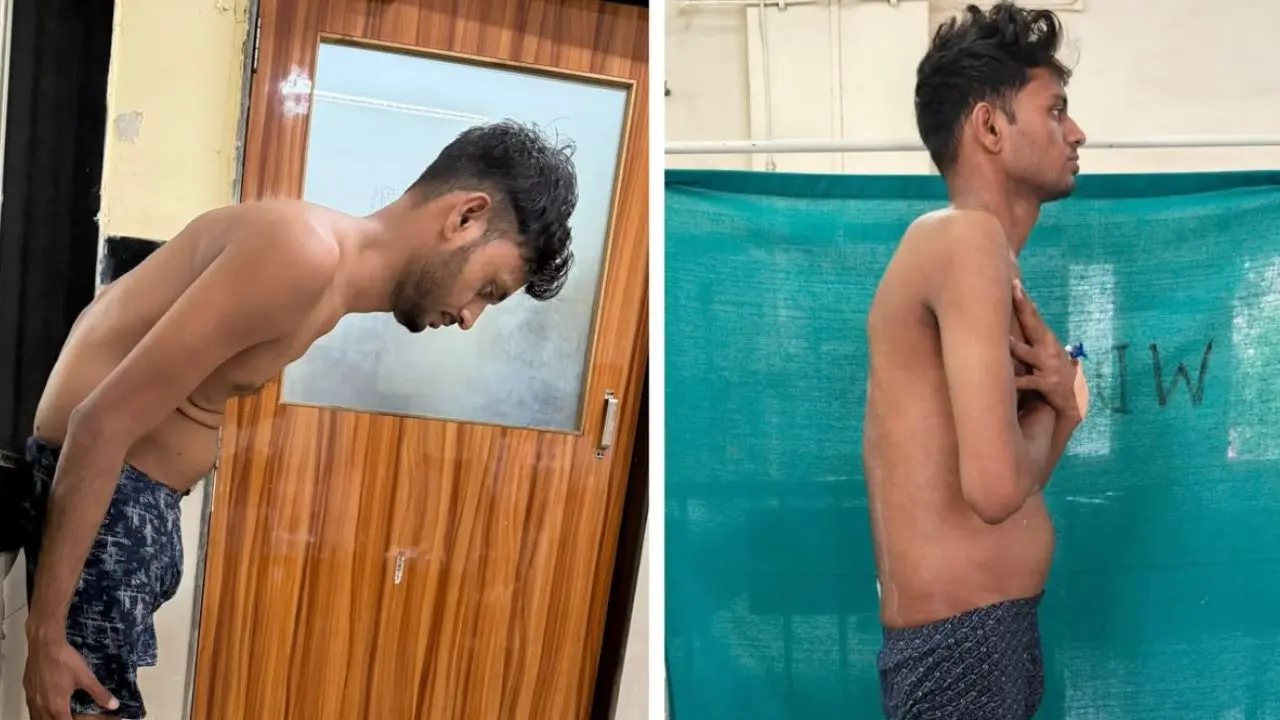
Mumbai doctors correct six-year spinal deformity in rare surgery on 32-year-old

A 32-year-old man from Maharashtra’s Hingoli, who had been living with severe spinal deformity caused by ankylosing spondylitis for nearly six years, underwent corrective spine surgery at Sir JJ Group of Hospitals in Mumbai.
Shivraj Mahadeo Javane, who was diagnosed with ankylosing spondylitis in 2021, had developed a severe forward curvature of the spine that made it difficult for him to stand upright, walk, sleep, bend or look straight ahead.
His condition had progressively worsened, eventually forcing him to quit his job at a bank in Hingoli in 2022. He later underwent hip replacement surgery in Chhatrapati Sambhajinagar in 2025 after abnormal weight-bearing caused by the spinal deformity severely affected his hip joint.
Severe spinal curvature linked to ankylosing spondylitis
Javane was admitted to Sir JJ Group of Hospitals on July 15.
Doctors conducted an HLA-B27 test and whole-spine X-ray, which confirmed severe spinal deformity associated with ankylosing spondylitis.
According to Dr Dhiraj Sonawane, Chief Spine Surgeon and Head of the Orthopaedic and Spine Unit at the hospital, ankylosing spondylitis is a chronic inflammatory condition that can cause the joints and ligaments around the spine to become inflamed.
As the condition progresses, new bone can form between the joints, causing them to fuse and making the spine increasingly rigid.
“In Shivraj’s case, ankylosing spondylitis had progressed to severe kyphosis deformity, causing his entire spine to bend forward into a bow-like posture,” Sonawane said.
The condition affected Javane’s posture, balance and mobility and made routine activities increasingly difficult.
Nearly 45-degree wedge of bone removed
Doctors performed a corrective osteotomy on July 17. During the seven-to-eight-hour procedure, surgeons removed a precisely calculated wedge-shaped section of bone, measuring nearly 45 degrees, from the lumbar spine.
The spine was then gradually straightened and stabilised using rods and screws.
The severity of the curvature also made positioning Javane for surgery challenging.
According to the surgical team, the operating table had to be adjusted to accommodate the deformity, while his head, eyes, abdomen and spine were carefully supported when he was positioned face down.
“Correcting a severe spinal deformity caused by ankylosing spondylitis is among the most challenging spine surgeries,” Sonawane said.
Patient discharged after recovery
Following the surgery, Javane underwent rehabilitation, physiotherapy and gradual mobilisation. Doctors said the procedure was aimed at improving his ability to stand upright, walk and perform daily activities.
He was discharged on July 23 and was advised to avoid heavy lifting and excessive bending, perform leg-strengthening exercises and attend follow-up appointments.
Doctors said untreated spinal deformity can continue to worsen, potentially making subsequent surgery more complex and increasing the risk of complications such as blood loss.
Rare complication
The hospital said ankylosing spondylitis affects approximately one in 2 lakh people, while severe kyphosis associated with the condition is much rarer, occurring in around one in 4 million people.
Doctors stressed that early diagnosis and treatment of ankylosing spondylitis can help slow its progression and potentially prevent severe spinal deformities.
 20
20 584226
 20
20
 20
20