From Assam Farm to 400 Stores Worldwide
Pass by Colaba and there are perfume shops lining the street. Among them is 75-year-old Ajmal Perfumes — one of the oldest in the city, today with 400 stores across 70 countries and 70 in India alone. The journey, however, began with a young man from Hojai, a small village about 165 kilometres from Guwahati, Assam, in 1950.
“Our founder, my grandfather Ajmal Ali, was a farmer. He discovered oud because it was essentially in the backyard. Oud to us is what jasmine is to people in Madurai. Someone introduced him to the fact that Arabs buy the wood, burn it and extract an oil they use as perfume. Initially he sourced it from the jungles and gave it to traders who brought it to Bombay. Then, like an entrepreneur, he asked himself the obvious question — why give it to someone else?” said his grandson and CEO, Abdulla Ajmal, 53.

Ajmal Ali moved his entire family to Bombay in the 1960s, believing the city could offer his children better education and opportunities. The first shop was a part of their first-floor apartment on Nagdevi Street, parallel to Mohammedali Road. “One side the family home, the other side the shop. We still have customers who call there and order by phone, it was always a relationship-based model,” said Abdulla, who grew up on the same street. He currently resides in Dubai with his family. “India gave birth to us and UAE adopted us, both are critical. But Dubai has been the ground on which we became global,” he noted.
From one shop on Nagdevi Street to an empire in UAE
From Nagdevi Street, the business expanded to Mohammedali Road and then Colaba. “Nagdevi Street was the wholesale and trading hub. Retail came to Mohammedali Road because it is the main artery. It became the OG (original) centre for perfumery retail in Bombay,” he shared, adding that Colaba came later. “Arab travellers, who used to stay in hotels on Marine Drive, began moving to Nariman Point, the Taj and similar places as their wealth grew. We were among the first to open in Colaba.”
The most-selling products at that time were oud oil and Indian attars — saffron oil, amber oil, sandalwood oil, and shamama from Kannauj, which is famous for its attars.
 Abdulla Ajmal
As the business grew, Ajmal Ali began travelling to Saudi Arabia, Kuwait and eventually UAE, selling his mixes to royals there. This was the late 1960s and early 1970s. During his travels he attended the open majlises of the late Sheikh Rashid of Dubai. “He was particularly drawn to Sheikh Rashid’s vision — tall buildings, a trade centre, a port that would surpass Aden in Yemen. That became Jebel Ali. My grandfather believed in that vision.” In 1976, he asked one of his five sons to open the first Ajmal Perfumes’ retail store in Murshid Bazaar in Dubai. From there, the business never looked back.
“A factory was set up in Dubai — first in 1987, a second in 2004. Today we have over 400 stores around the world, we are available in 65 duty-free outlets and on 14 airlines,” he shared. Today, they have over 300 exclusive fragrances, and more recently the brand also brought on board actor Ranveer Singh to promote its fragrances. On Ajmal Perfumes’ website and social media, Singh can be seen holding a bottle of Aristocrat (Rs 4,000) — an EDP (Eau de Parfum) with top notes of watermelon, lime and bergamot, which Abdulla says is his personal favourite.
Story continues below this ad
More recently, there seems to be a growing interest in the attars (also called ittars). When asked about them, Abdulla shared that the word has Persian roots — Itar in Persian, Attar in Indian usage, Atoor in Arabic — and all mean the same thing: essential oil.
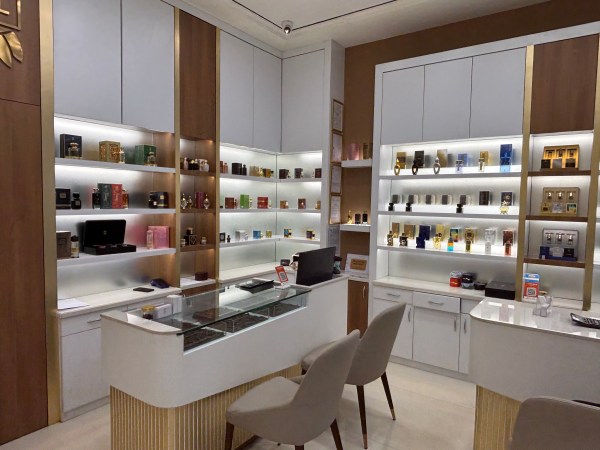 Inside Ajmal Perfumes’ store
“Technically, every perfume begins its life as an attar. Only when alcohol and water are added does it become an EDT (Eau de Toilette) or EDP,” he explained, adding that he predicted a resurgence in attars five years ago. “Major international brands like Dior and Amouage have begun releasing oil-format perfumes. But oil is not their specialty. It is ours.” Gen Z and young millennials, he says, are increasingly drawn to attar because they equate it with purity, and the interest is now year-round, not just seasonal. “They are far more conscious about what they put on their bodies than previous generations,” he said, adding that one of their most selling attars is a very soft musky, Misk-Rijali (Rs 999 for 10 ml).
The vision going forward, he says, is to position Ajmal Perfumes as a premium to entry-luxury global brand. “We are opening a store in Jakarta, a store in London in June, and Paris and New York are next. Distribution will be through retail, partnership with agents and distributors, and online,” said Abdulla. His benchmark for where he wants Ajmal Perfumes to sit? Amouage. “In terms of positioning and ambition, that is where I want Ajmal to be.”

 20
20 584226
 20
20
 20
20