Did SIR help BJP? What data reveals about fiercely-contested West Bengal election
New Delhi: Of the 293 seats where voting was held in West Bengal, BJP’s margin of victory was much higher than the post-adjudication SIR exclusions in 87 seats it flipped, an analysis by ThePrint found. In these 87 seats, the BJP’s margin of victory varied anywhere between 2,000 and 50,000 over and above the number of exclusions after adjudication.
The analysis also found that in some seats, SIR may have contributed to narrow BJP victories, while in many its lead was so significant that the outcome may not have changed even without the exclusions. In the case of TMC, the analysis found that improvement in victory margins was marginal compared to 2021, with some exceptions.
For this analysis, ThePrint analysed 2026 and 2021 assembly election results and disaggregated seat-wise data of the 27 lakh voters who were not allowed to vote since their appeals challenging the SIR adjudication were pending.
The Election Commission’s conduct of the Special Intensive Revision (SIR) in West Bengal has been criticised by non-NDA parties who blame it for the TMC’s loss to BJP in the state. The Mamata Banerjee-led government had challenged EC’s introduction of the “logical discrepancy” category as part of the SIR process in West Bengal, arguing that the fresh category was not introduced in any other state. Acting on the appeal, the Supreme Court directed that all such persons whose names were excluded from the electoral rolls could appeal before 19 appellate tribunals. If cleared by the tribunal, the names would be included in the electoral rolls but those electors were not allowed to vote in this election.
Overall, approximately 91 lakh names were removed from the electoral rolls in West Bengal in the run-up to the elections. These included 58 lakh voters, who are either dead or have relocated outside the state; and another 27 lakhs, who were removed during adjudication.
A total of 60.06 lakh names were flagged for adjudication under the “logical discrepancy” category.
Overall, BJP won 207 of the 293 seats where voting took place in two phases—up from 77 seats in 2021. The TMC’s tally declined from 215 in 2021 to 80 this time. The Congress won two seats, as did Humayun Kabir’s Aam Janata Unnayan Party, while the CPI(M) and All India Secular Front (AISF) each secured one seat. But, did the SIR impact electoral outcomes in West Bengal? An analysis by ThePrint threw up some other interesting trends.
Also Read: ‘I did not lose, won’t resign’—Mamata says TMC defeated not by public mandate but by a ‘conspiracy’
BJP’s victory margin > exclusions
While the BJP wrested more than two dozen seats from the TMC where the margin of victory was lower than the number of exclusions, the analysis also identified many constituencies where the BJP’s lead was large enough that the outcome may not have changed even without the exclusions.
For instance, in the Chunchura assembly constituency 11,828 people were found to be ineligible for voting while BJP’s margin of victory this time was 43,435. In 2021 Trinamool Congress won the seat by a margin of 18,417 votes.
It’s difficult to predict which party the ineligible voters would have voted for if their names were not excluded. But, even if one were to assume that all of them would have voted for TMC, BJP’s margin of victory would still be considerable.
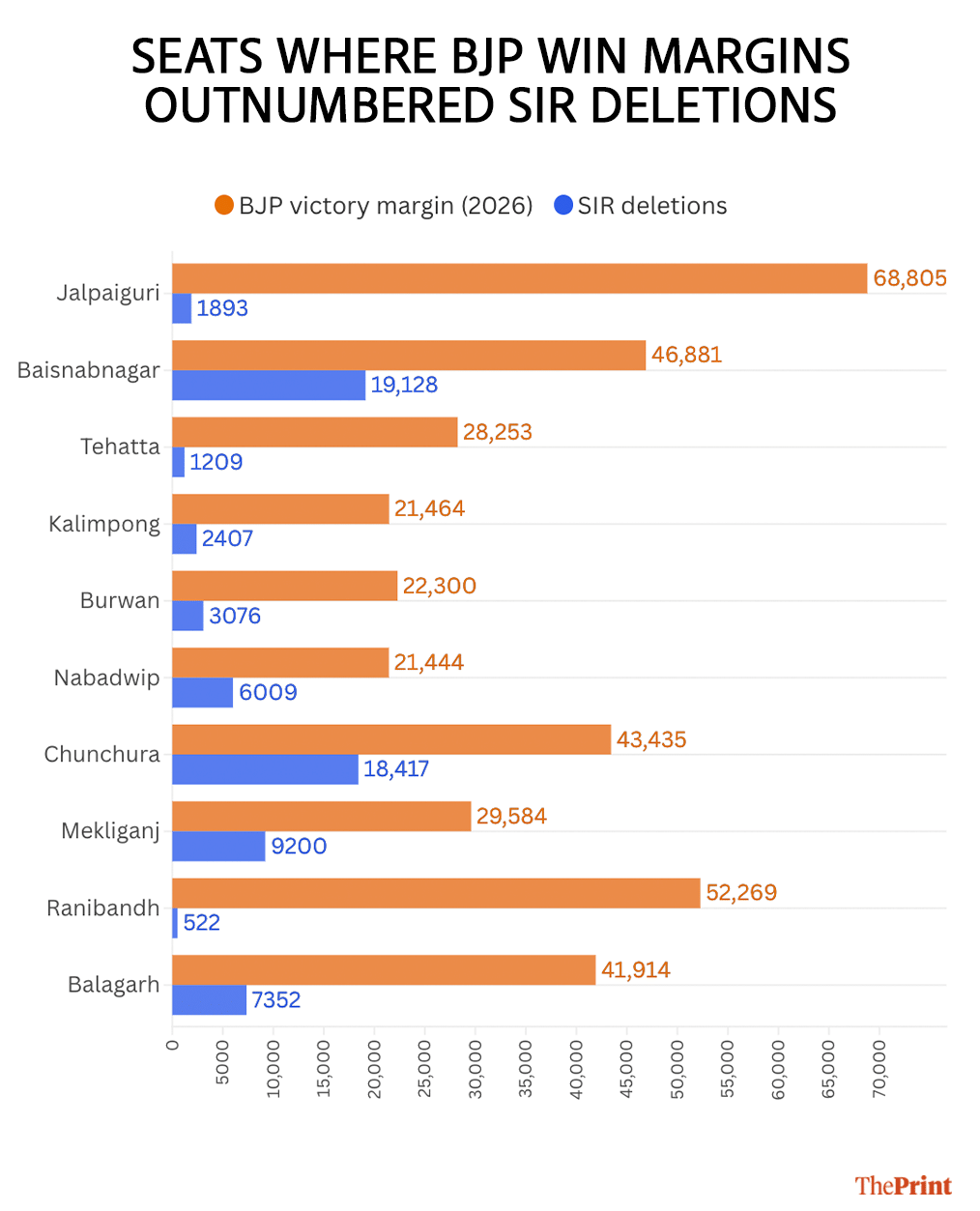
Another example is Balagarh, where 7,352 names were excluded, pending adjudication. The BJP won this seat this time by a margin of 41,914 votes. In 2021 Trinamool Congress won the seat by a margin of 5,784 votes.
Similarly, in the Ranibandh assembly constituency, 522 names were excluded. Here, the BJP’s margin of victory this time around was 52,269 votes. In 2021 Trinamool Congress won the seat by a margin of 3,939 votes.
TMC: Higher, lower & diminished margins
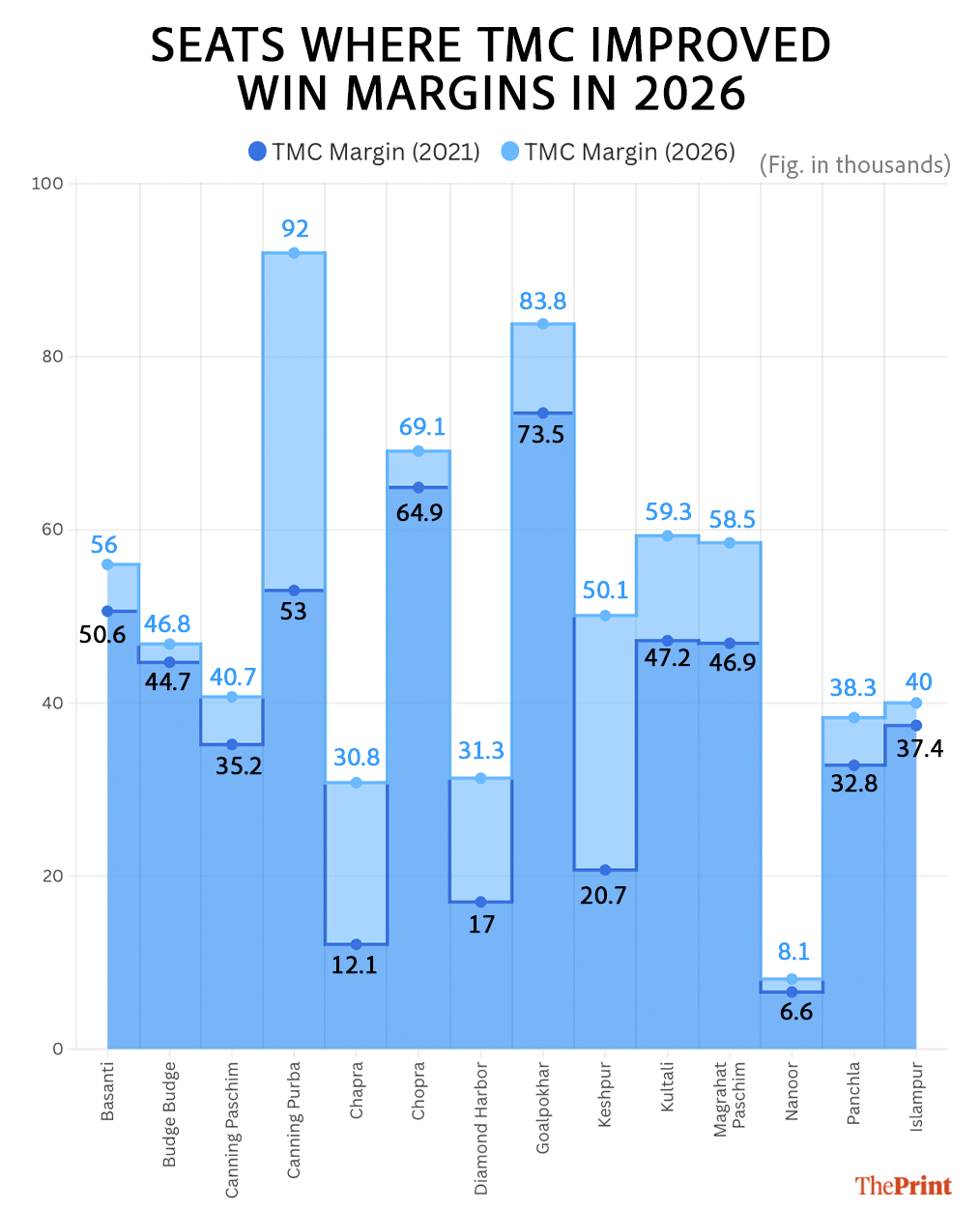
ThePrint’s analysis also found that across the state of West Bengal, TMC improved its performance in only 14 of the 293 seats it contested this time. In most of these seats, the improvement was marginal.
In Budge Budge, for instance, TMC increased its margin of victory to 46,850 from 44,714 in 2021.
Similarly, in Chopra, its margin of victory surged to 69,124 from 64,905 in 2021. About 28,000 names from this constituency were excluded during adjudication.
There were some exceptions though. In Keshpur, for instance, TMC doubled its margin of victory to 50,105 from 20,720 in 2021. Some 804 names were excluded from the electoral rolls here.
Similarly, in Canning Purba, TMC increased its margin of victory to 91,954 from 53,007 in 2021. A little over 11,000 names were excluded from the electoral rolls here.
The analysis also points to a larger shift. In many assembly constituencies in Malda, Murshidabad, and North Bengal—long considered TMC strongholds—the party has survived but its once-dominant victory margins have collapsed. In Sitai, which saw 20,000 exclusions during adjudication, TMC’s margin of victory dropped from over 10,000 to under 3,000.
And in Samserganj, a seat where exclusion of 75,000 electors raised eyebrows owing to disproportionately high exclusion rates in Muslim-majority voting booths, TMC’s winning margin collapsed from over 26,000 to under 8,000.
Also Read: BJP’s Bengal battle doesn’t end with election victory. TMC still controls local bodies
Anti-incumbency bites both ways
As for the BJP, ThePrint’s analysis found that it bettered its performance in many of the seats it had won in 2021. In Saltora assembly constituency, for instance, BJP increased its margin of victory to 32,135 from 4,145 in 2021. Some 449 names were excluded here.
Similarly, in Chhatna, BJP increased its margin of victory to 47,174 from 7,164 in 2021. Here, 248 names were excluded from the electoral rolls.
And in Bankura, BJP increased its margin of victory to 54,177 from 1,468 in 2021. Some 467 names were excluded here during adjudication.
However, despite the broader shift, this election did not see a uniform increase in support for the BJP. On the contrary, there was a swing against the BJP in certain constituencies that they won in 2021 and retained in 2026. Darjeeling is a case in point. The BJP retained the seat but saw its margin of victory decline to 6,057 from 21,276 in 2021.
A similar pattern was seen in Baharampur and Tufanganj.
The reversals were modest and ultimately inconsequential in the face of the BJP wave elsewhere, but they do underline that local dissatisfaction and anti-incumbency cuts across party lines, both at constituency level and state level.
SIR & narrow BJP victories
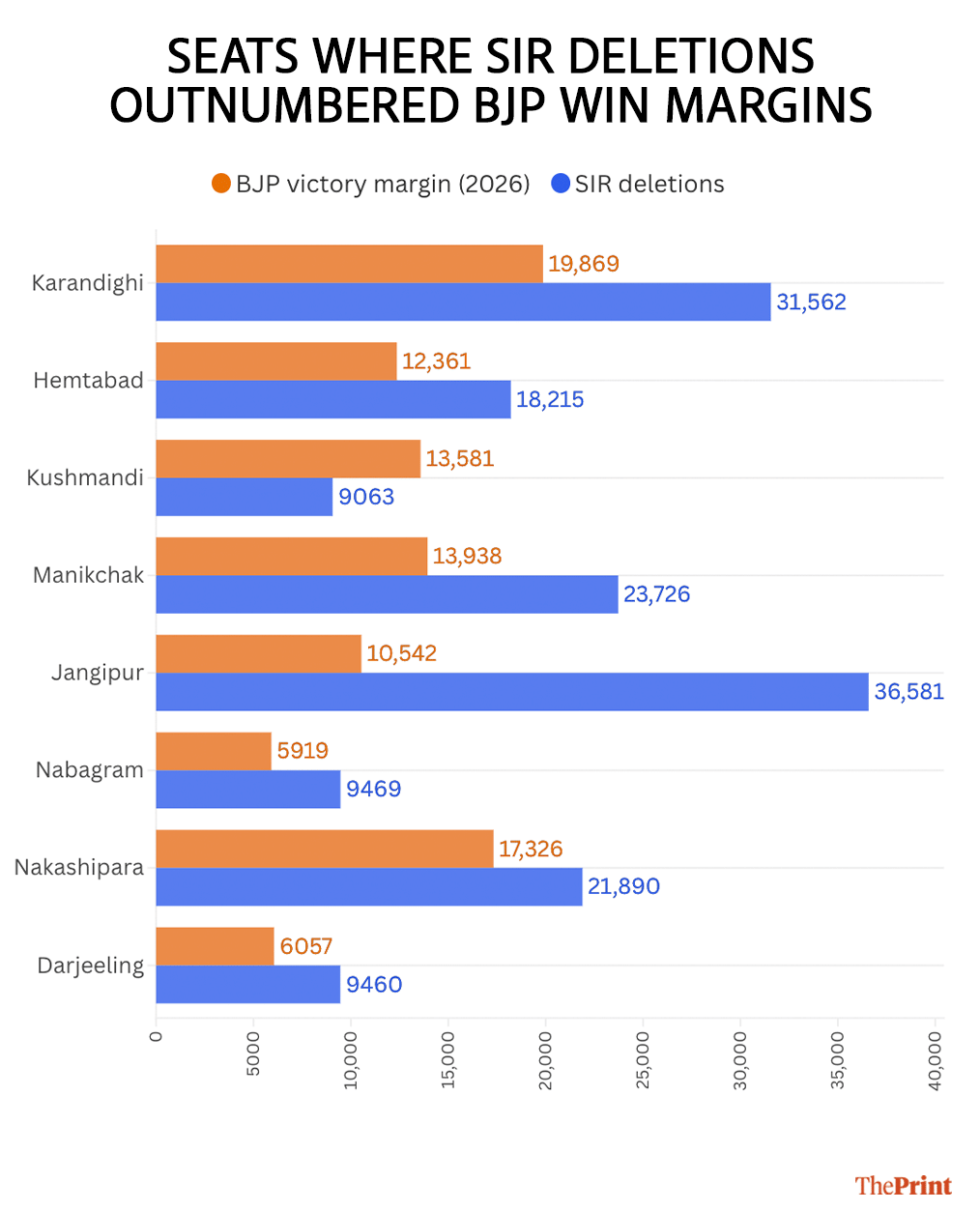
ThePrint’s analysis also found that SIR adjudication may have contributed to narrow BJP victories in several seats. For instance, BJP lost Kushmandi by 12,584 votes in 2021. It won the seat by a margin of 9,063 votes this time around. A total of 13,500 people were excluded from the electoral rolls in this constituency after adjudication.
Similarly, BJP lost Karandighi by 36,626 votes in 2021. It won the seat this time by a margin of 19,869 votes. As many as 31,562 voters were excluded here.
The data does not establish that exclusions alone caused these reversals. That being said, in a number of these closely-fought contests, the scale of exclusions was large enough to plausibly tip the scales in favour of the BJP.
Sahaj Sankaran is an alum of ThePrint School of Journalism, currently interning with ThePrint.
(Edited by Amrtansh Arora)
Also Read: Why Bangladesh played a big role in BJP’s West Bengal win
 20
20 584226
 20
20
 20
20