Around Town: Why everyone in Mumbai is still talking about Kaspers, Bandra’s buzziest bistro | Mumbai News
It opened late last year, dinner service only, and packed reservations. At a gathering earlier this year with a pastry chef and a food blogger, the conversation drifted to “have you dined at Kaspers yet?” The buzz had reached everyone, including a food influencer who has stopped dining out entirely to follow a diet. She made an exception for Kaspers.
Eight months later, it now opens for longer hours — covering breakfast, lunch and dinner, but the buzz hasn’t died down. Even on a heavily pouring evening earlier this week, the 38-seater bistro just off Hill Road was full: a bunch of ladies, a family of four, two girls catching up, a group of six young people. There’s chatter, the kind you can eavesdrop on without it touching your own evening.

Kaspers is the latest opening from restaurateurs Jay Yousuf and Gauri Devidayal’s Food Matters Group, the house behind The Table, Mag St. Bread Co., and Magazine St. Kitchen. The menu and the room are both put together by Chef Will Aghajanian, who has cooked at Mugaritz in Spain and Per Se in New York, and ran Horses in Los Angeles before the restaurateurs called him to Mumbai a little under three years ago now.
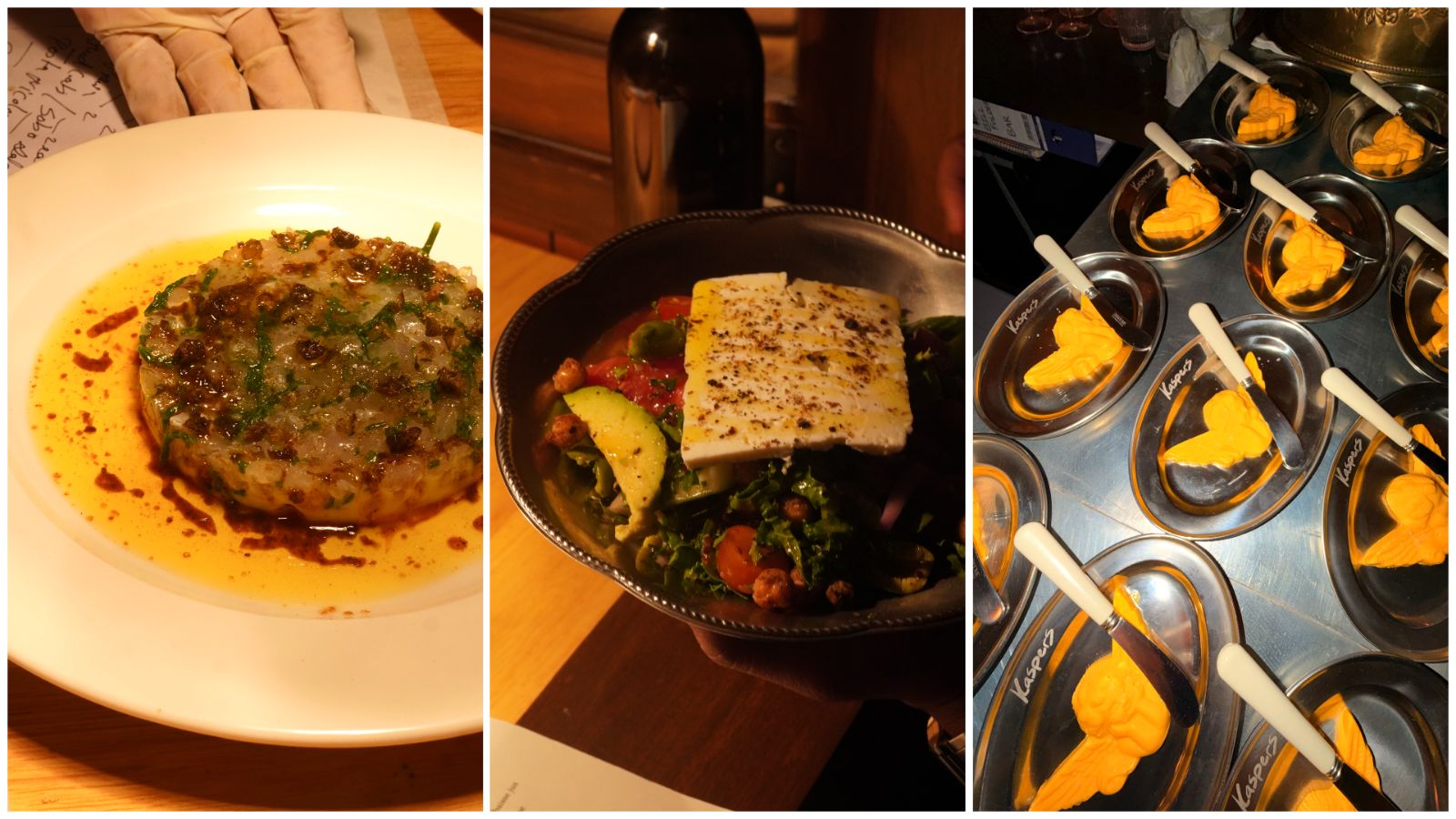 Sea bream tartare with meunière vinaigrette; Demi’s salad, barrel-aged sheep’s feta, crushed olive and watermelon; and bread & butter. Photo Courtesy: Special Arrangement
The space, designed with Patch Design Studio, is a piece of Paris folded into a busy Mumbai lane: hand-laid mosaic floors, deep maroon banquettes, a zinc bar. It is lit exactly the way Will wanted it. “Lighting is one of the most important things; it needs to be good, not overly bright,” he said. That instinct extends to everything guests touch. “Even the forks have a hidden logo on the back. There are a lot of small hidden details like that.”
The room is also, unmistakably, a canvas. Every table is topped with white paper and a packet of crayons, an invitation the artist Kacper Abolik set the tone for: he spent a month in Mumbai hand-painting the cherub frescoes that give the restaurant its name and its whimsy. On the night we visited, nearly everyone gave in to it. The family of four’s mother sketched a mountain scene while her daughter drew a waffle; a group of friends recreated the cherub motif from the walls. A few of these table-top doodles have already been framed and now hang in the space.
Will is candid about why he built the room this way. “I am pretty awkward, and when I used to date, I was bad at it, I have ADD (Attention Deficit Disorder, now called ADHD), so I need things to talk about, or the conversation stalls,” he said. “So the idea was: give people things that fill the void of an awkward date. It’s why Jenga comes out for the second seating, why the playlist shifts toward ’90s Blink-182 territory as the night wears on, why there is always something on the wall worth pointing at.” The two pillars at the centre of the room do plenty of that talking themselves. A nice mix of Hollywood and Bollywood memorabilia decorates them: Rekha from Umrao Jaan, a poster from the Folies Bergère cabaret hall in Paris, vintage adverts for Campa Cola and Charminar cigarettes, and covers from The New Yorker and Illustrated Weekly.
The menu resists easy geography, drawing on French bistro classics and Basque pintxos using seasonal ingredients with European flair. “It’s what sets it apart,” Will said of the Indian elements running through it. “There’s also Basque in there, Italian, and something like southern France meeting Indian flavours.” His tandoori crab, technically a Basque preparation before the tandoori paste goes on, ends up tasting, in his own words, like rustic coastal cooking “even though it’s meant to be tandoori crab.” Much of that flavour memory, he said, comes from staff meals cooked by his largely Bengali kitchen team, which he eats constantly.
Story continues below this ad
That range shows on the table. We began with charred dates and smoked goat’s curd with rosemary (Rs 750), a dish that leaned sweeter, better suited perhaps as a light dessert than an opener. The bread basket (Rs 450), sourdough, sesame focaccia and a crisp olive disc, came with a golden housemade butter, cultured with buttermilk and cream, finished with sea salt. Stronger was the ruby red beet lavash (Rs 950): crispy lavash topped with sliced avocado, pistachio, roasted beetroot, arugula leaves and mulberries. The sea bream tartare (Rs 975) was plated over browned-butter vinaigrette, and seasoned just right, with capers and parsley, and the golden crispy shortcrust of spinach and Taleggio read almost like a pizza. “I had to learn the vegetarian palate when I came to India,” Will said. “It’s still western at its base, but figuring out how to make it work for everyone was the goal.”
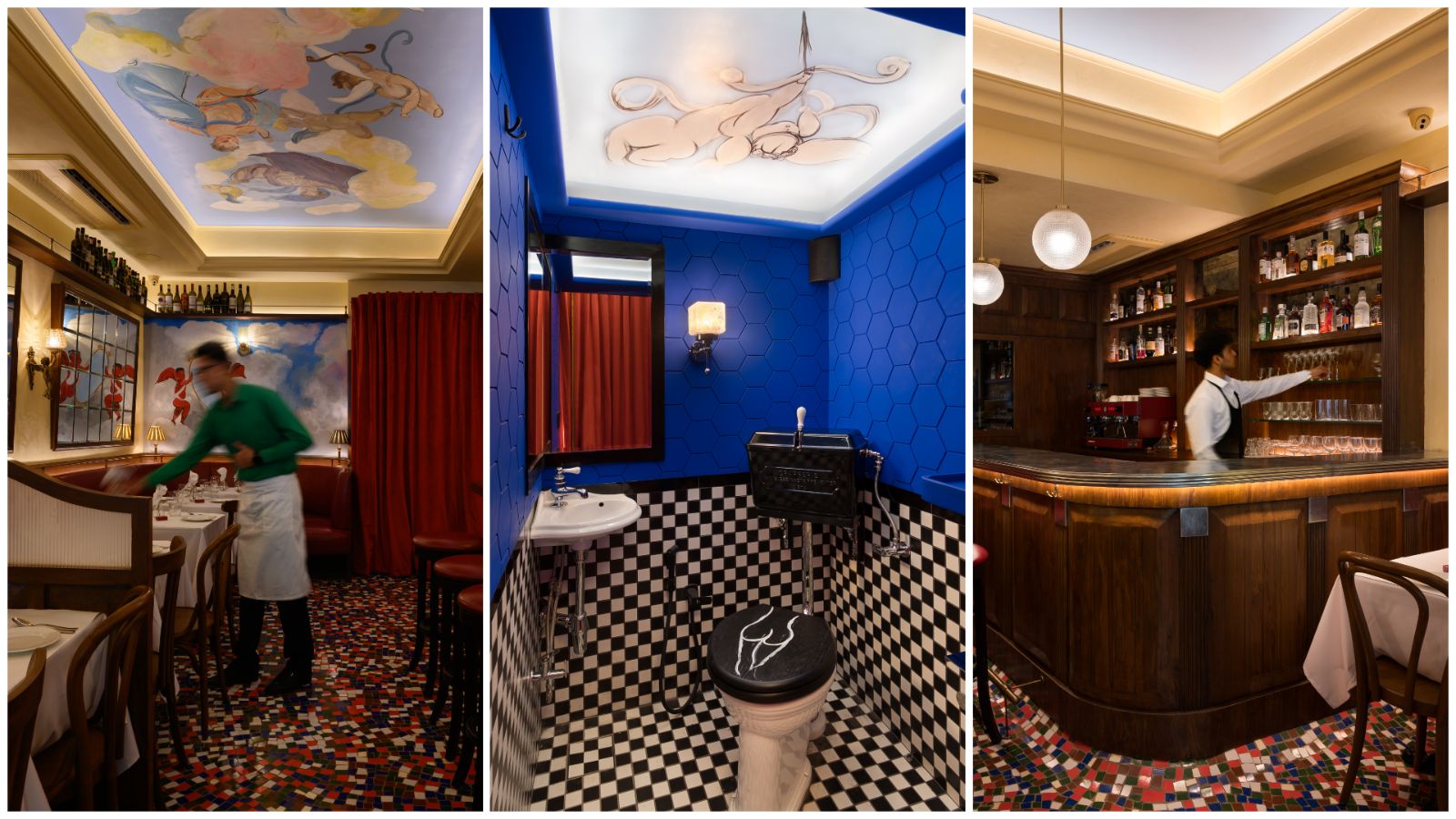 The interiors; Thomas Crapper toilet; and the bar at Kaspers. Photo Courtesy: Special Arrangement.
Demi’s salad (Rs 850), barrel-aged sheep’s feta over cherry tomato, onion, crushed olive and watermelon, came together very well, and we polished it off. The French onion soup crostino (Rs 675) didn’t land for us. But we thoroughly enjoyed the salt roasted tiger prawns with prawn head rouille and bouillabaisse jus (Rs 1050).
“It’s a king prawn dish, but we make almost a curry paste using Bouillabaisse spices instead of the traditional approach, so it ends up with a lot of Thai elements. It’s a hybrid of Southeast Asia and France. A lot of the food here works that way — it takes elements of Basque, French, or Italian cooking, and then becomes Indian or Southeast Asian somewhere inside it. There might be a sambal, there might be something hidden in there that we don’t talk about, but it’s what gives the dish more flavour. It’s always a bit of a balancing game,” said Chef Will. For drinks, we began with a lighter Aperol Spritz, moved on to a bold Negroni, and ended the night with a shot of espresso.
Desserts, which Will oversees personally, were the stronger half of the meal. The Santa Rosa plum and almond tart (Rs 650) had just the right tang, though its accompanying cream needed more sweetness to balance it. The pineapple baba au rhum with coconut cream (Rs 650) was heavy on alcohol and light on coconut. But the coffee cake tiramisu (Rs 650), dusted in dark cocoa, stole the meal. “It’s the way we use dark cocoa that changes it, like an Oreo tiramisu, playing on that trashy, familiar flavour,” Will said. “Secretly, it’s all a bit of a Cheesecake Factory. We just don’t talk about it.”
Story continues below this ad
No account of Kaspers is complete without its bathroom: a Yves Klein Blue room behind a red velvet curtain, built around a Thomas Crapper WC, with its own separate playlist. “The architects initially said it wouldn’t fit in the space,” Will said. “So I made a cardboard cutout of it every day and kept testing until we got it to fit.” It is, as he put it, a party in itself.
 20
20 584226
 20
20
 20
20