
Mumbai records driest May in 3 years despite season’s first pre-monsoon rain | Mumbai News
3 min readMumbaiMay 31, 2026 04:31 PM IST
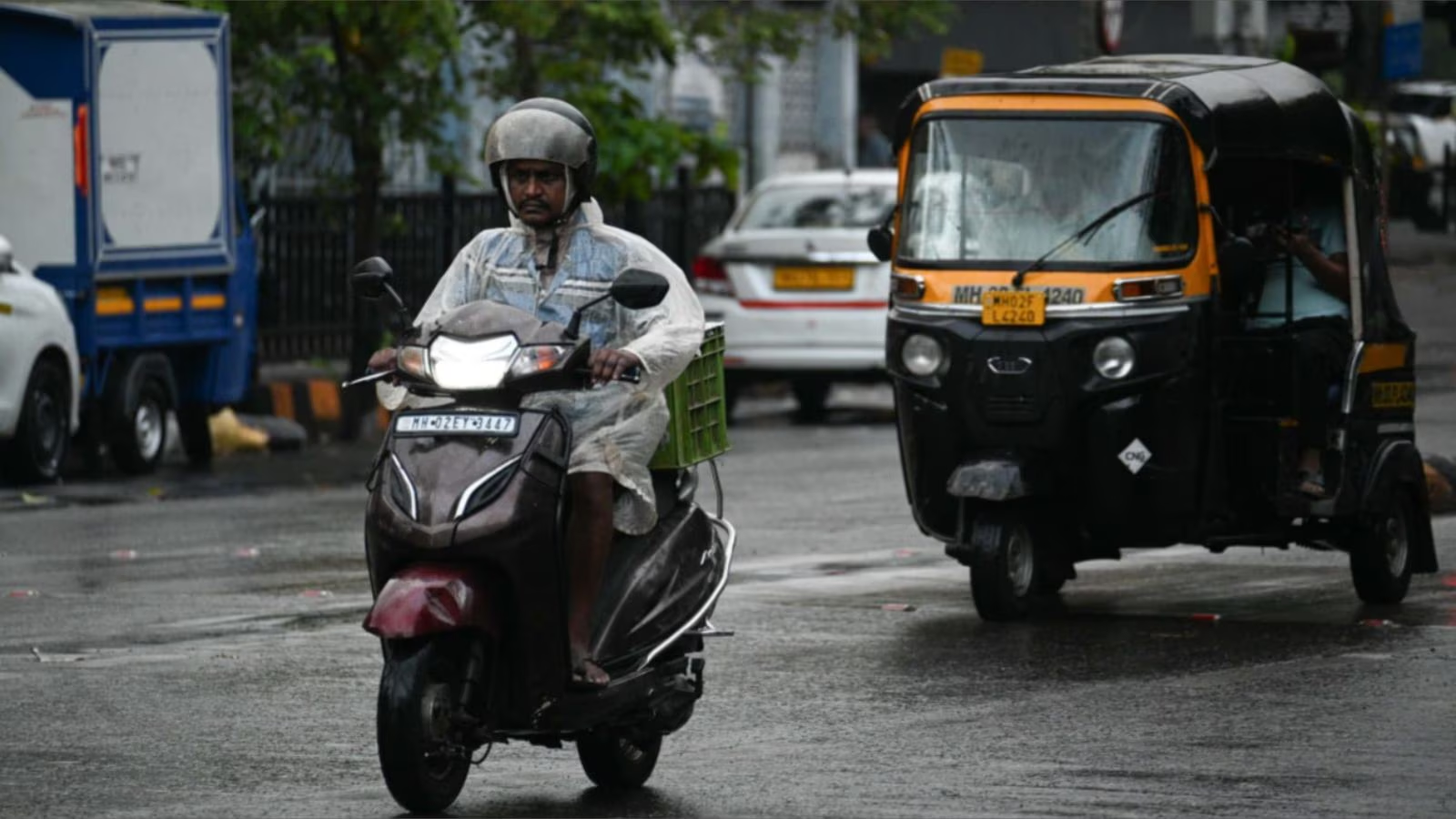
Moderate rainfall lashed Mumbai on Sunday morning, bringing respite to a city that had remained parched throughout May despite alerts about thunderstorms and occasional drizzles. While the city’s first pre-monsoon spell spurred the total rain recorded this month up to 8.8 mm, data from the India Meteorological Department (IMD) show that this has been the city’s driest May in the past three years.
The city’s dry spell marks a stark departure from the previous year, when Mumbai experienced its wettest May in 107 years, with the Colaba observatory recording 509 mm of rainfall as the city experienced its earliest monsoon onset in 75 years, on May 26.

This year, by contrast, records procured from the IMD showed that the Colaba coastal station and Santacruz observatory received no rain between May 1 and May 30. On May 31, however, moderate rainfall swept across Mumbai, with 8.8 mm recorded at the Santacruz observatory, bringing the total monthly rainfall to 8.8 mm. On May 22, pockets of eastern suburbs like Vikhroli, Kanjurmarg, and Mulund experienced drizzles. Even so, the observatories logged “nil” rain as the proportions were too little to be registered by standard units of measurement.
Furthermore, data showed that amid at least six heatwave alerts issued as early as March, the suburban station in Santacruz recorded 0 mm of rainfall between March and April.
According to records, this is Mumbai’s driest May in the past three years. In May 2025, the Santacruz observatory logged 395 mm of rainfall, 21.3 mm of rainfall in May 2024, and 3.4 mm of rainfall in May 2023.
The Santacruz station is recording a rain deficit of 9.7 per cent between March and May. Meanwhile, the Colaba coastal observatory has logged a rain deficit of 15.5 per cent until now.
While hot and humid temperatures are a prevailing feature for the city between March and May, the region is prone to experiencing thunderstorms and pre-monsoon showers during the season. Even as Mumbai has remained dry, heavy showers have swept several pockets of Maharashtra, with Pune, Kolhapur, and Satara receiving over 100 mm of rainfall until May 31.
Monsoon rainfall forecast revised downwards
Story continues below this ad
Mumbai’s dry pre-monsoon period coincides with the IMD forecasting a below-average monsoon across India owing to the development of El Niño systems. On Friday, the IMD also revised its rainfall forecast for the upcoming season downwards, stating the country is expected to receive only 90 per cent of the total long-period average of monsoon rainfall. Last month, in its first long-range forecast, the IMD said the country was set to receive 92 per cent of the rain during the season.
As per the latest climate model forecasts, El Niño conditions are likely to develop during the southwest monsoon season, while neutral Indian Ocean Dipole conditions are also likely to continue during the period. A climate phenomenon where sea surface temperatures in the central and eastern Pacific Ocean become warmer, El Niño weakens southwest monsoon winds and leads to a below-average monsoon in India. Earlier, weak monsoon years like 2015 and 2023 had an El Niño influence.
The absence of pre-monsoon showers throughout May also spurred a spike in temperatures throughout the summer, with the IMD issuing a heatwave alert for May 27, when temperatures surpassed 39 degrees Celsius. This year, Mumbai experienced an early onset of heatwaves with at least six events during March.

Stay updated with the latest – Click here to follow us on Instagram
 20
20 584226
 20
20
 20
20