
Property dispute can’t be turnedinto criminal case: Bombay HC | Nagpur News
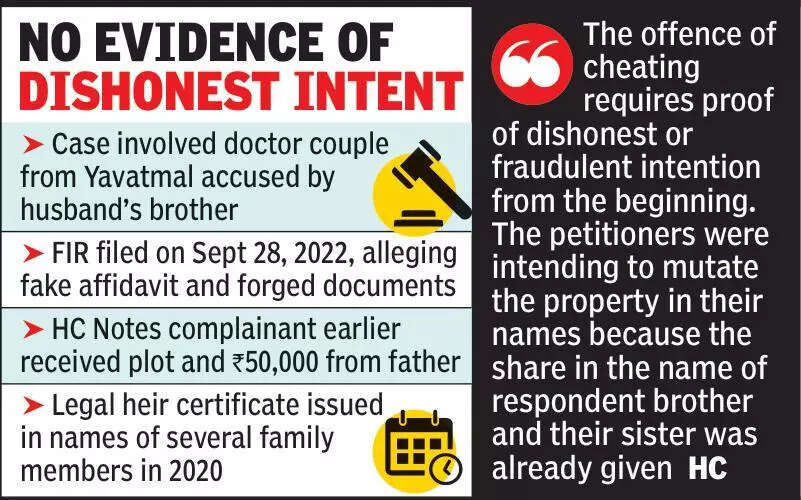
Nagpur: Coming to the rescue of a doctor couple from Yavatmal, the Nagpur bench of Bombay high court ruled that a family property dispute cannot be given a criminal colour in the absence of evidence of fraud or dishonest intent, quashing criminal proceedings against them.Justice Pravin Patil set aside proceedings pending before a judicial magistrate first class, holding that the case stemmed from a civil dispute among family members rather than a criminal act.A police complaint was filed by the husband’s brother on Sept 28, 2022, against their mother and other siblings, alleging that they prepared a false affidavit and fabricated documents to exclude his name from the list of legal heirs of their father before mutating their names in property records.Based on the complaint, police registered offences under IPC sections for cheating, forgery and dishonest concealment of property.After examining the record, the court noted that the brothers’ father died on Jan 1, 2014, and that the complainant himself acknowledged receiving a plot and ₹50,000 from his father, after which he began living separately.The bench also recorded that an application seeking issuance of a legal heir certificate was filed by another brother on July 13, 2020, and the certificate was issued in the names of several family members.Justice Patil observed that the allegations against the petitioners were minimal. “The role attributed to the petitioner-husband is only to the extent that he has put signature to the affidavit prepared by his other brother,” he noted, adding that there were virtually no allegations against the petitioner’s wife.The court also took note of the fact that the complainant’s name was later entered in the property card and that the petitioners earlier expressed willingness to include him as a legal heir after learning about the dispute. Justice Patil observed that the complaint appeared to be an attempt to convert a civil disagreement into criminal litigation. “The respondent brother with oblique motive and to give colour of criminal offence to the civil dispute existing between the parties, lodged the complaint against petitioners,” he said.Referring to a 2003 judgment of the Supreme Court, the Bench reiterated that courts must carefully examine surrounding circumstances where criminal proceedings are initiated in disputes that are essentially civil in nature.The court further clarified that the offence of cheating requires proof of dishonest or fraudulent intention from the very beginning of the transaction. “The petitioners were intending to mutate the property in their names because the share in the name of respondent brother and their sister was already given during the lifetime of the father,” the judge observed, concluding that no criminal intention could be inferred.The bench also emphasised that mutation entries in revenue or property records are made primarily for administrative purposes and do not by themselves create ownership rights over immovable property. Since the ingredients of cheating were not established, the court held that the allegation of forgery could not stand either, as forgery must be committed with an intention to cheat. Holding that continuation of the prosecution would amount to an abuse of legal process, the court quashed the criminal proceedings and the chargesheet against the petitioners.Key takeaways from HC verdictCase involved doctor couple from Yavatmal accused by husband’s brotherFIR filed on Sept 28, 2022, alleging fake affidavit and forged documentsNotes complainant earlier received plot and ₹50,000 from fatherLegal heir certificate issued in names of several family members in 2020Petitioners’ role limited to signing affidavit prepared by another brotherComplainant’s name later added to property cardMutation entries are administrative and do not create property title