Real Test of Democracy: Lessons India Cannot Ignore
Three books _Why Nations Fail, How Democracies Die,_ and _How Civil Wars Start_ are books which can tell you where you stand 25 to 50 years from today. The writings are always on the wall, its just that we don’t see them or we don’t want to see them.
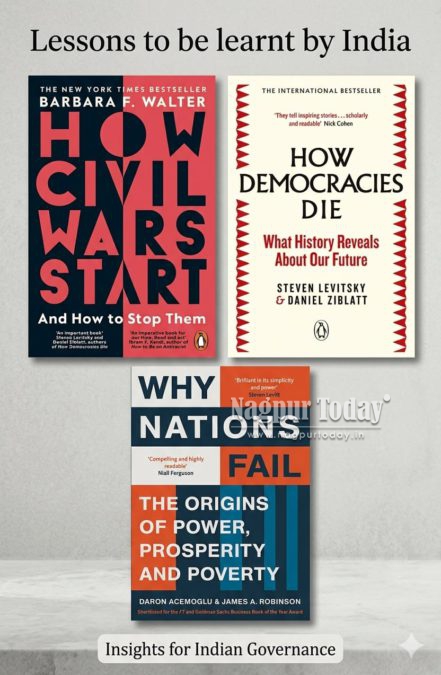
Democracies rarely collapse overnight. Their decline is gradual — shaped by weakening institutions, rising polarization, and fading public trust. The combined lessons of _Why Nations Fail, How Democracies Die,_ and _How Civil Wars Start_ offer an important lens through which India’s democratic journey can be understood.
Gold Rate
May 09- 2026 – Time 10.30Hrs
Gold 24 KT
₹ 1,52,200 /-
Gold 22 KT
₹ 1,41,500 /-
Silver/Kg
₹ 2,58,800/-
Platinum
₹ 88,000/-
Recommended rate for Nagpur sarafa Making charges minimum 13% and above

In _Why Nations Fail_, economists Daron Acemoglu and James A. Robinson argue that nations succeed when institutions are inclusive — ensuring equal opportunity, rule of law, and broad participation in economic and political life. India’s constitutional design reflects these ideals, yet persistent inequality and uneven governance can weaken citizens’ confidence if growth does not feel shared and in the present scenario the growth story is lopsided, we are heading to become the fourth largest economy of the world, but the per capita income is at a stand still – $2800 and comparing it to developed nations is a sheer waste of time and energy.
_How Democracies Die_, by Steven Levitsky and Daniel Ziblatt, warns that modern democracies are seldom destroyed by coups. Instead, erosion occurs slowly when political rivals stop viewing each other as legitimate competitors. Increasing polarization, aggressive rhetoric, and institutional mistrust — trends visible in many democracies, including India — can gradually weaken democratic norms even while elections continue regularly.
The final warning comes from _How Civil Wars Start_, where Barbara F. Walter explains that instability grows when societies enter a grey zone between full democracy and authoritarianism. When identity politics deepens and groups fear exclusion from power, political competition risks turning into social conflict.
The lesson is simple but urgent, nations remain stable when institutions are trusted, opponents are respected, and inclusion is real. Democracy’s greatest threats are rarely dramatic — they emerge slowly, through everyday erosion. Protecting it, therefore, is an everyday responsibility. Bottom line, the Constitution needs to be upheld.
Pankaj Roshan
80550 05000
Advertisement

Advertisement

Advertisement

 20
20 584226
 20
20
 20
20