
Alarm bells for Maharashtra: Public healthcare use hits rock bottom: NSO data
Nagpur: In a deeply concerning revelation that raises serious questions about the State’s healthcare priorities, Maharashtra has recorded the lowest utilisation of public hospitals in the country, with barely one-fifth of patients seeking treatment in government facilities.
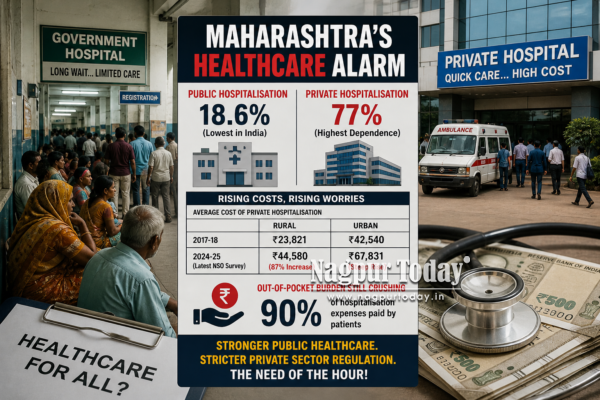
According to the latest 80th round survey on household health expenditure by the National Statistical Office (NSO), only 18.6% of hospitalisations in Maharashtra take place in public hospitals, while a staggering 77% occur in the private sector, highlighting a widening imbalance in access to affordable healthcare.
Gold Rate
May 05- 2026 – Time 10.30Hrs
Gold 24 KT
₹ 1,48,800 /-
Gold 22 KT
₹ 1,38,400 /-
Silver/Kg
₹ 2,47,500/-
Platinum
₹ 90,000/-
Recommended rate for Nagpur sarafa Making charges minimum 13% and above

Despite being one of India’s more economically advanced states and home to over 30 government medical and dental colleges, Maharashtra’s heavy dependence on private healthcare signals a systemic failure. Public health experts warn that this trend reflects years of policy neglect and increasing privatisation.
Dr. Abhay Shukla of the Jan Swasthya Abhiyan termed the situation alarming, stating that the data exposes deep-rooted structural issues in the healthcare system.
Lagging far behind other states
The contrast with other states is stark. While Maharashtra struggles at 18.6%, states like Tamil Nadu (43%), Rajasthan (45.3%), West Bengal (58.8%), and Goa (64.7%) report significantly higher reliance on public healthcare. Even the national average stands at 36.7%, making Maharashtra’s performance particularly troubling.
Skyrocketing healthcare costs
The crisis is further compounded by sharply rising medical expenses. NSO data reveals that average private hospitalisation costs have surged to Rs 44,580 in rural areas and Rs 67,831 in urban centres.
Compared to 2017–18, this marks an alarming increase, 87% in rural areas and a steep rise in urban costs as well. While overall inflation during this period stood at around 43%, healthcare costs have far outpaced it, nearly doubling the rate.
Experts attribute this surge to inadequate regulation and profit-driven practices in the private healthcare sector, leaving patients financially vulnerable.
Public healthcare not truly affordable
Even government hospitals, which are expected to provide affordable care, are not entirely free from financial burden. Patients continue to spend significantly on medicines and diagnostic tests.
Average costs in public hospitals have risen to Rs 8,080 in rural areas and Rs 8,364 in urban areas, largely due to out-of-pocket expenses for drugs and investigations that are supposed to be subsidised or free.
Insurance schemes falling short
Flagship government schemes like the Pradhan Mantri Jan Arogya Yojana and Mahatma Phule Jan Arogya Yojana appear to be offering limited relief on the ground. While these schemes promise coverage of up to Rs 5 lakh per hospitalisation, the reality remains stark. The average hospitalisation cost in Maharashtra stands at Rs 44,778, of which Rs 40,495 is still paid directly by patients, meaning nearly 90% of expenses come out of citizens’ pockets.
The findings come as a stark reminder in the aftermath of the COVID-19 pandemic, during which Maharashtra recorded the highest number of fatalities in the country. Despite that experience, public healthcare investment has not kept pace with the growing demand.
Experts are now calling for urgent and decisive action, strengthening public healthcare infrastructure, ensuring availability of free medicines and diagnostics, and enforcing stricter regulation of private hospital charges.
Unless immediate reforms are undertaken, the current trajectory risks pushing healthcare further out of reach for ordinary citizens, turning illness into a financial crisis for thousands of families across the state.
Advertisement

Advertisement

Advertisement