What RSS, BJP leaders may be trying to tell BJP on youth protests
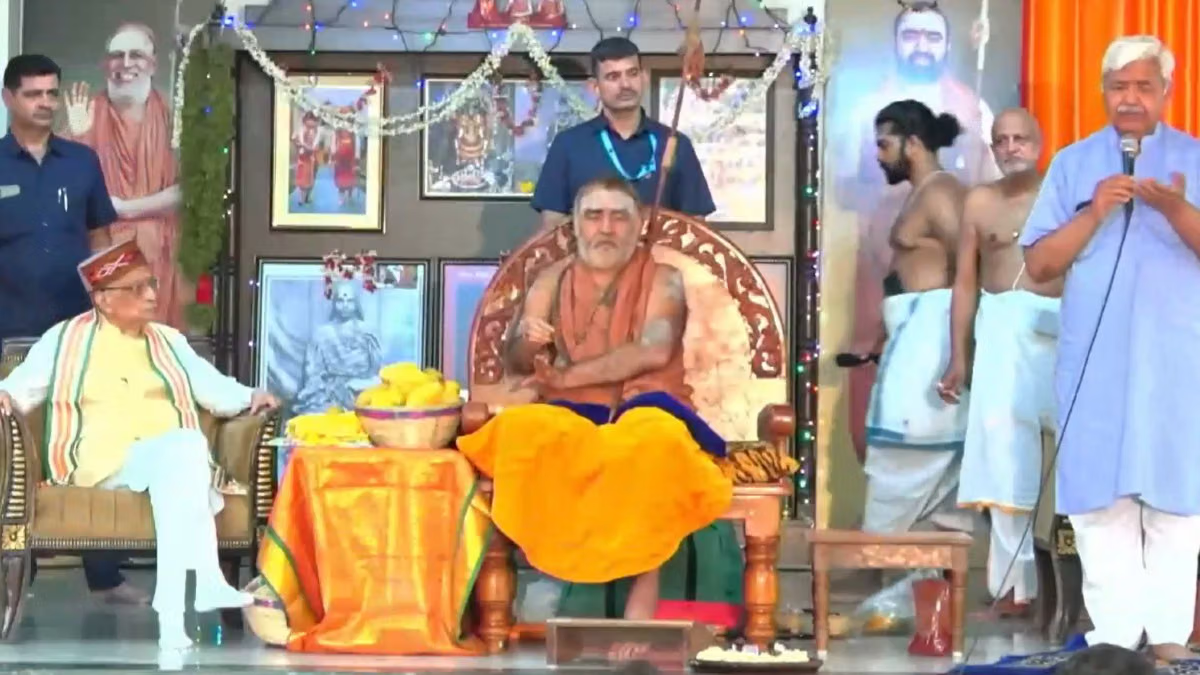
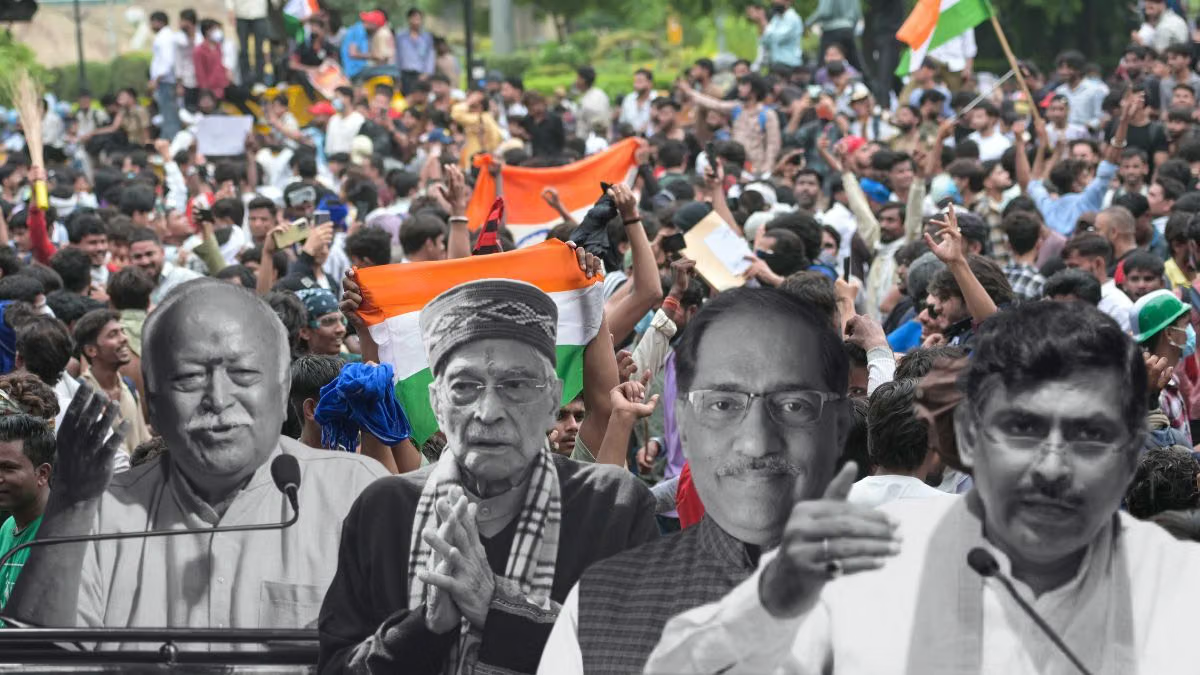
Last week, without referring to the young protesters, Mohan Bhagwat spoke about how the new generation asks questions and demands logic. He urged people to engage in dialogue with them instead of giving them orders.
Speaking at the valedictory session of a two-day national meeting on ‘Contemporary Motherhood’, Bhagwat called for a change in approach and style of engaging with the younger generation.
Ratan Sharda, who has written many books on the RSS, also came down heavily on the BJP’s media team, including its IT cell, in a post on social media platform X. He pointed to what he called a “total inability to create a narrative to counter hateful well crafted narrative of Left Ecosystem”.
However, he clarified that it was his “personal note” and had “nothing to do with RSS”.
Murli Manohar Joshi extended his support to the protest last week, criticising the use of “force” during the ‘Sansad Chalo’ protest march. In a post on X, Joshi wrote that such use of force “shall alienate large sections of Indian society from the national goal of Viksit Bharat”.
Joshi was the HRD minister in the Atal Bihari Vajpayee government and faced flak from political rivals for pushing the Sangh’s cultural agenda as the minister. Since 2014, Joshi has been in the political wilderness with no role in the party or the government.
Former BJP general secretary and ex-pracharak Muralidhar Rao also posted a veiled message on X, saying, “Governance may emerge from the mandate of the majority, but it endures only through the consent of the governed.”
Meanwhile, when Hindutva ideologue T.G. Mohandas made statements against the protests, threatening that he “would have shot” the protesters if he were in control, the RSS was quick to condemn the comments and distance itself from them.
Senior RSS functionary K.B. Sreekumar clarified that Mohandas is not an office-bearer of the RSS and called his remarks his “personal thoughts”. He said that the RSS does not agree with Mohandas’ comments and that “such views should be condemned in every highest possible manner”.
Political analysts see these remarks in the backdrop of massive protests across India, especially in New Delhi, led by the Cockroach Janata Party (CJP) over the NEET-UG 2026 paper leak as part critiques, part advice and nudges for the BJP government to course correct.
Milan Vaishnav, senior fellow and director of the South Asia program at the Carnegie Endowment for International Peace, says that there are concerns, including from within the Sangh, that the government has grown too distant from the common person, especially young people.
“I see these statements as nudges that aim to push the ruling party to be more engaged, more open to dialogue, and less insular. These tendencies to live inside a bubble tend to become more, not less, entrenched as time goes by,” he told ThePrint.
Ashutosh Varshney, political science professor at Brown University, also says that as a mother organisation, the RSS seems to be giving advice to the BJP.
The statements, he asserts, are “definitely a critique, not just a veiled critique; it’s a critique of the way the government has handled the youth. When it critiques the BJP, the RSS never says the BJP has betrayed the ideological mantle or ideological cause… It’s always a veiled argument, and the veiled argument is a hint and a suggestion. It’s part critique and part suggestion.”
Former editorial director at Swarajya magazine, senior journalist R. Jagannathan said that the statements point to a difference of opinion, and a message that the BJP could have handled the protests better.
Cautioning against viewing the BJP and the RSS with the same lens, he told ThePrint, “Though they definitely coordinate very closely with each other on some issues, they are not on the same page on all issues.”
“The statements by Bhagwat, Sharda, Rao and Joshi suggest that there is a difference between the RSS view of how things should be handled and how the BJP thinks it should handle them. Of course, the RSS is in an advisory capacity; it can say anything. The BJP has to govern, so it has to take its own call,” he says.
“I think it is an indirect advice to the government that everything cannot be done only through the legislature and executive action. You have to keep talking to people, and the mere act of talking actually can sort out some of the differences, even if you don’t necessarily agree,” he adds.
Owing to the month-long agitation, he says that “it is the right time for the RSS to tell the BJP that they look inwards for some of these mistakes”.
Also Read: Priyank Kharge escalates offensive against RSS, threatens legal action over its lack of registration
‘Daunting irreverence of the young’
A prominent critique of the youth protests has been the language used by some of the protesters. While humour and memes are part of their arsenal, the protest also saw abuses and insults hurled towards the government and its policies.
Varshney talks about this “daunting irreverence of the young”, saying, “It’s the extent to which Mr Modi was abused in very foul language by women, in particular young women, and so my expectation would have been that the RSS, in some form, would call it ‘Bharatiya sanskriti ke virudha’ (against Indian culture)… but this has not even been mentioned.”
Varshney then refers to Bhagwat’s statement, calling it the “most important of the lot”.
“His argument is that the older generation, when they were young, obeyed their parents and their elders. And this generation does not. He’s saying we have to accept that, and have a dialogue with them… It’s a very interesting formulation,” he says.
According to Varshney, the statement is a call to revive the “prachar and pracharak”, which is central to the RSS ideology of work.
“The idea is that through prachar and through pracharaks, you change young minds… The institution of Pracharak is the organisational core of the RSS strategy of work because the aim is to change the minds of the young more than anything else, so that the Hindu Rashtra that they have to establish would cease to be a dream and would become a reality one day,” he says.
“So, if the young minds are so angry that they can use language of the kind and the imagery of the kind that we saw on social media, then it’s the fault of prachar and pracharaks,” he adds.
The RSS, according to him, is therefore calling for different ways to do prachar and interact with the youth, “because the aim must remain changing the minds of the young”.
Specifically on Sharda’s tweet, Jagannathan says that it is the “sharpest comment” of the lot.
In his post, Sharda alleged that the BJP media seemed to have “no connect with the ground, no feedback mechanism obviously, and did not understand youth anger built over months, not just on NEET”.
NEET, he said, “was the straw on their back”. He wrote about the “total inability to create a narrative to counter hateful, well-crafted narrative of Left Ecosystem”, and said that the media team “didn’t go beyond memes or whataboutry”.
Sharda also defended his post, saying, “People like me speak from field experience, not Excel sheets or PPTs. My criticism 2024 served BJP wonderfully well. Yes, I will keep struggling for success of nationalist forces, support BJP but speak up where required (sic).”
Jagannathan says that Sharda’s comment was “more significant and more direct”.
“Communication means you must focus on your target audience. So I think what he (Sharda) is trying to say is that ‘Look, you (the BJP media team) are trying to please your bosses rather than trying to actually communicate with the audience that is supposed to listen to your advice and your messages’,” he explained.
‘Sane voices’
Instead of calling these discordant voices, a few experts call these statements “sane voices” of senior leaders.
Prof Chandrachur Singh, who teaches political science at Hindu College, says the problem is that the disillusionment of younger students is primarily because of the gap between the vision articulated by the government and the ways in which that vision has been rolled out.
He adds that the grievance of the younger generation is genuine, but also credits the government with having taken real steps, through the National Education Policy (NEP), to address structural issues in education. The gap, he says, is more about implementation and communication with intent.
“If you recall, Modi ji started his campaign in 2014 at SRCC. Somewhere I think that connect needs to be renewed and perhaps the government felt that having an NEP in place was enough of a signal. I think the government should build on that momentum and look not just into exam reform, but also at how educational institutions are governed,” he says.
In this context, Singh says that the statements by different leaders present a “saner voice” — one that strengthens the government’s own long-term goals rather than working against them.
“Coming from seniors like Mohan Bhagwat, or Murli Manohar Joshi, it’s really cautionary advice offered in good faith, which I think the BJP and the government will find useful to heed. It may sound discordant because there’s a perception that the RSS functions as a pressure group, but I don’t see it that way,” he says.
“It’s the voice of a well-wisher, someone invested in the government’s success.”
Rahul Verma, a fellow at Delhi-based think tank Centre for Policy Research, also says that he wouldn’t characterise these as discordant voices within the BJP.
“You can take comments from Murli Manohar Joshi or Mohan Bhagwat’s comments much more as advice from the elders of the party, who may be thinking that this is a difficult moment for the party and the government and how they should deal with it.”
“None of these voices in any way are attacking the government to call it open rebellion or completely discordant,” he told ThePrint.
Verma says that those who were protesting over the past month were mainly the younger generation, middle-class youth and their parents – which is a natural constituency of the BJP.
“If you see discontent or dissatisfaction among your own constituency, then it’s natural that there are going to be certain voices that are going to speak up,” he says.
Verma says the protest came at a time when the BJP government was also facing headwinds on other fronts, including economic anxiety and allegations of theft in the Ram Temple complex.
“So some people are going to point out that all is not well, and we need to be careful. And so, some sort of sane advice,” he adds.
‘Murmurs under the calm’
Some experts say the statements lay bare the internal voices of different factions within the party.
Senior journalist and political analyst Rasheed Kidwai asserts that although political parties often experience some level of disquiet and dissent, those voices may not be prominent in the case of a party in power and when there is a personality cult.
“But in a crisis situation, you do hear from all these voices… Not necessarily that these people are sidelined, but they have a view and they have a conscience, courage of conviction, and an ability to call a spade a spade. Politically and from a democratic point of view, it’s very welcoming because it keeps the leadership under some kind of check,” he says.
Kidwai also points to the larger issue of succession and different camps within the party.
“Nobody talks about it… There are many claimants, and in that sense, there are various camps (within the party), with people looking at their own future… And the role of RSS people is very important,” he says.
“Traditionally, the BJP cadre was very disciplined, but now, purely in terms of the legislative wing of the BJP, maybe 20 percent of people are outsiders… So on the surface it all looks calm and quiet, but below it, there are murmurs, and that is why you hear these voices.”
Verma also pointed to the possibility of such internal factionalism.
“All parties are made up of factions. There are always going to be competing interests in any party. So whenever the main leading faction of the party seems weaker, you would see other voices coming up,” says Verma.
“This is not to say that those who have made such statements recently belong to different factions of the BJP —they might or they might not—but these are all representative of different pressure groups within the party,” he adds.
“I still think that those voices have not come to attack or tarnish the image of the government. They have come more as raising concerns.”
Kidwai refers to the relationship between the RSS and the BJP as a philosopher-king relationship.
“When the philosopher is not heard, or the philosopher’s sagacious advice is not heeded, then the philosopher starts speaking differently, just to signal it to the king—hear me out,” he explains.
(Edited by Sugita Katyal)
Also Read: Advani wrote for it on cinema, Deendayal on politics. The 80-yr journey of ‘RSS-inspired’ Organiser
 20
20 584226
 20
20
 20
20