Congress’ student rally becomes Gen Z-style political show
Dehradun: The odds were stacked against the Congress’ ‘Chhatron Ki Goonj‘ rally in Dehradun long before Rahul Gandhi arrived. Hours of relentless rain had turned the Bannu School grounds into muddy slush, forcing supporters to wade through puddles to reach the venue.
The rally itself had been shifted after the Dehradun administration cancelled permission for the party to hold it at Parade Ground. To make matters worse, a 65-year-old Congress worker died during preparations at the venue just 24 hours before the event when an iron rod from the canopy being erected fell on him. Before speaking at the rally, Rahul Gandhi paid his respects to the party worker and also visited his home in Dehradun
As evening fell, there were over 15,000 supporters at the venue. Youngsters, parents, schoolchildren in uniform and middle-aged supporters streamed into the massive white marquee in large numbers, umbrella in one hand and mobile phone in the other, for an event that, at first glance, resembled a Gen Z concert more than a political rally.
Inside, the atmosphere was far from sombre. An enthusiastic emcee urged the crowd to “party hard” as Bollywood and Punjabi hits blared through towering speakers. Coloured lights swept across the venue, young men and women danced in the aisles, filmed Instagram reels and waved their phone flashlights in the air. Giant LED screens and concert-style production added to the rally looking like a party.
It was evident that the Congress had sought to strike a chord with young audiences not through speeches at first, but in a language they understood—trending music, social media moments and an atmosphere designed for participation before politics.
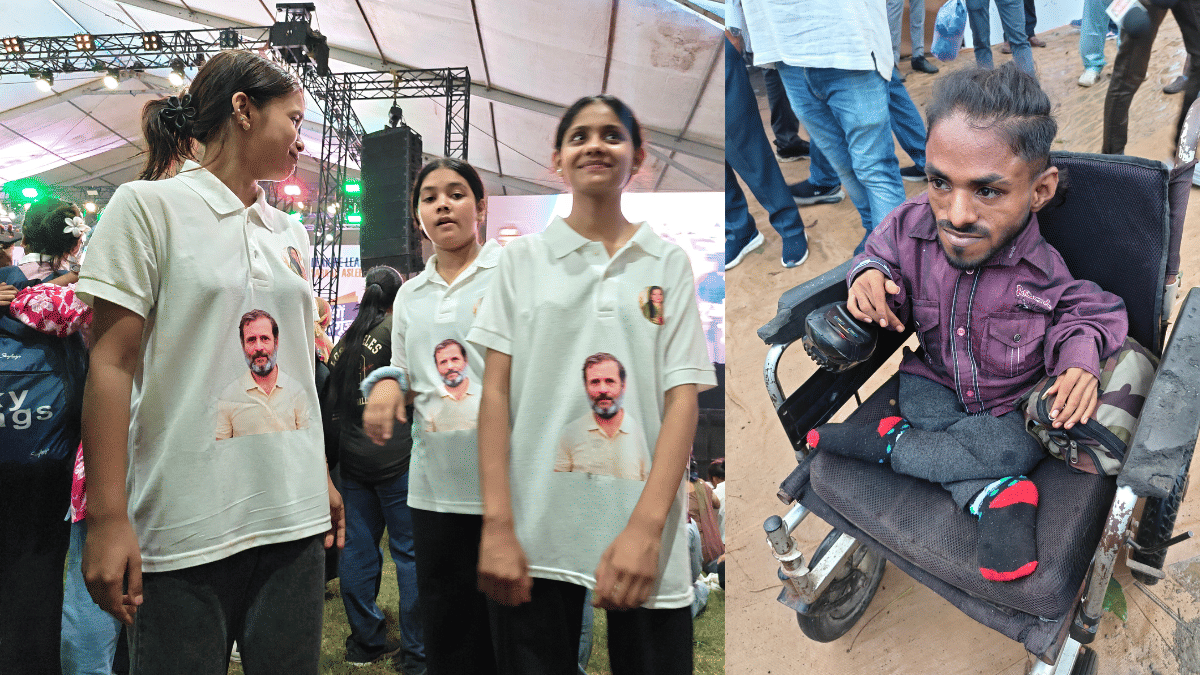
But beneath the concert-like setting, the party’s message was unmistakable. Towering LED screens flashed slogans such as “System Weak, Paper Leak”, “Shiksha Revolution” and “Chhatron Ki Goonj“, while volunteers in matching blue “Shiksha Revolution” T-shirts moved through the crowd. Schoolchildren in neatly pressed uniforms sat alongside college students, parents, elderly supporters and even a young attendee in a wheelchair near the front rows.
Unlike a conventional Congress rally, party flags were few. The branding revolved almost entirely around students, examinations and India’s education ‘crisis’.
Although billed as a platform for students, the audience was far from exclusively made up of young aspirants. Congress workers, Youth Congress and NSUI cadres formed a significant part of the gathering, with supporters travelling from different parts of Uttarakhand and neighbouring states.
Roads leading to the venue remained choked as local Congress leaders brought in their own supporters. Students were visible throughout, but they shared the space with party workers and local leaders, making the event both a student outreach programme and a display of organisational strength.
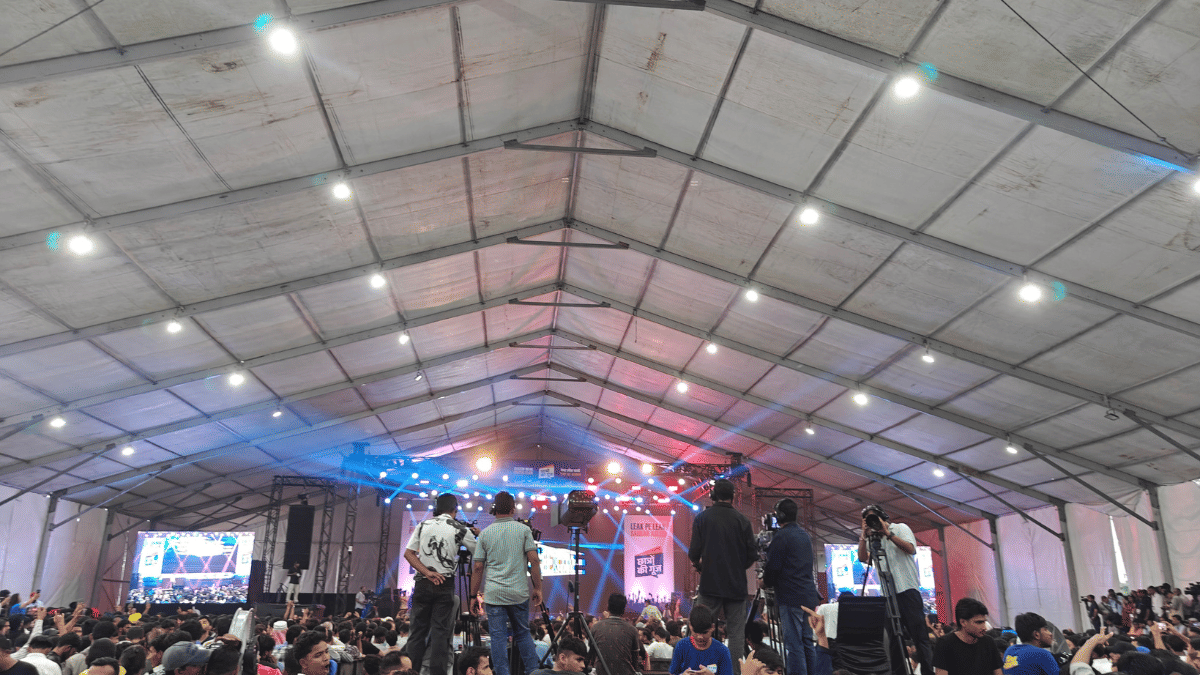
Before Gandhi took the stage, a local Dehradun rapper known for anti-government songs performed to warm up the crowd. When Gandhi finally arrived, supporters greeted him with raised phone flashlights, many cheering him like they would cheer a celebrity.
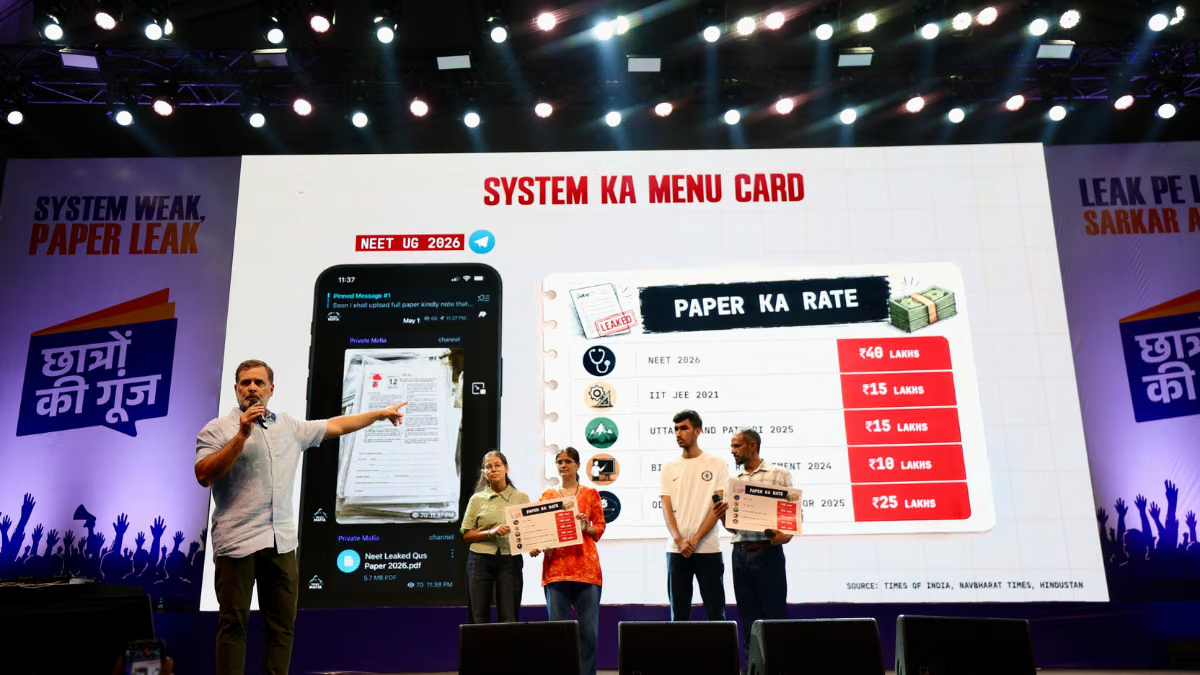
The mood shifted almost immediately once he began speaking. “This is not a political meeting. This is about the youth of this country,” Gandhi said, describing the examination system as the biggest issue confronting young Indians.
He alleged that there had been 152 paper leaks over the past decade, affecting 7.5 crore students, while “no one has been punished”. Every paper leak, he said, wipes out years of hard work. Students prepare for competitive examinations for nearly five years, often studying 10 hours a day, while families spend an average of Rs 9 lakh on coaching and education, he said.
“Every student and every family makes sacrifices, yet one percent with money and connections manipulate the system, while the remaining 99 percent bear the consequences,” he said.
He also called for a “21st-century examination system”, stating that educational institutions must function independently. Vice-Chancellors, he said, should not be appointed on the basis of political affiliation, and the National Testing Agency must be insulated from political interference so that students can regain confidence in the examination process.
The evening’s most emotional moment came when the Kargil war veteran father of Riya Thapa—the Dehradun school topper who died by suicide after she could not clear the NEET-UG and whose death by suicide has become central to the Congress campaign—walked onto the stage.
Holding back tears, he said that if the government could not remove Union Education Minister Dharmendra Pradhan, it should “at least express grief”. He urged the Centre to acknowledge the suffering of families whose children had devoted years to preparing for examinations, only to lose hope amid repeated allegations of paper leaks.
Gandhi embraced him before stepping aside, allowing him to speak.
Several students and a teacher then shared their own experiences of cancelled examinations, years of preparation lost and a growing distrust of the recruitment and examination system.
Within minutes, the concert-like atmosphere had given way to one marked by grief, frustration and quiet attention—a transition that perhaps best captured what the Congress sought to achieve through ‘Chhatron Ki Goonj‘, turning student anger over paper leaks into a broader political campaign.
The Congress has claimed there have been 152 paper leaks across India since 2014. According to the party, 38 involved central or national-level examinations, while Rajasthan, Gujarat and Maharashtra reported 11 each, Uttar Pradesh 10, Assam eight, Karnataka seven, Bihar, Haryana and Madhya Pradesh six each, and Jammu and Kashmir and West Bengal five each.
The party’s list includes alleged leaks in examinations such as NEET, JEE Main, UGC-NET, CUET, SSC, CTET, CBSE board examinations, Railways recruitment tests and several state recruitment and board examinations, which it cites as evidence that paper leaks have become a nationwide issue affecting students and job aspirants.
(Edited by Viny Mishra)
Also read: Congress hits pause on student outreach campaign as Rahul extends foreign visit, rallies postponed
 20
20 584226
 20
20
 20
20