In Maharashtra’s cities, the sex ratio at birth is now as skewed as Haryana’s | Mumbai News
4 min readMumbaiJun 5, 2026 07:00 AM IST
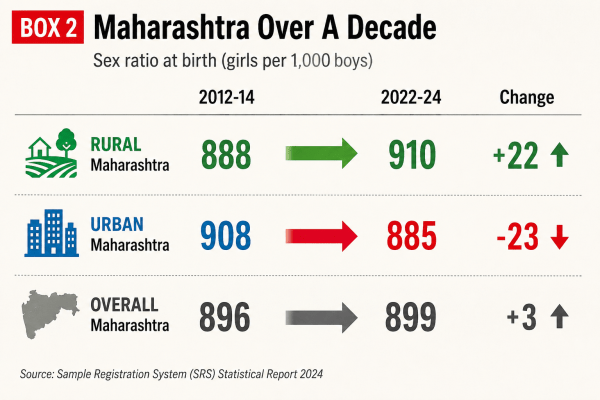
Maharashtra’s sex ratio at birth has remained virtually stagnant over the past decade, moving marginally from 896 girls per 1,000 boys in 2012-14 to 899 in 2022-24. The headline number, however, masks a striking divergence**:**
While rural Maharashtra registered a significant improvement from 888 to 910, the urban sex ratio fell sharply from 908 to 885. The decline in cities has effectively offset rural gains, leaving the state’s overall gender balance at birth below the national average.

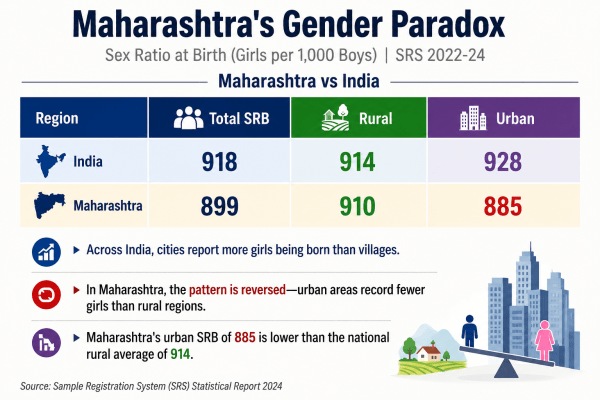
According to the Sample Registration System (SRS) Statistical Report 2024 released last week, Maharashtra recorded a sex ratio at birth of 899 girls for every 1,000 boys during the 2022-24 period, lower than the national average of 918. The state’s urban sex ratio at birth stood at 885 girls per 1,000 boys, compared to 910 in rural Maharashtra. Nationally, the trend is reversed, with urban India recording a higher sex ratio at birth than rural areas.
A comparison with data from a decade ago shows that the decline has been concentrated in cities. Between 2012-14 and 2022-24, Maharashtra’s overall sex ratio at birth remained largely unchanged, moving from 896 to 899. During the same period, the rural ratio improved from 888 to 910, while the urban ratio fell from 908 to 885.
When compared to other states, Maharashtra stands in stark contrast to the top performers and finds itself grouped with the historically poorest performers.
Maharashtra lags behind the states leading the country in gender parity at birth, namely Chhattisgarh (978) and Kerala (974). Other states maintaining healthy ratios include Himachal Pradesh (956), Andhra Pradesh (946), and Assam (946).
Maharashtra’s SRB of 899 places it just slightly above the absolute worst-performing regions in the country. It ranks narrowly ahead of only Bihar (896), Haryana (885), Delhi (876), and Uttarakhand (872).
Story continues below this ad
The most alarming divergence from the national average occurs in Maharashtra’s urban centres. Nationally, cities tend to be safer for gender parity at birth, with the all-India urban SRB standing at a healthy 928 (outperforming the national rural average of 914). Conversely, Maharashtra experiences an inverted trend where its urban SRB stands at 885, compared to its rural SRB of 910. To put this into perspective, Maharashtra’s cities have the same sex ratio at birth as Haryana’s overall state average (885).
The figures stand out because Maharashtra performs relatively well on several other demographic indicators. This stands in contrast to Maharashtra’s performance on several other demographic indicators. The state’s Total Fertility Rate (TFR) stands at 1.4 children per woman, well below the national average of 1.9 and among the lowest in India. Only Delhi (1.2) and Kerala, Tamil Nadu and West Bengal (1.3 each) report lower fertility rates. Maharashtra’s TFR is comparable to Andhra Pradesh, Jammu and Kashmir and Punjab, and significantly lower than states such as Bihar (2.9) and Uttar Pradesh (2.6).
The state also records high levels of institutional deliveries, though it relies far more on private healthcare than most of the country. Nationally, nearly 72 per cent of deliveries take place in government hospitals and 23.7 per cent in private facilities. In Maharashtra, government hospitals account for 57.7 per cent of deliveries, while private hospitals account for 40.9 per cent — the second-highest share among larger states after Kerala.
Maharashtra also fares relatively well on indicators related to women’s welfare. The mean age at marriage for women is 23.4 years, slightly above the national average of 23.1 years. Child marriage remains relatively uncommon, with only one per cent of marriages taking place before the age of 18, compared to the national average of 2.1 per cent.
Story continues below this ad
The data also points to a state that is ageing faster than much of the country. People aged 60 years and above account for 10.4 per cent of Maharashtra’s population, compared to the national average of 9.7 per cent. While this remains lower than Kerala (15.1 per cent) and Tamil Nadu (14.2 per cent), it is considerably higher than younger states such as Bihar (7.8 per cent). Reflecting this shift, senior citizens account for 67.2 per cent of all deaths in Maharashtra, compared to 60.8 per cent nationally, underscoring the growing importance of elderly and geriatric care in the state.

Stay updated with the latest – Click here to follow us on Instagram
 20
20 584226
 20
20
 20
20