RSS legal arm seeks law on ex judges testifying abroad
New Delhi: The Akhil Bharatiya Adhivakta Parishad (ABAP), affiliated with the Rashtriya Swayamsevak Sangh, has passed a resolution demanding a law to prohibit former constitutional court judges from testifying before foreign courts in proceedings adverse to India’s sovereign positions or public institutions.
The outfit referred to the examples of four retired judges, including former Supreme Court justices Deepak Verma and Markandey Katju, who have appeared in extradition cases involving fugitives Vijay Mallya and Nirav Modi, among others.
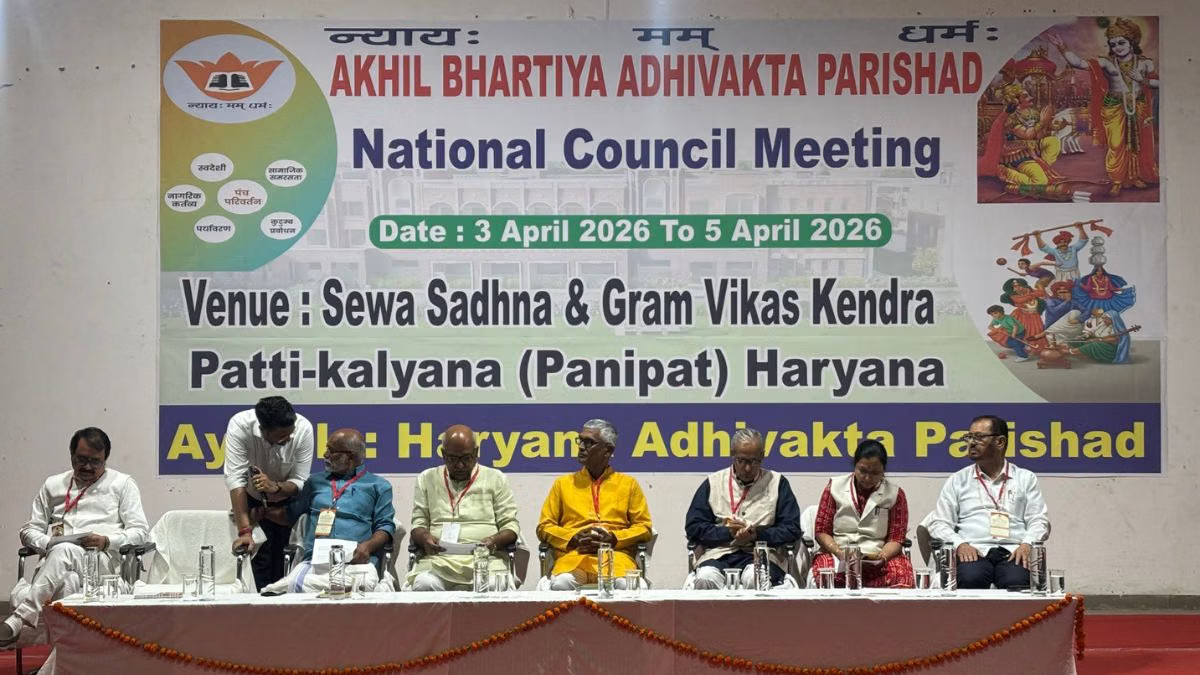
The resolution, passed by the ABAP National Council Sunday at Samalakha in Haryana, calls for a Judicial Officers (Post-Retirement Conduct and Accountability) Act. It asserts that the documented record in this regard is “damning”.
ABAP cited the example of Justice Deepak Verma, who has appeared in three foreign proceedings. The most recent was last month, when he appeared as an expert witness in Nirav Modi’s extradition proceedings before a UK court, telling it that the embattled diamantaire would be prone to the risk of “custodial torture” in India and that prolonged custodial interrogation was “inevitable”.
The UK High Court (King’s Bench Division) nonetheless found India’s assurances “reliable” and “cognisable”, and rejected Nirav Modi’s extradition appeal. Modi is wanted in a Rs 13,000-crore Punjab National Bank (PNB) fraud case.
Justice Verma had also appeared in proceedings involving fugitive and billionaire Vijay Mallya in 2020, and arms consultant Sanjay Bhandari in 2022.
Former Supreme Court judge Justice Markandey Katju and retired Bombay High Court judge Justice Abhay M. Thipsay appeared as expert witnesses in Nirav Modi’s extradition case before the Westminster Magistrates Court in 2020–21.
Justice Katju had told the British court that the “Indian judiciary has largely surrendered before the political executive”, while Justice Thipsay submitted the evidence against Modi would not qualify as cheating or criminal breach of trust under Indian law.
Retired Rajasthan High Court judge Justice Pana Chand Jain—who died this year—had appeared as an expert witness for Vijay Mallya in 2019.
The ABAP resolution said all four retired judges “forfeited their moral entitlement to every benefit and designation flowing from the constitutional offices they once held”. But, it added, that “this cannot be attributed to retired judges as a class”, noting that many former judges had displayed restraint by declining such engagements.
Asked about ABAP’s demand, Justice Thipsay Tuesday said the outfit has the right to make such suggestions to Parliament but he does not think a legislation like this would be constitutionally valid.
“If such a Bill is actually presented in Parliament, then only is there some point in commenting on it,” he told ThePrint.
“Some opinions given before foreign courts in such matters criticise the Indian judicial system or prison system. As far as my opinion is reflected in the resolution, it was purely on legal points without making any comments on the fairness of the Indian judiciary or Indian prison system,” he said.
Justice Verma refused to comment on the resolution. ThePrint has reached out to Justice Katju via email with a request for comment. The report will be updated if and when he responds.
Also Read: Lineage runs deep in India’s Supreme Court. 60% judges are from lawyer or judge families
What ABAP proposes
According to the resolution, the proposed law would require former judges accepting remunerated expert, advisory or consultancy roles in cross-border litigation to make full and timely disclosure to an institutional body, with details uploaded on a publicly accessible website. It would impose a complete ban on former constitutional court judges testifying before foreign courts in matters adverse to India’s sovereign positions or public institutions.
Violations would trigger automatic forfeiture of all retirement benefits—including pension, accommodation, security, ancillary honorary facilities, and the right to participate in arbitration as either arbitrator or counsel—as well as statutory withdrawal of the right to use the title “Justice”.
A parliamentary oversight committee with full powers of inquiry and adjudication is also envisaged.
The ABAP has demanded that the central government appoint a committee to prepare a complete draft Bill and submit it within 60 days to the Minister of Law and Justice and the leaders of both Houses of Parliament.
The resolution closes with this declaration: “The advocates of Bharat will not be silent while the Republic’s own former judges, pensioned by the Indian taxpayer and titled by the Constitution, rent their robes to those who have plundered their hard-earned money and acted against the interests of the sovereign people of Bharat. Even as we record this, we consciously maintain our maryada—both in the language we employ and in the restraint of our future actions–solely to preserve the institution’s dignity; we only hope that better sense will prevail.”
ABAP was formed in 1992, and claims lakhs-strong membership. The parishad was inaugurated by Rashtriya Swayamsevak Sangh (RSS) ideologue Dattopant Thengadi, the architect of several affiliated organisations such as the Bharatiya Mazdoor Sangh and the Bharatiya Kisan Sangh. Some ABAP members, such as Justice Adarsh Goel, have also made it to the bench, while others like Bhupender Yadav, made it to politics.
Also Read: Legal pedigree not just entrenched in SC. 1 in 3 HC judges related to judges, ex-judges or lawyers