Kamal Haasan’s MNM skips TN polls, backs DMK
Chennai: With Kamal Haasan’s Makkal Needhi Maiam (MNM) announcing on 24 March that it will skip the upcoming Tamil Nadu Assembly elections and extend unconditional support to the DMK-led alliance, the party’s political trajectory has come full circle—from electoral ambition to strategic withdrawal.
The move, triggered by stalled seat-sharing talks with the DMK, also comes in the backdrop of Haasan’s unopposed election to the Rajya Sabha in June 2025 with DMK backing, underscoring both a shift in priorities and MNM’s diminishing organisational strength after years of inconsistent electoral participation.
Haasan launched MNM in February 2018 with promises to serve as an anti-corruption, welfare-based, and ideologically neutral platform. In 2019, the party contested all 39 Lok Sabha seats independently and secured 3.72 per cent of the votes but failed to win a single seat. In the 2021 Assembly polls, MNM allied with smaller parties, contested 142 seats, and managed only 2.62 per cent vote share; Haasan himself lost the Coimbatore South seat by a narrow margin.
Though he had sharply criticised both DMK and AIADMK as “looters” earlier, while claiming he was not against Dravidian ideology, Haasan joined the DMK-led alliance for the 2024 Lok Sabha polls and campaigned for its candidates. The Rajya Sabha seat was part of that pre-poll understanding.
Sworn in as Rajya Sabha MP on 25 July 2025, Haasan secured MNM’s first national voice. But since 2021, the party has been on the decline, with growing internal dissent and post-poll analyses citing cadre mismanagement. The political activity of MNM has been restricted to public statements and reactions over socio-political issues on X, and there has been barely any organisational political activity.
“The cadres were not very active with respect to participating in any political activity on the ground because the party was not contesting the elections in the last few years. After our leader was sworn in as Rajya Sabha MP, the focus gradually shifted to the 2026 Assembly elections, with meetings of the executive committee focused on determining poll strategy, roles of party members and positioning of the party regarding seat sharing. One cannot say that the leadership has weakened, we are just supportive allies,” said an MNM functionary.
Political analyst Sumanth Raman told ThePrint, “MNM had a good vote share in 2019 but it kept deteriorating in each election. They did not contest in multiple elections, which led to the loss of relevance. The vote share was significant earlier but has been lost over time,” he said.
The limited electoral success and shifts toward alliances and support for the DMK in 2024 led to many resignations from the party. Many MNM workers moved to BJP or DMK due to internal rifts, including some executive committee members. A party functionary said, “The members of the party had their own political ambitions when MNM was formed and they moved to other parties when they did not see their ambitions fulfilling. We do not blame them because it is an individual choice.”
“We agree that there is a lack of momentum in the party. The cadres realise that there has to be organisational strength besides the electoral plans. Many of the senior leaders who associated initially with the party switched to others on similar grounds,” said an MNM functionary.
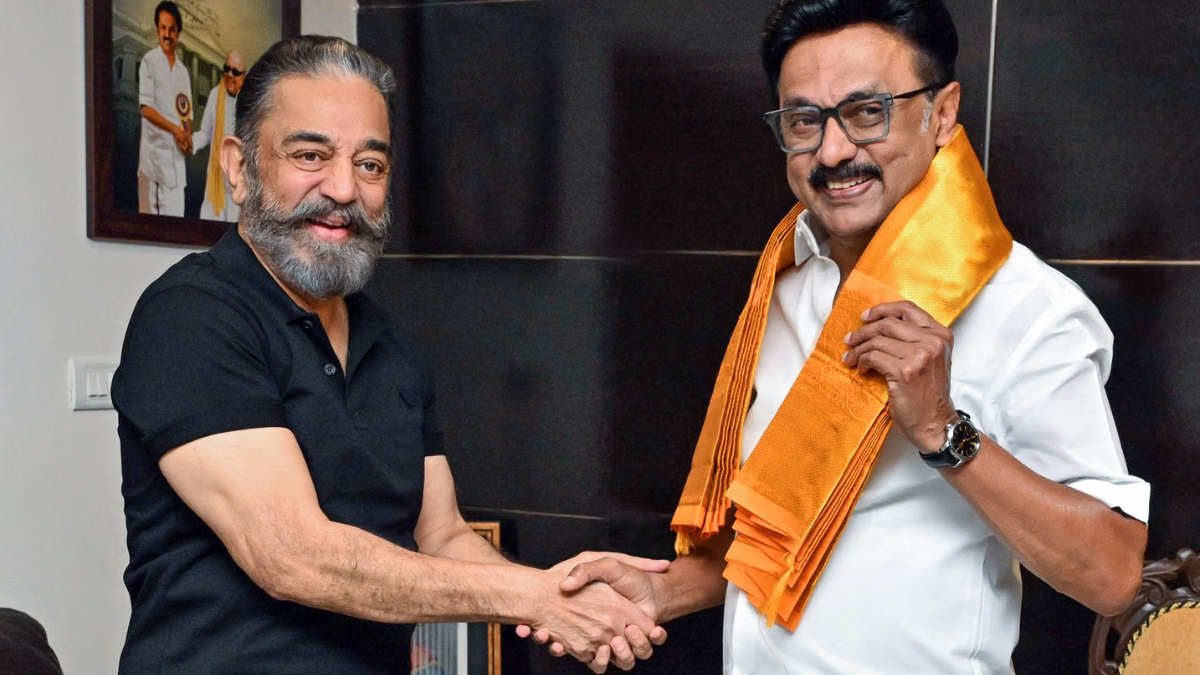
After meetings with CM M. K. Stalin ahead of the 2026 Assembly elections, Haasan rejected DMK’s offer of 2 seats under the ‘Rising Sun’ symbol, demanding at least 12 to honour cadre sentiments. While DMK did have an upper hand in negotiations because of the MNM’s limited relevance, the party also lacked clarity.
“Even the decision on who would be candidates was left to the executive committee. There was no clear decision, and later it was conveyed that only two seats were allotted under ‘Rising Sun’. Majority of us were against the idea of contesting under a different symbol because it conflicts with the ideological bond we have with our symbol,” an executive committee member told ThePrint.
Later, Kamal Haasan decided to opt out of the elections, the same way he had in the past few elections. However, contesting without the symbol was a point of conflict, and the party said it would continue to support the DMK.
“In the current challenging political climate, the number of seats offered to us and the suggestion to contest under the ‘Rising Sun’ symbol is not acceptable to me or to the members of Makkal Needhi Maiam,” Haasan stated.
Reacting to the decision, Viduthalai Chiruthaigal Katchi founder Thirumavalavan urged DMK leader M. K. Stalin to encourage MNM to participate in the polls under its own symbol as it would allow the party to uphold its ideology, while at the same time benefit from MNM’s vote share.
Many MNM members appreciated Thirumavalavan’s suggestion. “By highlighting the power of ideological strength that transcends the vote bank, your raising of your voice gives immense strength to people like us,” said MNM’s Gopinath Thuraiyur on X.
Kamal opting out also drew criticism. AIADMK leader Sathyan said in a press statement: “The decision by Kamal Haasan not to contest in the assembly election is not a sacrifice; it is his incompetence. This is the problem with actors who are on the silver screen. They believe that in public life, whatever you talk about in front of the camera is what you need to deliver in public life. In public life, you have to have the political acumen, leadership attributes, and qualities to do good for the people.”
Political analysts note that Kamal Haasan’s urban, educated support base never translated into broad electoral strength because, unlike MGR, he lacked deep roots in the Dravidian movement and failed to expand the party’s reach or contest all seats strategically. By moving to the national stage in Parliament, Haasan’s presence in state politics is further limited.
“In 2019, MNM got the votes of elite population and it was limited to areas like Coimbatore. The votes that came to him were also of the people who were upper caste or middle class people who had some form of anti-Dravidian sentiment. After 2021, they did not contest any elections and we can see there is no policy or organisation or agitation that MNM is actively participating in. There is also no engagement of cadre on the grassroot level,” says political analyst Arun Kumar.
But despite the limited activity, the party aims to revive its presence and expand further, rising beyond being DMK’s echo in the state. “We understand that we all need to take individual responsibility. Our leader has also asked each one of us to take up the responsibility to work for the party. We are very clear in our ideologies and we have not remained silent on major public issues. We are evaluating what can be done to ensure the party gains momentum,” Sneha Mohandoss, state secretary of MNM’s women’s wing told ThePrint.
(Edited by Viny Mishra)
Also read: Kamal Haasan warns of the dangers of ‘hatriotism’. ‘It diminishes the nation’