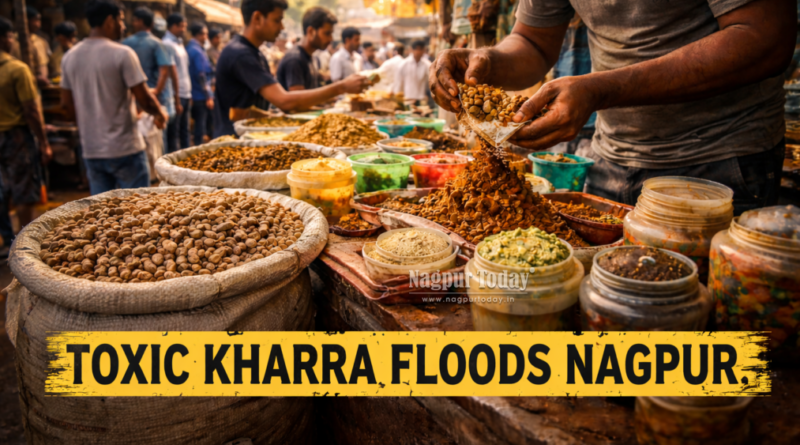
FDA raids expose just the tip of Nagpur’s kharra trade
Advertisement


Nagpur: The seizure of 570 tonnes of substandard supari worth Rs 14 crore by the Food and Drug Administration Nagpur between April 1, 2025 and February 28, 2026 was projected as a major enforcement success. But less than two weeks after the raids were reported, a deeper ground investigation suggests the crackdown may have uncovered only a small fragment of a far larger and deeply entrenched supply chain feeding Nagpur’s thriving kharra trade.
The seizures raise a disturbing question: How much unsafe supari has already entered the city’s consumption network, and where has it gone?
Gold Rate
Apr 09,2026 – Time 10.30Hrs
Gold 24 KT
₹ 1,52,100 /-
Gold 22 KT
₹ 1,41,500 /-
Silver/Kg
₹ 2,45,100/-
Platinum
₹ 90,000/-
Recommended rate for Nagpur sarafa Making charges minimum 13% and above
Seizures big, supply intact
Despite the large-scale action by the regulator, kharra remains readily available across Nagpur, sold openly in several neighbourhoods with little fear of enforcement.
A ground visit to multiple localities revealed vendors selling loose and pre-mixed kharra without any apparent regulatory oversight. In many cases, the mixture is prepared on the spot, with tobacco, lime and crushed supari blended in front of customers.
Officials themselves acknowledge that seizing consignments rarely disrupts the actual retail supply chain. “We intercept consignments, but once the material enters local markets, tracing its movement becomes extremely difficult,” a senior FDA officer admitted.
The missing link in the crackdown
The investigation highlights a critical blind spot in enforcement: the connection between the bulk supari trade and Nagpur’s informal kharra mixing units.
According to traders and insiders in the business, a significant share of the seized or diverted stock eventually finds its way into small, unregistered mixing units operating quietly across the city.
These units operate outside any formal monitoring system. Without quality checks, testing or standardisation, substandard or contaminated supari can easily enter the food chain.
If even a portion of the seized stock had already been processed and sold before the raids, thousands of consumers may have unknowingly consumed unsafe products, raising alarming public health concerns.
Inside Nagpur’s kharra economy
The word kharra itself comes from the grinding sound produced during its preparation. In Nagpur, it has evolved into a local tobacco culture with dozens of variations.
A resident from Sitabuldi said vendors often offer 10 to 15 different varieties, depending on ingredients and strength. Among the most commonly sold variants are:
• Saoji tobacco kharra, known for its intense flavour
• Gavran kharra, made using locally sourced tobacco
• Branded tobacco kharra, prepared with commercial tobacco such as Gaichaap or Eagle
• Black kharra, containing higher tobacco content
• White kharra, with greater lime concentration
Prices remain extremely affordable, ranging from Rs 20 to Rs 30 for 20 grams and going up to Rs 100 or more for 100 grams, making it accessible to almost every section of society.
Hidden health dangers
Public health experts warn that substandard supari may contain fungal toxins, pesticide residues or chemical contaminants. When mixed with tobacco and lime, the compound can significantly increase the risk of oral cancer, gum disease and other serious health complications.
Doctors say repeated exposure to such mixtures can accelerate addiction and worsen long-term health outcomes, particularly among younger users.
Ban that exists mostly on paper
Maharashtra has officially banned gutkha and flavoured tobacco products, but kharra has effectively escaped the regulatory net. Because it is locally prepared, largely unbranded and sold through informal networks, enforcement agencies struggle to apply the same regulatory framework used for packaged tobacco products.
The result is a decentralised, loosely controlled market where production and sales continue largely unchecked.
Profits over safety
Economics plays a major role in sustaining the trade.
Kharra is cheap to manufacture and highly profitable, especially when lower-grade raw materials are used. Traders admit that in a competitive and unregulated market, cost often takes priority over safety standards.
For small vendors and informal mixing units, the business offers quick returns with minimal investment.
Youth increasingly drawn in
Perhaps the most worrying trend is growing consumption among young people.
With easy availability and no warning labels, kharra is widely perceived as a harmless local habit. Vendors are often found selling the mixture near schools, colleges and labour hubs, making it accessible to students and daily wage earners.
Health workers report rising cases of early tobacco dependence among teenagers, suggesting that the habit is spreading quietly but rapidly.
The situation raises a larger question: What is being done to prevent easy access to addictive tobacco mixtures for Nagpur’s young population?
Enforcement gaps remain
While authorities have seized large consignments of substandard supari, monitoring at the last-mile level remains weak.
Local mixing units and street vendors operate largely outside systematic inspection. Once raw supari enters city markets, there is no effective mechanism to track its distribution or consumption.
For Nagpur, the issue is no longer merely about tobacco enforcement. It has evolved into a hidden public health crisis unfolding in plain sight.
The recent seizures may have revealed part of the problem. But the deeper network—linking bulk traders, informal processors and thousands of retail sellers—suggests the investigation is far from over.
Advertisement

Advertisement