‘It will take less than five minutes to reach NMIA from Atal Setu’: CIDCO chief | Mumbai News
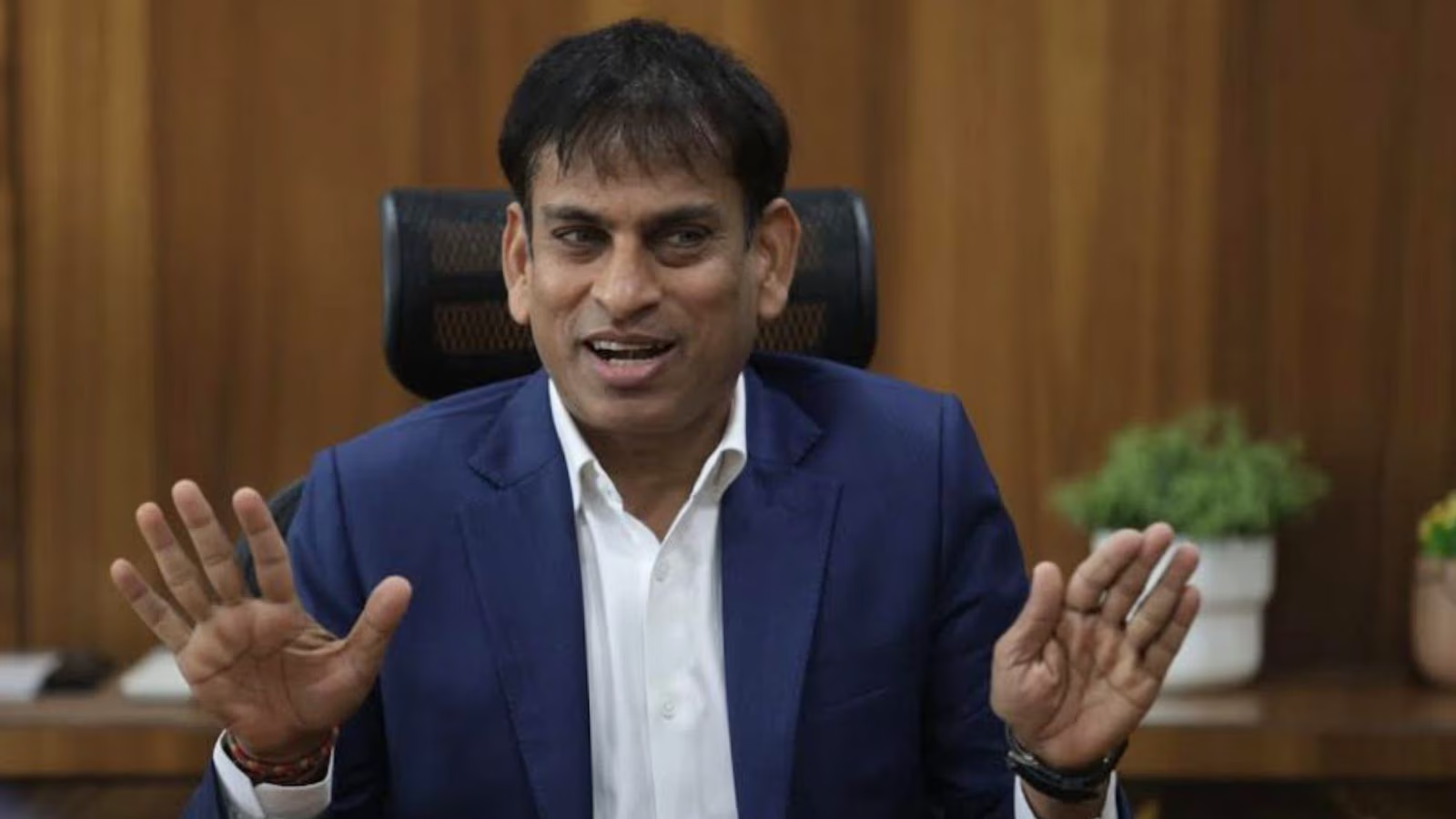
The City and Industrial Development Corporation is spearheading one of the largest urban expansion exercises in the Mumbai Metropolitan Region. From the proposed Metro Line 8 linking Mumbai’s two airports and the Thane NMIA Elevated Corridor to the development of NAINA, CIDCO is at the centre of Navi Mumbai’s transformation. In an interview with The Indian Express, CIDCO Vice Chairman and Managing Director Vijay Singhal discusses project timelines, connectivity plans, affordable housing and preparations for meeting the region’s future infrastructure needs.
A. The 32 km Metro Line 8, which will connect the two airports and includes 9.5 km of underground alignment, has already received approval from the Maharashtra government. A peer review of the Detailed Project Report (DPR) is currently underway and may recommend a few minor alignment changes due to on ground complexities.

The final review is expected within the next two weeks. Thereafter, CIDCO will submit a proposal to the state government for viability gap funding (VGF), which will support execution of the project on a Public Private Partnership (PPP) basis.
Following approval, tenders are expected to be floated within approximately two months.
Q. CIDCO is also planning the 24 km Thane NMIA Elevated Corridor. What is the status of that project?
A. The Rs 6,300 crore Thane NMIA Elevated Corridor has already received approval from the Maharashtra Cabinet. The proposal has now moved to the next stage of approvals and is expected to be cleared by an empowered committee in the coming days, after which it will be placed before the competent authority for final approval.
We expect all approvals to be in place within the next two weeks. Since the Request for Proposal (RFP) document and concession agreement are already ready, the tendering process can begin immediately thereafter.
As the project is being implemented on a PPP basis, the corridor will be toll operated.
Story continues below this ad
Q. International flights are expected to begin from NMIA soon, but much of the surrounding road infrastructure is still under construction. What is currently ready and what can commuters expect in the future?
A. To improve connectivity between South Mumbai and NMIA, CIDCO is constructing the Ulwe Coastal Road from the Atal Setu. At present, vehicles have to travel via Chirle Junction and Amra Marg to reach the airport. The new road will provide a direct connection.
About 80 per cent of the work has been completed. While the project was originally expected to be ready by August or September, there could be a delay of a few months due to disruptions caused by the West Asia conflict. We now expect it to be completed by November. Once operational, travel time from Atal Setu to the airport will be less than five minutes.
At the northern edge of the airport, a six kilometre road from Kalamboli is already operational. The road connecting the eastern side of the airport from Panvel is also ready.
Another road is being built from the Panvel Express Highway to the airport. It includes three bridges, of which two are complete. The third is expected to be completed within the next few months. Travellers from Pune will use the cloverleaf interchange being constructed by MSRDC, which is also nearing completion, before accessing the airport through these bridges.
Story continues below this ad
Q. At what stage is the development of the Navi Mumbai Airport Influence Notified Area (NAINA)?
A. Although NAINA was established in 2013, development activity on the ground has accelerated only recently. Spread across approximately 22,500 hectares, the area has been divided into 12 Town Planning Schemes (TPS).
The first phase involves road works worth around Rs 8,000 crore covering nearly 200 km. All utilities, including electricity, water supply, sewage and optical fibre cables, are being placed underground using a plug and play system to eliminate future road digging.
The roads will feature cycle tracks, wide footpaths, riverfront development and a walk to work planning concept.
Once road infrastructure is completed, we will focus on developing open spaces and growth centres that will attract residential, commercial, hospitality, healthcare and educational projects.
Story continues below this ad
Q. CIDCO is developing several specialised growth centres, including Educity, Medicity, an Integrated Logistics Park and an Entertainment Arena. What is the progress on these projects?
A. In Educity, six universities have already received Letters of Intent from the University Grants Commission. This accounts for nearly half of all foreign universities approved by the Government of India, all of which are coming up in Navi Mumbai.
There is space for four more universities, and discussions are underway with institutions ranked among the top 50 to 75 universities in the United States. A master plan is being prepared and construction could begin this year.
Medicity, spread across 100 hectares, will include a tertiary care hospital, nursing and medical colleges, a biotechnology hub, an innovation centre, wellness facilities, medical tourism infrastructure and medical equipment manufacturing units. Discussions are underway with a global healthcare institution that is expected to anchor the project.
Bids have already been received for a 172 acre land parcel at the Integrated Logistics Park. The project has attracted strong interest from both domestic and international players due to its proximity to JNPA and NMIA.
Story continues below this ad
For the Entertainment Arena in Aerocity, an Expression of Interest received an encouraging response. The facility is envisioned on the lines of London’s O2 Arena or New York’s Madison Square Garden. Spread across more than 10 acres, it will have seating for 20,000 people and a standing capacity of 25,000. The RFP is nearly ready and will be issued shortly.
Q. What is the status of Aerocity, which is expected to support the airport ecosystem?
A. The DPR for Aerocity is ready. The development will include hotels, commercial spaces, residential projects and training centres.
The first phase will focus on a pocket closest to Amra Marg. The design has been prepared by consultants Nippon Koei and includes extensive open spaces, public plazas and landmark buildings.
 20
20 584226
 20
20
 20
20