
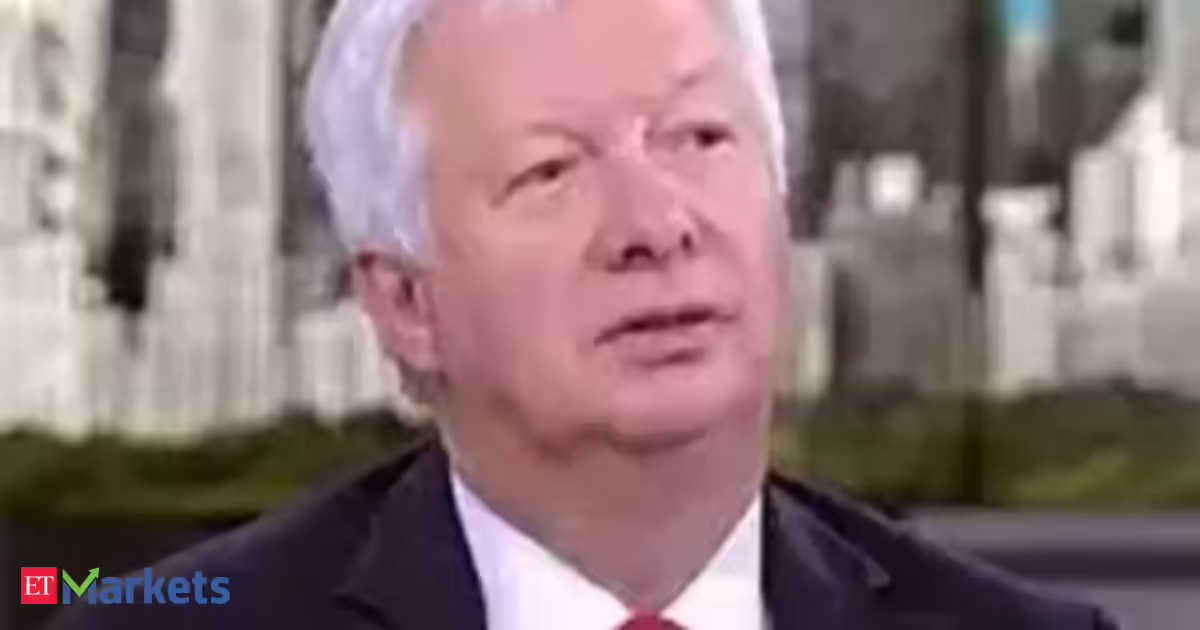
Markets in limbo as US–Iran uncertainty clouds global outlook: Geoff Dennis
Dennis noted the lack of clarity in the evolving situation and said, “Well, it is fair to say my head is spinning on all the different views that you hear from Trump and from Iran and everybody else. I am sure yours are as well and the markets certainly are. We get these continuous conflicting headlines. One day it looks good, the next day it does not look so good. And frankly, nobody knows and I do not know.”
He added that unless there is tangible progress on a ceasefire and reopening of key trade routes, markets are likely to remain stuck in uncertainty.
“And until there is really any real sign of a proper ceasefire which leads to some progress towards opening the Strait of Hormuz, we are going to continue to be in this sort of limbo with respect to the Iran war and how it all plays itself out. It is just incredibly uncertain,” he said.
Oil markets stabilise below extreme forecasts despite conflict risk

Despite ongoing geopolitical tensions, crude oil prices have not surged to the extreme levels many analysts had feared in a prolonged disruption scenario. Brent crude has moderated compared to earlier expectations of a sustained spike.Dennis pointed out the disconnect between earlier forecasts and current pricing:
“The knock-on effect is interesting to me because as you mentioned earlier, the price of oil is now Brent is now at 93 basically. It spent a long time between 100 and 120. It has broken out of the trading range to the lower end,” he said.
He further highlighted how supply and demand dynamics are cushioning the market:
“This is despite lots of forecasts from around the world of people saying if the Strait of Hormuz stays closed for a long period of time, it is going to go $150, $180, $200 a barrel. And so although this war is sort of in limbo and we have not got any sort of significant move towards a true conclusion, the oil price is now helping to support global markets because it is a lot lower than people thought it would be at this stage and it has broken out of the lower end of its trading range,” he said.
Near-term caution advised amid stretched valuations
Looking ahead, Dennis warned that investors may need to remain cautious over the next few months, citing stretched valuations across several markets and uncertainty around inflation and interest rates.
“I am wary about this over the next two to three months. I mean, I am not negative but I am wary about it because I think that it is entirely possible that a couple of things could happen,” he said.
He also flagged risks around oil supply dynamics and inflation pressures:
“Now on the actual side of the markets themselves leaving the Iran war out of it right now, we are sitting in a situation where markets are very-very expensive not so much in em of course compared to say the US, we have got Korea in a clear bubble of sorts, we got Taiwan in something of a bubble as well, and we have now a significant risk that US interest rates have bottomed out for the year and may well have to go up because inflation is higher.”
Emerging markets outperform, but India lags behind
While emerging markets have delivered strong returns in dollar terms, India has notably underperformed compared to peers such as South Korea and Taiwan, which have attracted significant technology-driven flows.
Dennis admitted that expectations around India did not play out as anticipated:
“One thing I got wrong is I assumed that once China deteriorated this year, India would get some of that money and that has not been the case, so that is one thing.”
He attributed India’s underperformance largely to weak foreign inflows: “The issue with India as far as I am concerned is there is just no foreign interest in the market right now. FII flows have been negative. They are poor.”
He also flagged macroeconomic constraints linked to oil prices and inflation: “India basically imports all of its oil, it is going to put some upward pressure on inflation and possibly potentially if the economy is a little weaker could lead to a wider budget deficit and it is not clear what the scope will be in this sort of environment for the RBI to reduce interest rates.”
Outlook: Potential rebound possible, but timing remains uncertain
Despite near-term challenges, Dennis remains constructive on India over a longer horizon, though he cautions that the timing of any recovery in flows is highly uncertain.
“I would much rather be in India than China or even Korea and Taiwan on a 12-month basis.” He added that a weaker dollar and stabilising oil prices could eventually support a turnaround in sentiment:
“A weaker dollar would help here because the rupee has been weaker. It has rallied the last two or three days or so.” However, he stressed that global factors will ultimately dictate timing:
“But when that turning point will be does not depend on me, it will depend on when foreign investors decide that this is a good time to go in because the impact of the higher oil prices has begun to be fully discounted by Indian investors.”
A market driven by geopolitics, not fundamentals
The broader message from the discussion is that global markets remain heavily influenced by geopolitical developments, particularly the US–Iran conflict, with oil prices acting as the key transmission mechanism into risk assets.
“My head is spinning. We get different headlines every day. I pretty much ignore them. Nothing is happening to fundamentally resolve this war apparently and so the risk of war beginning again is still there and that would push oil prices up and that is handicapping India in the short term,” he concluded.
 20
20 584226
 20
20
 20
20