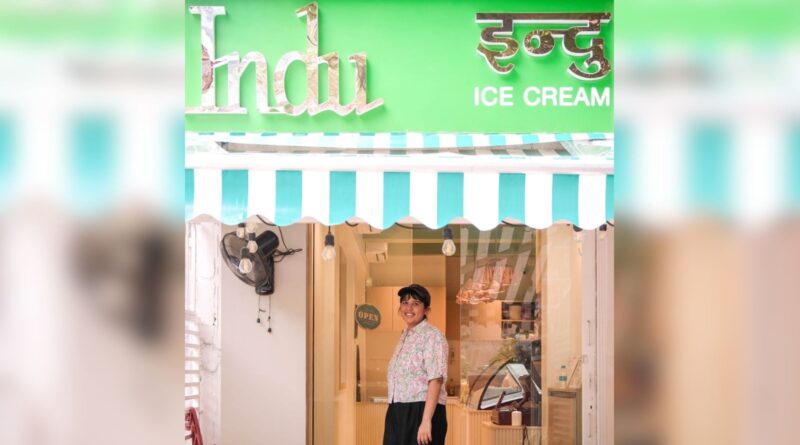
Around Town: Finally, Indu Ice Cream has a scoop-shop! Here’s what to expect | Mumbai News
It’s 10.30 pm and there’s a long queue at Indu Ice Cream. People of all ages, standing in line for a scoop of something familiar or something they’ve never tried. Hours earlier, Saloni Kukreja had told us she’d be at the shop until it closes at 12.30. We didn’t fully understand the need then. Now we do. She and five others barely have a second to look up — scooping, offering tasters, patiently explaining to a pre-teen why toppings are pre-decided per flavour and can’t be switched, before turning to pipe salted caramel onto a filter coffee ice cream for the next person in line.
A few weeks ago, when 30-year-old Kukreja announced on Instagram that Indu would finally have a physical outlet, the response was largely: Finally.

She always knew she wanted to work in food. Home science was the only subject she excelled at in school, but a degree in it was a no from her parents. She did a BMS at HR College instead, and started doing content creation on Instagram and writing a food blog ‘Food of Mumbai’ on the side. This was 2014. She was 17. By second year of college, brand collaborations were bringing in money. By graduation, a string of internships had made one thing clear: corporate life wasn’t it. She pursued content full time and enrolled at Northwest Culinary Academy in Vancouver in 2019.
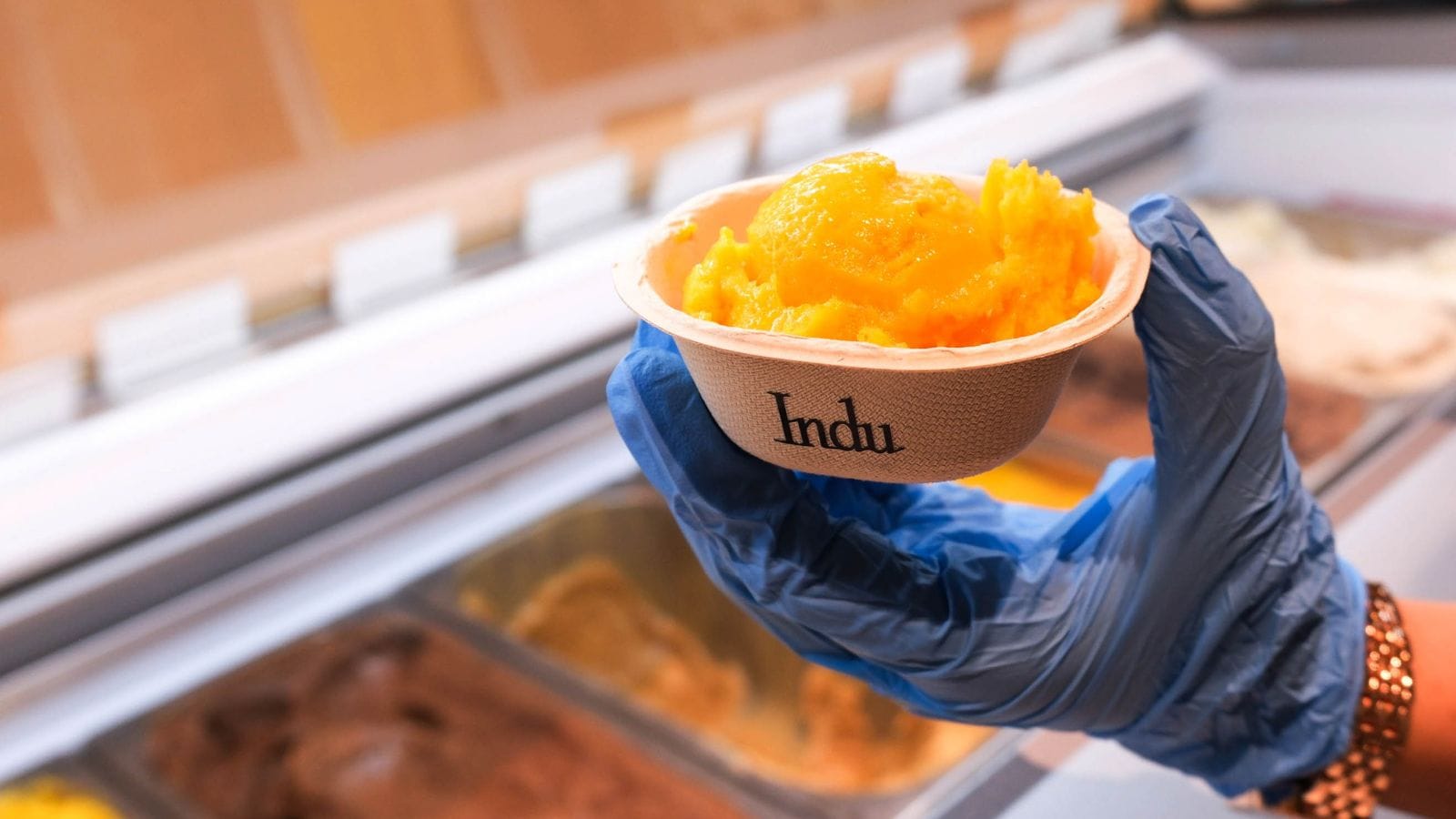 Amras is seasonal but, in Saloni Kukreja’s words, crosses all boundaries when it’s available. Express Photo by Nidhi Jacob.
There she worked on a farm, in cafes, in hot kitchens, and crossed hot kitchens off the list. Pastry held her — the pre-planning, the intricacy, the way everything is accounted for before you begin. Ice cream specifically felt like a blank canvas.
The last bakery she worked at had started as a mill, sourcing grain directly from Canadian farmers, milling on-site, no commercial wheat, no instant yeast. It planted something. She came back to Bombay wanting to do the same with Indian ingredients — indigenous grains, local fruits, flavour profiles that patisserie here hadn’t touched. She assessed the market and concluded it wasn’t ready. Ice cream was.
In the summer of 2023, she ran a four-month pilot out of her Khar home — six flavours, a retailer license, small-batch production at a friend’s facility, packaged and sold from her own freezer. Filter coffee; dark chocolate with jaggery and sesame; pistachio baklava; vanilla with chocolate fudge and kaju chikki; kala khatta sorbet and kachchi kairi sorbet. Thus, Indu Ice Cream, a brand rooted in Indian flavours, was born.
The premise was clear: no standard white or brown ice cream base with added flavouring. Instead, every flavour would have its own unique base recipe. The vanilla used real vanilla, the pistachio-baklava featured house-made nut butters, and there would be no artificial flavouring, thickeners or preservatives.
Story continues below this ad
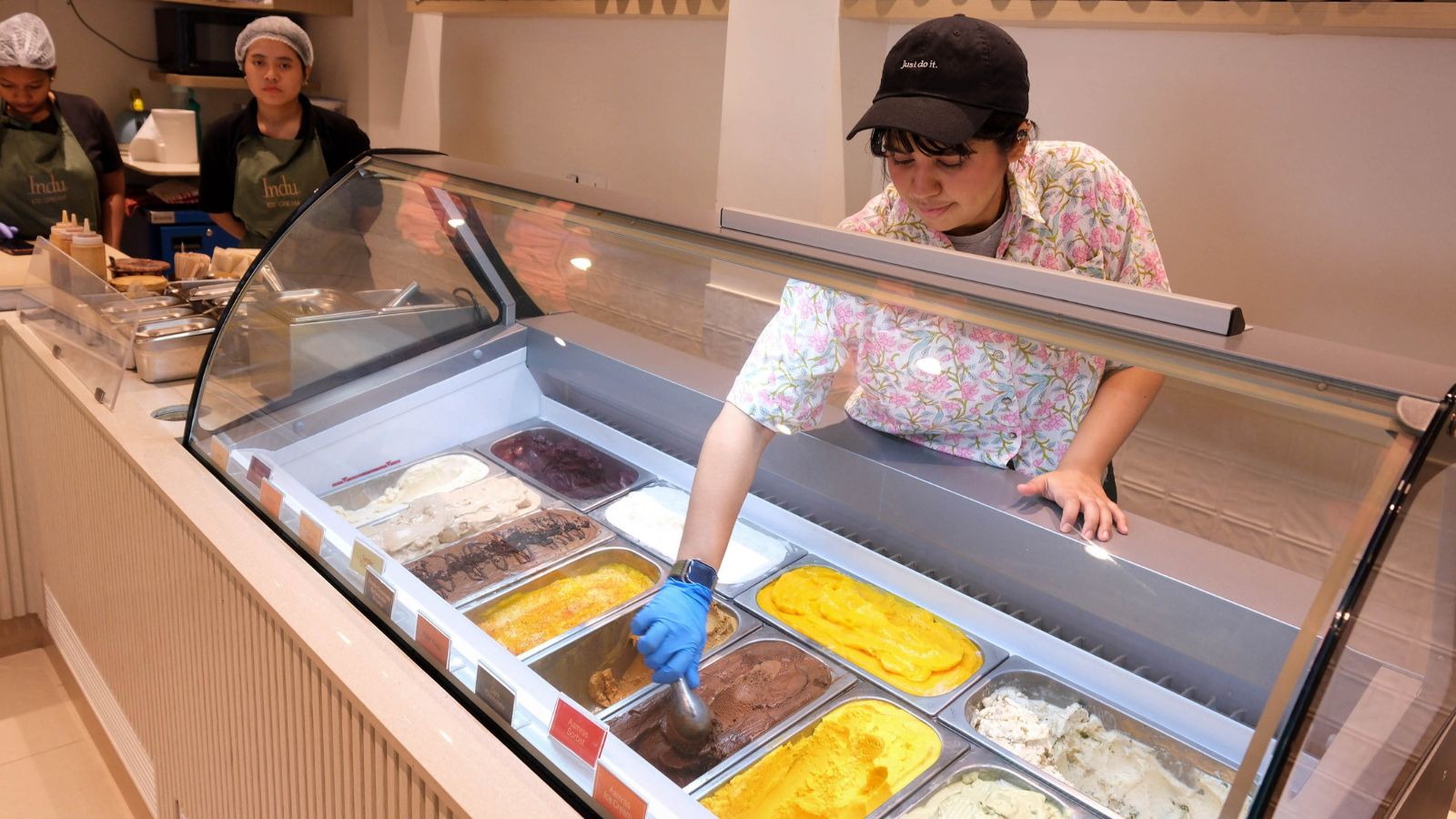 Saloni Kukreja scooping out a scoop of ice cream at Indu Ice Cream. Express Photo by Nidhi Jacob.
She had 200,000 followers on Instagram at the time, which helped the brand reach a wider audience. Early bestsellers were pistachio, kachchi kairi, and dark chocolate. Surprisingly, filter coffee — now the iconic Indu flavour — was a slow starter. So was kala khatta, which is currently one of the fastest-moving things at the scoop shop. “In delivery, people couldn’t see or taste it first,” she said. “At the shop, the colour and the visual of masala being added convert people instantly.”
What also stood out was the name, Indu Ice Cream, and the distinctly Indian aesthetic, complete with block-print fabric lids. The branding was done by her sister, with a clear brief: an Indian name that was short, simple and rooted in Indianness across the logo, colours and overall identity. After rejecting nearly 30 names, her sister called one Monday afternoon with “Indu” — a Sanskrit word meaning “cooling”, while also echoing Indus. Catchy and quick.
Kukreja was also clear that there would be no plastic in her packaging. “Kraft paper tubs can’t really be printed on, so the block-print cloth cover became the solution,” she said, adding that she has always been obsessed with block prints. The fabric comes from a friend’s production unit in Jaipur, originally using scrap from their garment runs, now with fresh commissioned prints too. The Indian-ness was always meant to go beyond the flavour — into the packaging, and into how she shows up. The jewellery, the prints she wears, the brand: one continuous thing, partly intentional, partly just who she is.
In 2024 she moved into a delivery kitchen next to Candy’s in Bandra — a surprising location for a delivery-only operation, but she needed to stay close to her content studio in Khar. She was still funding everything through content creation and couldn’t afford to separate the two lives. She deliberately held off on a scoop shop. “I felt the product still needed improvement, and delivery gave more breathing room.” The first year of production was rough — an Indian machine that caused problems throughout, recipes overhauled in the first six months. The second year was smoother. The delivery format also allowed for layering that a scoop shop can’t replicate: the filter coffee tub has hazelnut butter and caramel built into it, the butter hardening in the freezer for crunch while the caramel stays gooey. The 250ml Sunday size comes with a chocolate disc on top you crack open.
Story continues below this ad
Collaborations have been part of the strategy since 2024: Skoda, Fenty Beauty, Tinder (a breakup ice cream series, one flavour called Toxic Espresso), Plum Body Butter. A way to stay in people’s minds without a physical space. That problem is now solved.
The scoop shop needed less R&D than expected, years of pop-ups had already shown her how the ice cream behaves when scooped. The main adjustment was sorbet temperature: sorbet ideally sits two to three degrees higher than ice cream due to water content, but both now share a display temperature, so recipes were tweaked accordingly.
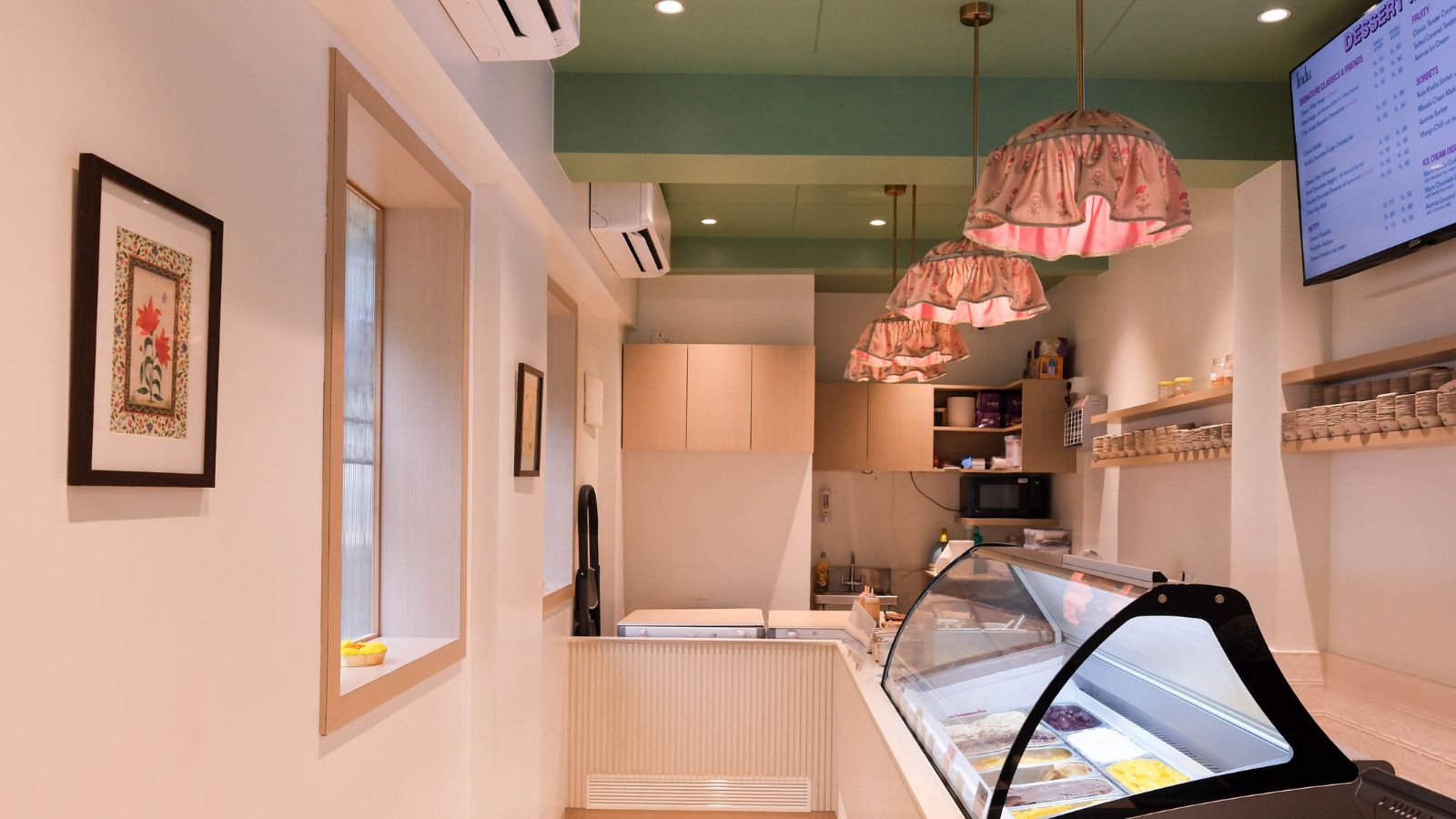 The interiors. Express Photo by Nidhi Jacob.
The current menu runs about 14 flavours, roughly half classic, half Indu-special. Top three at the shop: Nutella cookie with hazelnut ice cream, filter coffee brownie cheesecake, double chocolate butterscotch, and pistachio baklava, always. Amras is seasonal but, in her words, crosses all boundaries when it’s on. The chhaas sorbet — dahi churned with curry leaf, chilli, and ginger, practically froyo in ice cream form — was meant to be a one-summer thing. It worked well enough to return.
When asked how often she gets requests for sugar-free ice cream, she admits it’s very frequent, especially from older customers. “The issue is that sugar isn’t just sweetness — it’s structural. Replicating that texture without sugar requires additives I don’t want to use,” she said. She has experimented with coconut sugar and other natural alternatives, but none have worked cleanly so far. While she continues to look for an option that performs like sugar, she says she isn’t willing to add ingredients she doesn’t believe in simply to create a sugar-free range for the sake of it.
Story continues below this ad
At Indu Ice Cream, matkas are priced between Rs 180 and Rs 240. The 250ml tubs cost Rs 350-420, while the 500ml tubs are priced between Rs 590 and Rs 750. At the scoop shop, single scoops start at Rs 150 and go up to Rs 200.
 20
20 584226
 20
20
 20
20