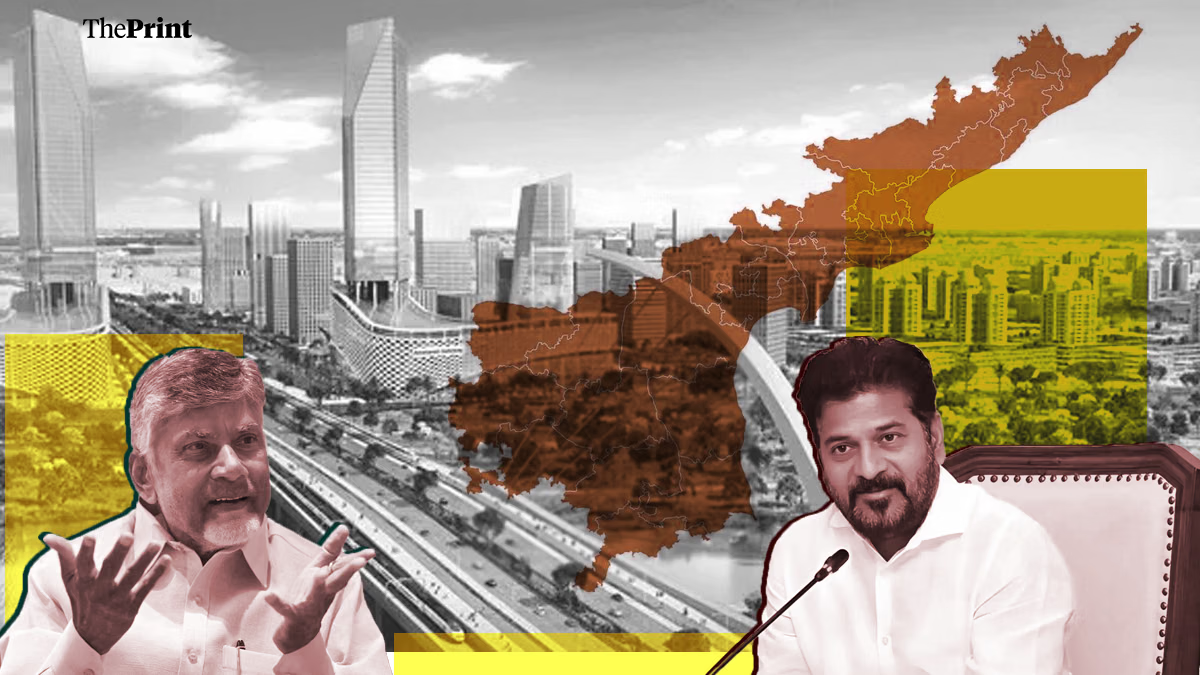
In CM Revanth’s governance style in Telangana, a reflection of ‘guru’ Chandrababu Naidu’s playbook
Hyderabad: Two and a half years into his term, Telangana Chief Minister Revanth Reddy’s policy and governance model strongly mirrors that of his mentor and former colleague, Andhra Pradesh Chief Minister N. Chandrababu Naidu, according to senior bureaucrats and political observers.
Andhra Pradesh’s decentralised model of industrialisation, land pooling for the new capital region at Amaravati, and the technocratic governance model that rests on the expertise of seasoned corporate professionals all have clear parallels in Telangana.
In the third week of May, Revanth announced to his government secretaries that executives of multi-sectoral global capability centres (GCCs) should be urged to consider locations outside of Hyderabad, much like Andhra Pradesh’s intra-state development across the Rayalaseema, southern and north-coastal regions.
Future City, a 30,000-acre greenfield smart city on the outskirts of Hyderabad, is seen as Amaravati’s twin, where Andhra Pradesh’s land pooling method is being adopted to design a city from the ground up as a net-zero, self-sustaining metropolis to decongest Hyderabad’s core.
To assist the state in big-ticket projects and policy formulation, Revanth’s C-suite consultants have helped formulate policies in life sciences, aerospace, and artificial intelligence.
Kalyan Chandra, a political strategist and adviser to regional parties in southern India, told ThePrint that Revanth’s lack of experience in administrative roles and frosty relations with his cabinet colleagues make him rely on external sources for policy ideas and formulation.
“Revanth is neither a visionary like Chandrababu Naidu nor a voracious reader like former Telangana CM K. Chandrashekar Rao. He may have leapfrogged to secure his position within the Congress like Karnataka CM Siddaramaiah, but he does not compare well with the latter’s astute fiscal management and governance skills,” said Chandra. “However, Revanth is a street-smart politician who knows how to adapt himself to the changing political winds.”
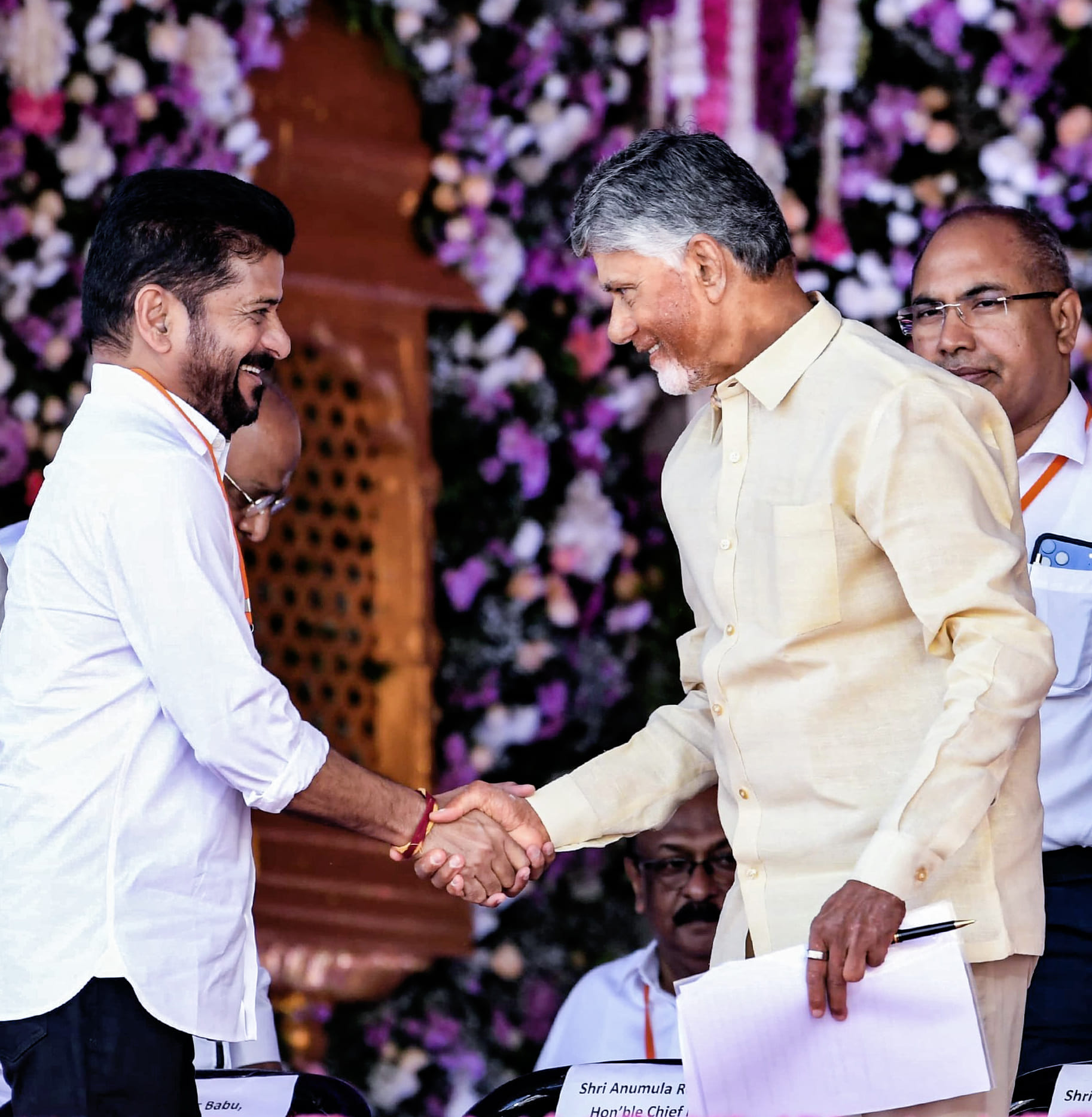
Also read: Employability must become India’s national mission, says Andhra Pradesh CM Naidu at CII event
Naidu’s protégé
Revanth, who built his career after joining the Telugu Desam Party (TDP), was considered one of Naidu’s sharpest protégés, with political preferences rooted in pragmatism rather than ideology.
Before joining the Congress in 2017, Revanth was the TDP working president and assembly floor leader.
Bureaucrats working closely with the Telangana chief minister told ThePrint that even as both leaders exercise unilateral executive actions, their core models remain alike across major areas of administration and governance.
Moreover, with funds to non-BJP states tied to the implementation of central government schemes, the similarities between Andhra Pradesh’s and Telangana’s schemes have become more pronounced.
When Revanth helped the Congress come to power in December 2023 on the back of the party’s six guarantees, party insiders say he knew there was little room to execute long-term projects.
To secure his position in the party with many contenders for the chief minister’s post and lend stability to the government, time-tested policies were necessary, they added.
This is where Naidu’s policies, already underway in Andhra Pradesh after bifurcation, came in handy.
Shortly after assembling his cabinet in December 2023, Telangana decided to scrap the two-child policy, which restricted couples in the state from having more than two children, to keep the population in check. Its policy was annulled shortly after Andhra Pradesh called off its two-child policy.
In 2025, Revanth announced that Andhra Pradesh’s model on assigned lands, which grants poor families full property rights, was under consideration in Telangana. Nearly a year later, he also sent a delegation to Andhra Pradesh to study how the state was dealing with Telugus living overseas.
More recently, in the 2026 budget, Telangana rolled out a midday meal scheme for junior college students, just as Andhra did.
Revanth’s 8,000 Mahila Bhavans, inaugurated across Telangana on 25 May, mimic Andhra Pradesh’s Mahila Pranganams. Both are state-sponsored community facilities built to drive women’s empowerment, skill development, and economic independence.
Naidu was a pioneer in formulating the self-help group concept way back in 1999 to assist women in vocational training and community engagement to encourage entrepreneurship amongst women.
While most of these policies have had or are likely to have a successful run in Telangana as well, policymakers, business houses, and bureaucrats often question what they describe as the chief minister’s lack of ingenuity.
However, they are quick to appreciate Revanth’s trip to the Harvard Kennedy School in Cambridge, where he completed an executive education programme titled ‘Leadership in the 21st century’.
“Revanth Reddy never fails to acknowledge Naidu’s influence over him and even calls the latter his guru. With Naidu’s World Bank model of appointing consultants being successful since 1999, when he was CM of united Andhra Pradesh, multinational corporations expect every CM to emulate Naidu’s style of functioning as a full-time CEO of the state,” said Raka Sudhakar, a senior journalist and commentator.
“It is hard to dislodge this practice, and leaders in the years after have adopted the same style to ensure continuity of capital investments,” she added.
Both KCR and Revanth were compelled to implement some of Naidu’s policies because MNCs and Andhra businessmen who undertook large infrastructure projects in irrigation, airports, and highways sought assurances that there would be no disruption to their business operations.
“Hyderabad ceased to be Telangana’s capital alone once it became a software, pharma, and financial hub. Its geographic location may be in Telangana, but with foreign and domestic investors calling the city home, there is just no turning back,” said Raka Sudhakar.
“Telangana has no choice but to become like Tamil Nadu, where growth in manufacturing and services continues despite new governments being sworn in every five years,” she added.
The irony of Andhra’s bureaucrats and politicians continuing to operate out of Hyderabad is not lost either. With IAS officers split between Telangana and Andhra Pradesh, the likelihood of successful policies being implemented in both states after informal consultations among the executive cadre is not entirely ruled out, sources in both governments told ThePrint.
Revanth’s former colleagues in the TDP told ThePrint that even his political leanings echo Naidu’s in many ways.
At times, they are centre-aligned; on other occasions, he keeps a safe distance from the Bharatiya Janata Party by toeing the line of his Congress top brass.
Ministers in the cabinet, who work alongside Revanth, told ThePrint on condition of anonymity that his governance style is closer to Naidu’s than to Rahul Gandhi’s.
But they are forced to adapt to Revanth’s style of functioning to safeguard Karnataka and Telangana, the two southern states where the Congress party came to power on its own, enjoying a majority in the assembly.
(Edited by Sugita Katyal)
Also read: The Hyderabad manoeuvre: How PM Modi stirred up the political pot in Telangana
 20
20 584226
 20
20
 20
20