‘I could not call myself an engineer’: How Maharashtra’s aborted Muslim quota left a Beed man without his degree for nine years | Mumbai News
For nine years, Farukh Ilahi Sayyad carried the qualifications of an engineer without the degree certificate to prove it.
A beneficiary and later a casualty of Maharashtra’s brief and controversial 5 per cent Muslim reservation policy, the 33-year-old from Beed spent nearly a decade caught between changing governments, a lapsed ordinance and bureaucratic deadlock before the Bombay High Court finally directed the University of Mumbai to release his engineering degree earlier this month.
Sayyad’s ordeal traces back to 2014, when the then Congress-NCP government announced 16 per cent reservation for Marathas and 5 per cent reservation for Muslims in government jobs and educational institutions ahead of the Assembly elections. To navigate constitutional restrictions against religion-based reservation, the quota was structured under a Special Backward Category-A (SBC-A), covering around 50 socially and educationally backward Muslim communities.
It was under this category that Sayyad, then 21 years old and a resident of Jawalben village in Beed district, secured admission to Finolex Academy of Management and Technology in Ratnagiri for a degree course in electrical engineering.
The youngest son of a daily wage worker in a family with little formal education, Sayyad completed Diploma in Electrical Engineering with 72.71 per cent marks, making him eligible for direct second-year admission to an engineering course.
“With the reservations announced, I was initially allotted a Pune-based college based on the marks. However, I opted out as the fees of Rs 1.13 lakh was too high. In the second round of selection, I was allotted a seat in the Finolex Academy of Management and Technology in Ratnagiri under the SBCA category and I accepted as the fee was Rs 63,000 per year and affordable,” Farukh Ilahi Sayyad told The Indian Express from Dubai.
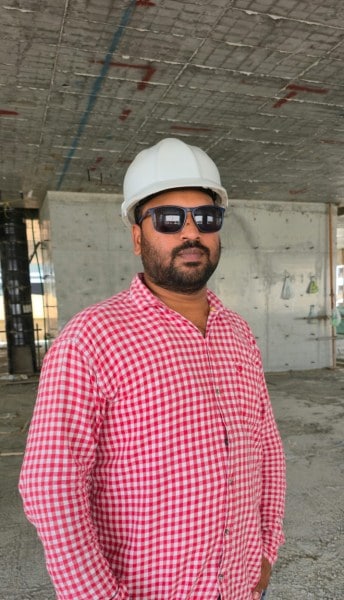 Farukh Ilahi Sayyad
In July 2014, he obtained a caste certificate confirming his SBC-A status. But when he applied for a caste validity certificate in February 2015, the political and legal landscape had changed.
Story continues below this ad
The BJP-led government had come to power in Maharashtra in October 2014, and the reservation policy was challenged before the Bombay High Court. In November that year, the High Court struck down Maratha reservation but permitted 5 per cent reservation for Muslims in educational institutions, observing that denying such reservation would impede efforts to bring Muslim youth into the mainstream of secular education.
However, the ordinance was never converted into a permanent law and lapsed in December 2014 after the new government chose not to preserve the Muslim quota framework.
Soon after, Sayyad said the state scrutiny committee informed him that it could not issue a caste validity certificate because the reservation itself was no longer in force.
“I made various representations to authorities but to no avail. I was told that I would be able to continue my studies if I paid the fees that was being charged for open category students. I agreed, hoping that the issue would get resolved,” he said.
Story continues below this ad
Although he completed the course in 2017, the college and the University of Mumbai withheld his final-year marksheet and engineering degree because he had not submitted the caste validity certificate.
Unable to resolve the issue, Sayyad moved to Kuwait in 2018 on the basis of his diploma qualification before finding work in Dubai. He returned briefly during the Covid pandemic.
“What pinched me is that in spite of being an engineer, I could not call myself one or get the desired jobs because I did not hold a physical copy of my degree,” Sayyad said. “With companies tightening norms on whom they hired for engineering jobs, I felt it was time that I took from the state what was rightfully mine.”
Earlier this year, during a visit to India, Sayyad approached advocates Amol Ghuge and Gaurav Ugale and moved the Bombay High Court seeking release of his degree and results.
Story continues below this ad
“Our contention before the court was that repeal of a law does not automatically extinguish rights, liabilities or proceedings that arose under it. We argued that withholding our client’s degree was preventing him from practising his profession and infringing upon his right to livelihood. We also submitted that the petitioner could not be penalised for a subsequent shift in the government’s legal position and that education already imparted ought to be protected,” advocate said.
The state argued that since the 2014 ordinance had lapsed without becoming law, all related government resolutions and circulars automatically stood cancelled.
Earlier this year, the Maharashtra government formally scrapped a decade-old resolution linked to the Congress-NCP government’s 2014 Muslim reservation policy in education, triggering a political sparring match between the ruling BJP and the Opposition. While Opposition parties termed the move anti-minority, the BJP dismissed the quota as an unimplemented “appeasement” measure announced ahead of elections.
In its May 6 verdict, the Bombay High Court directed the University of Mumbai to release Sayyad’s eighth semester results along with his original degree, passing and leaving certificates after recording his statement that he was not seeking the benefit of the 5 per cent reservation under the February 17, 2026 Government Resolution, and had already paid fees applicable to the open category. Sayyad also undertook to pay any additional fees, if required. Accepting the statement, the bench of Justices Advait M Sethna and R I Chagla disposed of the petition.
Story continues below this ad
“It is a huge relief,” Sayyad said. “It has been a harrowing nine years trying to get hold of my degree. I do not know how many other Muslim students got admission during this four-month window and are facing similar problems. I feel strange fighting for a right that was granted by the state. In spite of not doing anything illegal, I had to suffer for nine years.”
 20
20 584226
 20
20
 20
20