Nitin Gadkari Leads by Example, Uses Bus Travel to Save Fuel
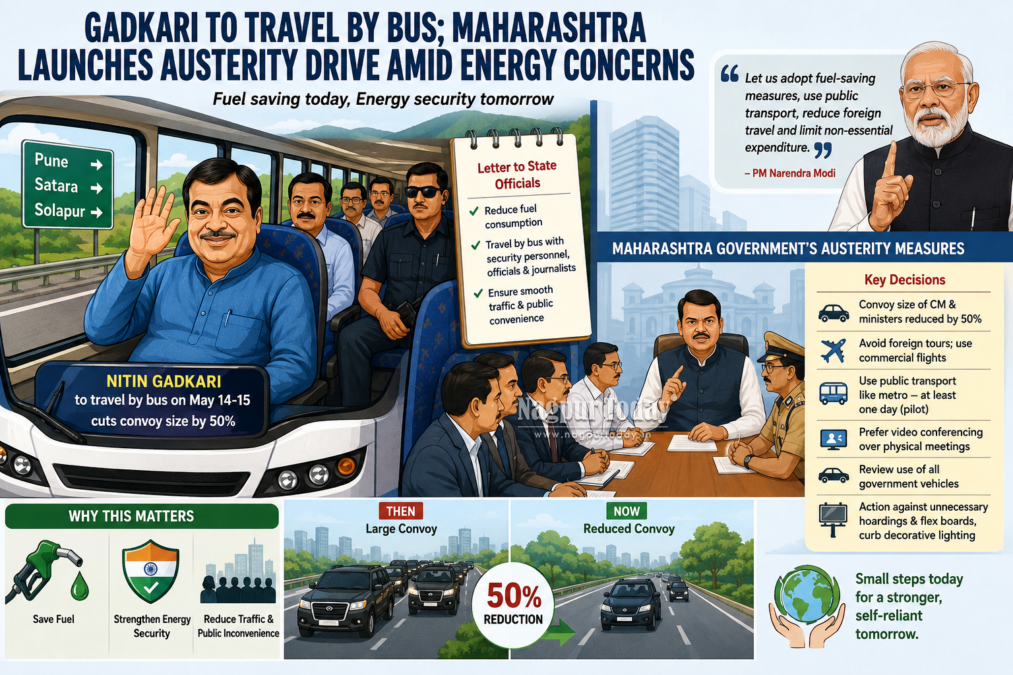
Nagpur: In a significant move aimed at promoting fuel conservation and austerity, Union Minister for Road Transport and Highways Nitin Gadkari has decided to travel by bus during his May 14-15 tour of Pune, Satara and Solapur, responding to Prime Minister Narendra Modi’s recent appeal for energy-saving measures amid the ongoing global energy concerns linked to tensions in West Asia.
Gadkari, who is scheduled to inspect roads being developed to improve connectivity between the shrines of medieval saints Sant Dnyaneshwar and Sant Tukaram, has also directed the Maharashtra administration to reduce the size of his official convoy by 50 percent.
Gold Rate
May 14- 2026 – Time 10.30Hrs
Gold 24 KT
₹ 1,63,000 /-
Gold 22 KT
₹ 1,51,600 /-
Silver/Kg
₹ 2,92,400/-
Platinum
₹ 88,000/-
Recommended rate for Nagpur sarafa Making charges minimum 13% and above

In a communication sent to the Chief Secretary, Director General of Police (DGP), district collectors and senior police officials, Gadkari emphasized that reducing fuel consumption has become essential for national energy security. He stated that travelling by bus along with security personnel, officials and journalists would help save fuel while also reducing traffic congestion and inconvenience caused to the public during VIP movements.
The Union Minister’s decision is being viewed as a swift and symbolic response to the Prime Minister’s call urging citizens and government functionaries to adopt austerity measures, minimize fuel consumption, prefer public transport, avoid unnecessary foreign travel and limit non-essential expenditure in light of the evolving international energy situation.
Meanwhile, the Government of Maharashtra on Wednesday announced a series of immediate austerity and energy-saving measures following high-level review meetings chaired by Chief Minister Devendra Fadnavis.
As part of the new directives, the number of vehicles in the convoys of the Chief Minister and all state ministers will be reduced by half with immediate effect. The government has also made police commissioners and superintendents of police responsible for ensuring that convoy sizes remain within prescribed limits during official visits.
The state government further instructed ministers and senior officials to avoid foreign tours until further orders. Ministers have also been advised against using government aircraft and helicopters unless absolutely necessary and instead encouraged to use scheduled commercial flights.
In another major initiative, ministers and senior bureaucrats have been asked to increase the use of public transport systems, including metro rail services. As part of the first phase of implementation, ministers and senior officials have been encouraged to use public transport for at least one day on an experimental basis.
The government has also directed departments to rely more on videoconferencing instead of frequently summoning officials to Mumbai for meetings, in an effort to reduce travel-related expenditure and fuel usage.
Additionally, departments have been instructed to review the allocation and use of government vehicles across offices. Authorities were also ordered to take stricter action against unnecessary hoardings and flex boards and to curb decorative lighting at such locations as part of broader energy conservation measures.
Senior government officials were present during the review meetings where the decisions were finalized.
Advertisement

Advertisement
Advertisement
 20
20 584226
 20
20
 20
20