Unskilled workers, missing safety officers, vanishing owners
Advertisement

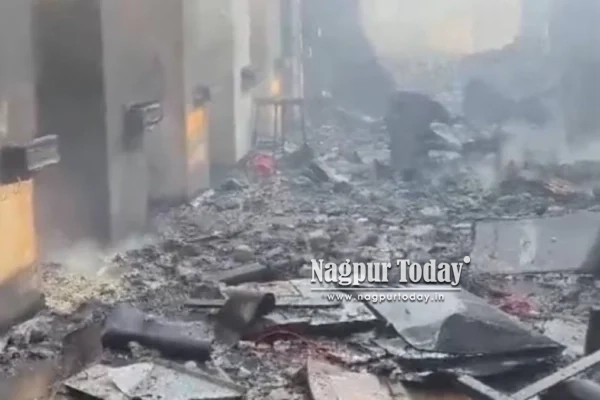
Nagpur: The devastating explosion at SBL Energy Ltd’s detonator unit in Raulgaon village of Katol taluka, which killed 26 workers in March, is increasingly emerging as a case of systemic negligence rather than an industrial accident.
In a startling disclosure before the Nagpur Bench of the Bombay High Court, Nagpur Rural Police revealed that inexperienced and unskilled workers were handling hazardous chemicals inside the factory, a glaring lapse that may have directly contributed to the deadly blast.
Gold Rate
Apr 09,2026 – Time 10.30Hrs
Gold 24 KT
₹ 1,52,100 /-
Gold 22 KT
₹ 1,41,500 /-
Silver/Kg
₹ 2,45,100/-
Platinum
₹ 90,000/-
Recommended rate for Nagpur sarafa Making charges minimum 13% and above

The revelations came in an affidavit filed by Superintendent of Police (Rural) Harssh Poddar before a division bench of Justices Anil Kilor and Raj Wakode, which is hearing a public interest litigation filed by social activist Jammu Anand.
According to the police affidavit, the company grossly violated mandatory industrial safety norms while operating a highly sensitive explosives facility. Despite employing a workforce of 809 employees, the company had appointed only one safety officer, even though regulations require at least two qualified safety officers along with two medical officers.
The situation was equally alarming on the medical preparedness front. Investigators informed the court that only 183 workers had undergone mandatory medical examinations, leaving hundreds of employees exposed to hazardous working conditions without proper health monitoring.
Emergency preparedness at the factory also appeared dangerously inadequate. The affidavit stated that the facility had just one ambulance for the entire workforce, while the production unit lacked even a basic CCTV surveillance system, raising serious questions about monitoring and accountability within the plant.
The explosion, which occurred around 6.45 am on March 1, instantly turned the factory floor into a death trap. Seventeen women workers died on the spot, while several others succumbed to severe injuries during treatment, pushing the death toll to 26.
What has shocked investigators further is that warning signs had already surfaced months earlier. The police informed the court that a similar explosion occurred at the same facility on April 26, 2025, after which authorities had recommended that the company’s licence should not be renewed.
Despite the red flag, operations at the plant continued, raising uncomfortable questions about regulatory oversight and enforcement.
During the hearing, petitioner’s counsel Arvind Waghmare questioned why criminal charges have not yet been invoked against the company’s directors or owners, despite the scale of the tragedy.
Responding to the concern, the police told the court that sufficient evidence is not yet available to invoke provisions under the Explosives Act, 1908, adding that further action will depend on final reports from the Petroleum and Explosives Safety Organisation (PESO) and the Directorate of Industrial Safety and Health (DISH).
Representing the state, additional government pleader Kalyani Marpakwar informed the court that investigations are ongoing and that regulatory findings will determine the next course of legal action.
Chairman Sanjay Chaudhary, CEO Alok Chaudhary untraceable
Meanwhile, another disturbing aspect of the case continues to deepen the mystery surrounding the tragedy, the disappearance of the company’s top leadership.
More than a month after the blast, SBL Energy Limited Chairman Sanjay Chaudhary and CEO Alok Chaudhary remain untraceable, leaving investigators and victims’ families asking a troubling question: Where are the owners?
Sources said the two had left Raipur for Nagpur on the day of the explosion and had informed authorities that they would arrive by evening. However, soon after the police registered a criminal case, both their mobile phones were switched off, and since then, there has been no trace of them.
A police raid at Alok Chaudhary’s residence in Raipur reportedly yielded no breakthrough.
The state government has since suspended the company’s licence and announced compensation for the victims’ families, but for the relatives of the 26 deceased workers, financial relief cannot substitute accountability.
As investigators continue to piece together the chain of lapses that led to the disaster, uncomfortable questions are growing louder: Did the company’s leadership know about the safety violations? Were they tipped off before the law could catch up with them? And did systemic delays give them enough time to disappear?
Until these questions are answered, the Raulgaon blast will remain not just a tragic industrial disaster, but a grim reminder of what happens when profit, negligence and weak enforcement collide.
Advertisement

Advertisement

 20
20 584226
 20
20
 20
20