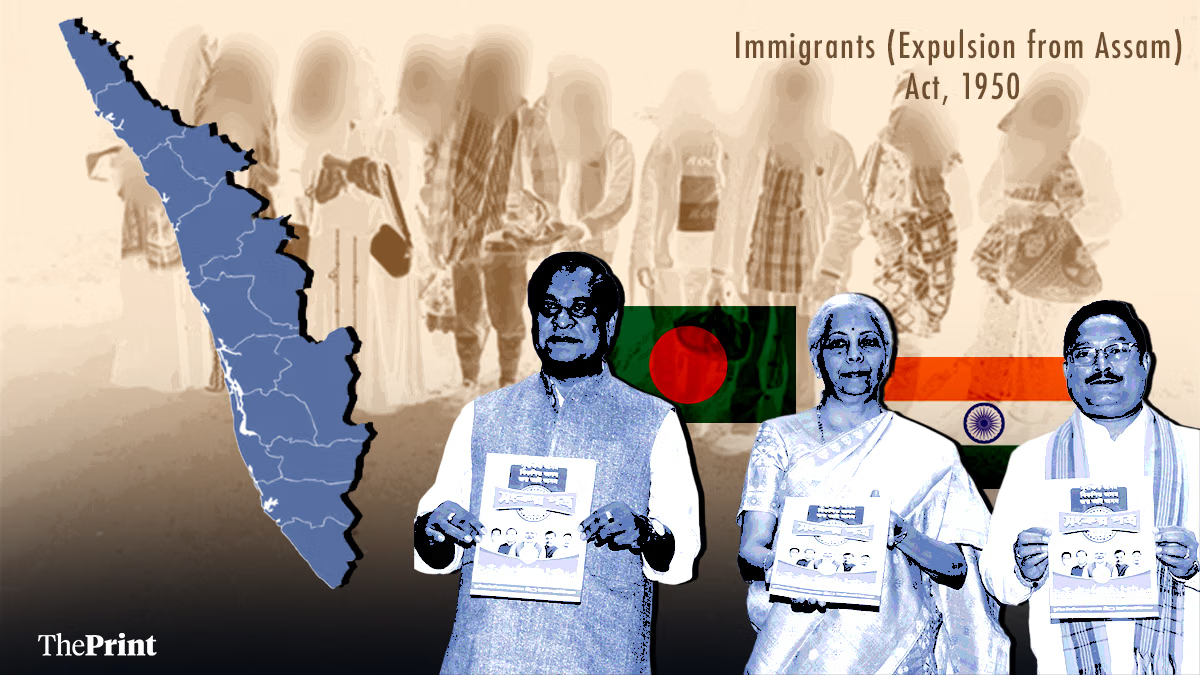
What’s the 1950 law Nehru put on hold that BJP vows to ‘unleash on Bangladeshi Miyas’ in Assam
The manifesto promises protection of the land, heritage and dignity of the indigenous people of Assam by implementing the 1950 law, to “expedite the process of detection and pushback of illegal immigrants”, and “free every inch of land from encroachment by illegal immigrants”.
The law first came in as an Ordinance in January 1950 and was replaced with an Act in March of the same year. However, it was short-lived and lay dormant for several decades, owing to an intervention by then Prime Minister Jawaharlal Nehru.
Last year, the Assam Cabinet approved the standard operating procedure (SOP) to guide District Commissioners and Senior Superintendents of Police in implementing the 1950 law to expel illegal migrants from Assam.
“Our District Commissioners (DCs) have been instructed that any person, who they feel is suspicious or any person who has been declared a foreigner by the tribunal, should immediately be issued an expulsion order. Then the police or the BSF will take action to send them back to Bangladesh,” Chief Minister Sarma had said.
What does the law say, why was it brought in, and why was its use discontinued? ThePrint explains.
Also Read: Illegal immigrants ‘assault on Assamese culture, had invaded state’—BJP’s Assam in-charge Jay Panda
What does the law say
The law empowers the Central government to order the expulsion of “certain immigrants” or “class of persons” who had come to Assam, if the Central government says that their stay is “detrimental to the interests of the general public of India or of any section thereof or of any Scheduled Tribe in Assam”.
Such people can be directed to leave India or Assam within a specified time and through specified routes.
However, the provision makes an exception for refugees, saying that it won’t apply to any person who, due to civil disturbances, was displaced or left any area that later became a part of Pakistan.
It also provides for a three-year jail term and fine for anyone who contravenes an expulsion order under this law, fails to comply with it or harbours any person who contravenes such an order or fails to comply with it.
The statement of objects and reasons of the Act says that during the last few months, a “serious situation” has arisen from the immigration of a very large number of East Bengal residents into Assam.
“Such large migration is disturbing the economy of the Province. Besides giving rise to a serious law and order problem,” it says, adding that the bill seeks to confer necessary power on the Central government to deal with the situation.
You may be hiding in plain sight but we will hunt you down and EXPEL you from India.
This mission continues as we PUSHED BACK 14 illegal infiltrators in the wee hours today – some fresh explorers while some experienced troublemakers.
Committed to a Secure Assam. pic.twitter.com/cayJkH8BbG
— Himanta Biswa Sarma (@himantabiswa) January 18, 2026
A Parliamentary response from July 1952 clarified that on receipt of a police report showing sufficient grounds against any person justifying expulsion, the District Magistrate or Sub-Divisional Magistrate is empowered to pass an order of expulsion. It said that the law requires the person expelled to be escorted to the border of Assam.
“No special machinery has been set up to administer the Act. District and Sub-Divisional Magistrates are empowered to take action,” it added.
Why was it passed
The law was preceded by the Immigrants (Expulsion from Assam) Ordinance 1950, which was in force from 6 January 1950 up to 1 March 1950, when the new law came into effect.
The bill was first introduced by N. Gopalaswamy Ayyangar, the then Minister for Railways and Transport, in December 1949 in the Constituent Assembly (Legislative), but could not be passed for want of time. An ordinance was then promulgated.
During a debate on the bill in February 1950, Ayyangar said that the provisions were “vital to the preservation of the economy of Assam” because the influx of “undesirable immigrants” into Assam from East Pakistan was growing.
He told Parliament that while there were about 1.5 lakh to 2 lakh “undesirable immigrants” in Assam up until mid-1949, the number had since increased to half a million.
According to reports from the time, the Assam government had raised alarm bells over the influx with the Central government towards the end of 1948.
One solution considered was a permit system between Assam and East Pakistan. However, the government felt that such a system would impose restrictions on the freedom of movement of a large number of people who had to pass between East Pakistan and Assam or West Bengal in their ordinary work.
This law then came up as an alternative solution.
During the discussions on the Bill, Ayyangar told Parliament that while this was a Central law, the Central government had delegated its powers under the Ordinance to the Assam government and certain specified officers of the Assam government recommended by them.
Ayyangar assured Parliament that ever since the Ordinance was promulgated, not only had the influx of immigrants slackened, “but substantial numbers of Muslims who had come into Assam are now finding their way back to their homes in East Bengal”.
He was certain that “if it is really worked in the spirit in which the provision is intended to be worked, I think there will be results which in the course of a short time will put an end to this evil”.
Why was it discontinued
The discontinuation of the bill seems to be linked to a pact between Jawaharlal Nehru and his Pakistani counterpart, Liaquat Ali Khan, on 8 April 1950.
Under the Nehru-Liaquat pact, or the Delhi pact, the two governments agreed to give their minorities “complete equality of citizenship, irrespective of religion”.
Among other things, the pact said that in respect of migrants from East Bengal, West Bengal, Assam and Tripura, where communal disturbances had occurred, the two governments had agreed that “there shall be freedom of movement and protection in transit”.
In a letter to the then Chief Minister of Assam, Gopinath Bardoloi in April 1950, Nehru wrote that all action under the Act should be stopped completely for the time being, saying that much had happened since the law was passed.
He said that while the Nehru-Liaquat pact, signed two days before the letter, did not refer to this law specifically, Liaquat Ali Khan did talk to him about it.
“I told him that I could not agree to including that in the Agreement, but undoubtedly we would look into it and see how it was affected indirectly by the principles of the spirit of the Agreement,” he wrote.
Nehru said that in any case, “it would be most unwise to take any action under that Act now”.
Their main purpose, he said, was “to concentrate on getting full control of the situation in East and West Bengal and Assam and to remove the sense of fear from the minorities.”
“Everything else should be subordinated to this. If we cannot succeed in this, then all kinds of other problems will overwhelm us. But we are determined to succeed. Therefore, please see to it that nothing is done under the Assam Expulsion Act,” he asserted.
Nehru also referred to a case from Dibrugarh, where district authorities had issued a notice to an old resident to leave within three days.
How many were expelled
In July 1952, the government told the Lok Sabha that the law came into effect in March 1950 and it was in effect till 8 April 1950, but “under the Prime Ministers’ Agreement of 8 April 1950, it was decided that the Act should be kept in abeyance”.
It pegged the number of immigrants expelled from Assam under the Ordinance and the Act at 354.
“Some persons who returned to Assam were arrested and prosecuted. The exact number of such persons cannot be ascertained,” the response said.
While the law continued to be in abeyance for decades after, last year, the Assam Cabinet approved the SOP for its implementation.
According to media reports, the SOP requires DCs to direct suspected illegal immigrants to produce evidence of their citizenship within 10 days. If the evidence does not convince the DC, he shall provide his opinion in writing and shall pass an expulsion order to remove the illegal immigrant from Assam through a specified route, giving 24 hours’ notice.
If a person is declared a foreign national by a foreigners’ tribunal, this process isn’t required, and the DC can pass an expulsion order directly after all the remedies available to the person, to approach the high court or the Supreme Court, are exhausted.
If the illegal immigrant does not remove himself despite the expulsion order, the DC shall either keep such illegal immigrant in the ‘Holding Centre’ or hand him over to the Border Guarding Force nearest to him for expulsion, the cabinet decision adds.
“Illegal immigrants, if detected near zero line, or within 12 hours from his/her entry in the state, will be pushed back immediately without any further process,” it adds.
The Act was then invoked in November last year, when the Sonitpur district administration directed five people to “remove” themselves from India within 24 hours, after they were declared foreigners by a tribunal. In December last year, the government once again ordered the expulsion of 15 people from Nagaon district.
In January this year, Sarma posted on X about the expulsion of “14 illegal infiltrators in the wee hours — some fresh explorers while some experienced troublemakers”.
(Edited by Sugita Katyal)
Also Read: Where does the law stand on Himanta Biswa Sarma’s video of ‘shooting’ Muslims?
 20
20 584226
 20
20
 20
20