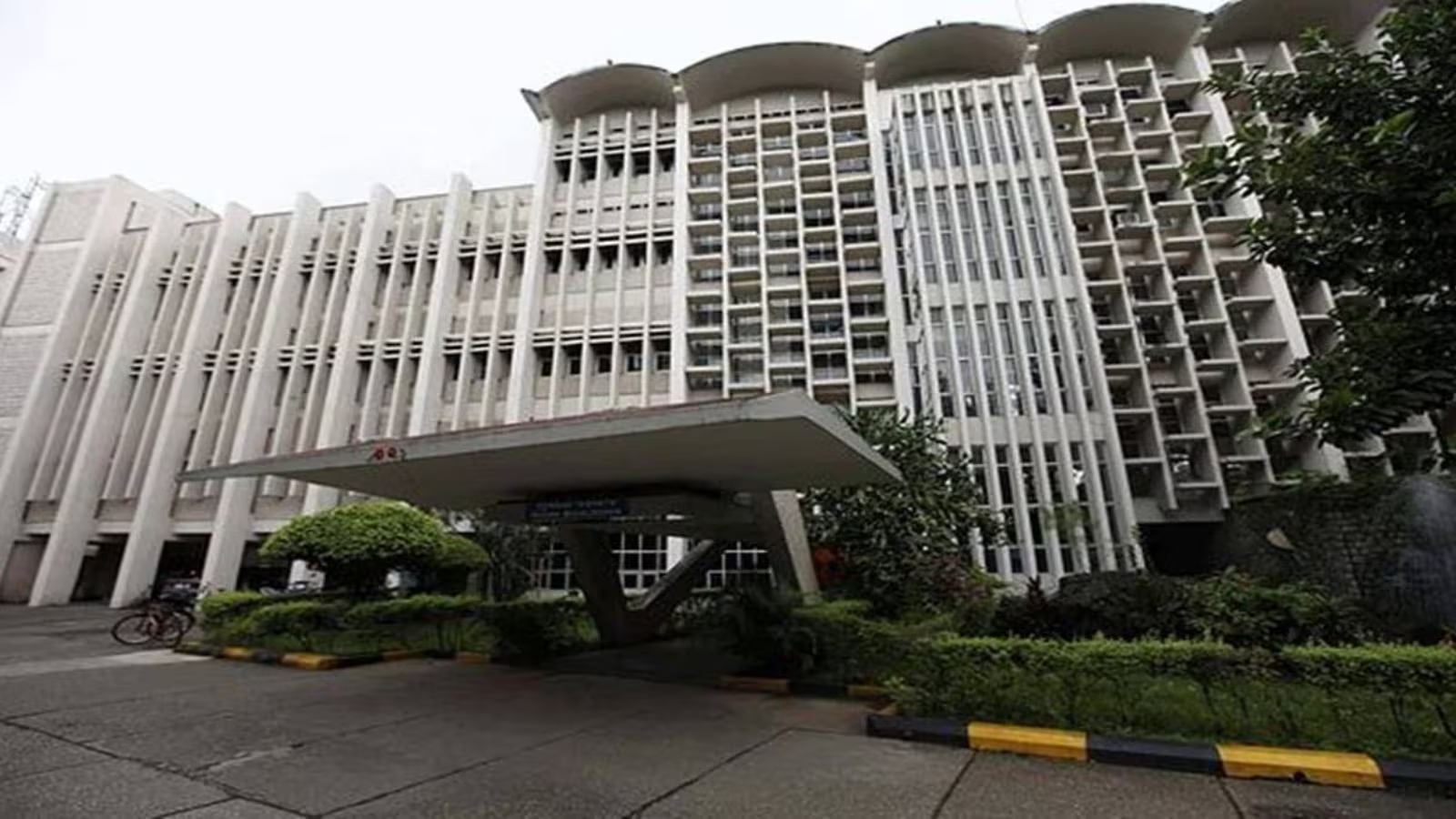
IIT Bombay Firm to Commercialise Campus Tech Innovations
3 min readApr 3, 2026 09:50 PM IST
In a first-of-its-kind move among India’s premier engineering institutions, Indian Institute of Technology (IIT) Bombay has launched a dedicated company aimed at accelerating the commercialisation of early-stage technologies developed on campus but left unused after initial validation.
The new entity – Translational Research Yielding Solutions for Tomorrow (TRYST) — will operate as an on-campus consultancy firm with its own CEO, engineers and business development team. Its focus will be to identify technologies which are promising yet ‘dormant’ ideas and translate them into market-ready products, within a strict timeline.

Additionally, it will also scout for industry challenges to identify opportunities to develop solutions using IIT Bombay’s academic expertise.
Professor Milind Atrey, deputy director (academic, research and translation) at IIT Bombay said it will play a pivotal role in bridging the gap between laboratory innovation and real-world application. He said, “Despite having impressive research output by faculty members at IIT Bombay, many technologies are stalled at the proof-of-concept stage as students graduate, faculty moves on or due to other challenges in areas such as funding, market linkage or just because the professor is not looking at developing that technology as a market-ready product etc. TRYST will step in to evaluate industry demand, refine these technologies into usable products and then either license them to companies or help the teachers on the start-up route.”
Emphasising the need for application-oriented research in academic institutions, Atrey said that it is also important for the innovations to be converted into market-ready products for industry to adopt.
Professor Chandrasekhar Yerramalli, professor in-charge of the TRYST, “Typically, tech-innovations validated in lab settings are considered as those which are at Technology Readiness Level (TRL) 3. For industry adoption they need to be at TRL 6 to 7.” The TRYST, Atrey said will play a critical role of support in this intermediate translational phase, where most academic innovations get stalled due to lack of sustained efforts and specialised skills.
A key differentiator, the duo noted, is the strict timeline. Unlike traditional academic research, which can span years, TRYST aims to deliver functional prototypes within six months to a year. “Industry cannot wait five years for a PhD outcome. They need reliable and time-bound solutions, and that is where this model fits in,” said Atrey highlighting that the recently held Bharat Innovates Deep-Tech summit also showed the importance of translational research.
Story continues below this ad
The initiative is also expected to free faculty from administrative and operational burdens by centralising project execution within TRYST. According to information shared by the institute, revenue generated through licensing or industry partnership will be shared with innovators under the existing institute policies.

 20
20 584226
 20
20
 20
20