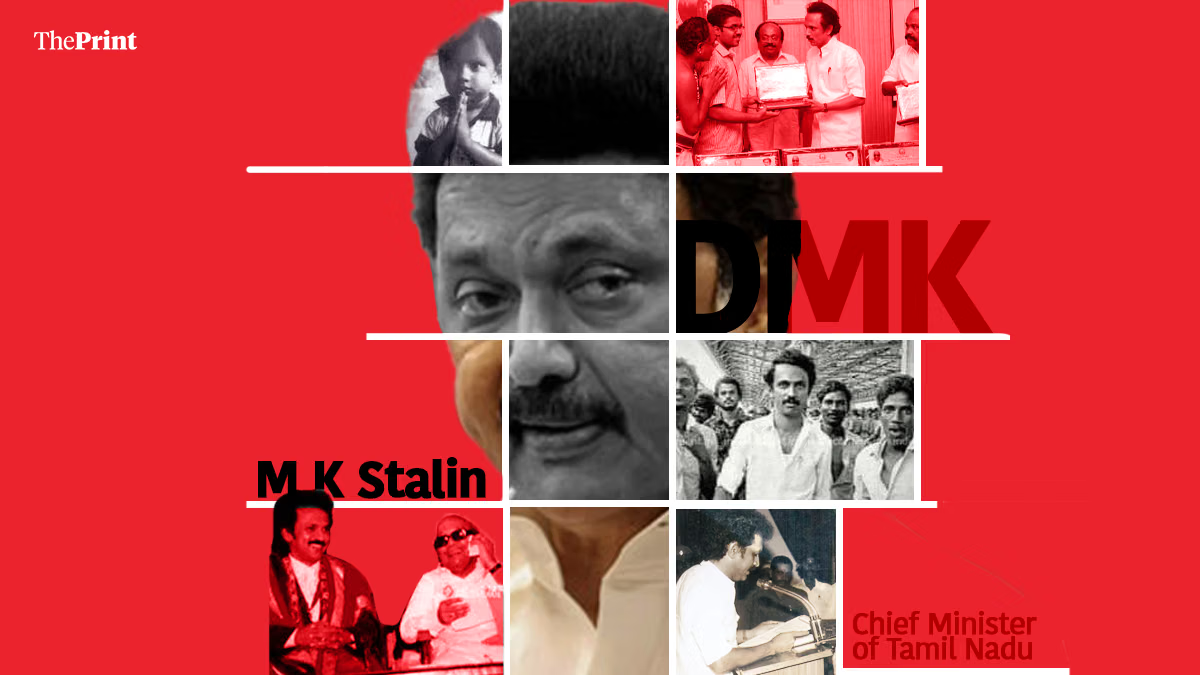
Stalin’s rise is the story of DMK’s evolution—a dynastic elevation marked by friction
Stalin spent many years working at the ground level and built his place in the party under his father M. Karunanidhi. He has upheld the Dravidian model as a core value, turning the DMK into a party that mixes strong support for state rights with effective governance.
Stalin’s challenges are far from over. The rise in law and order lapses, deaths in police custody, questions inside the family about his half-sister Kanimozhi’s role compared to his son Udhayanidhi Stalin’s rise, and constant attacks from the Opposition on dynastic politics are some issues he needs to address.
Youth wing leader to Chief Minister
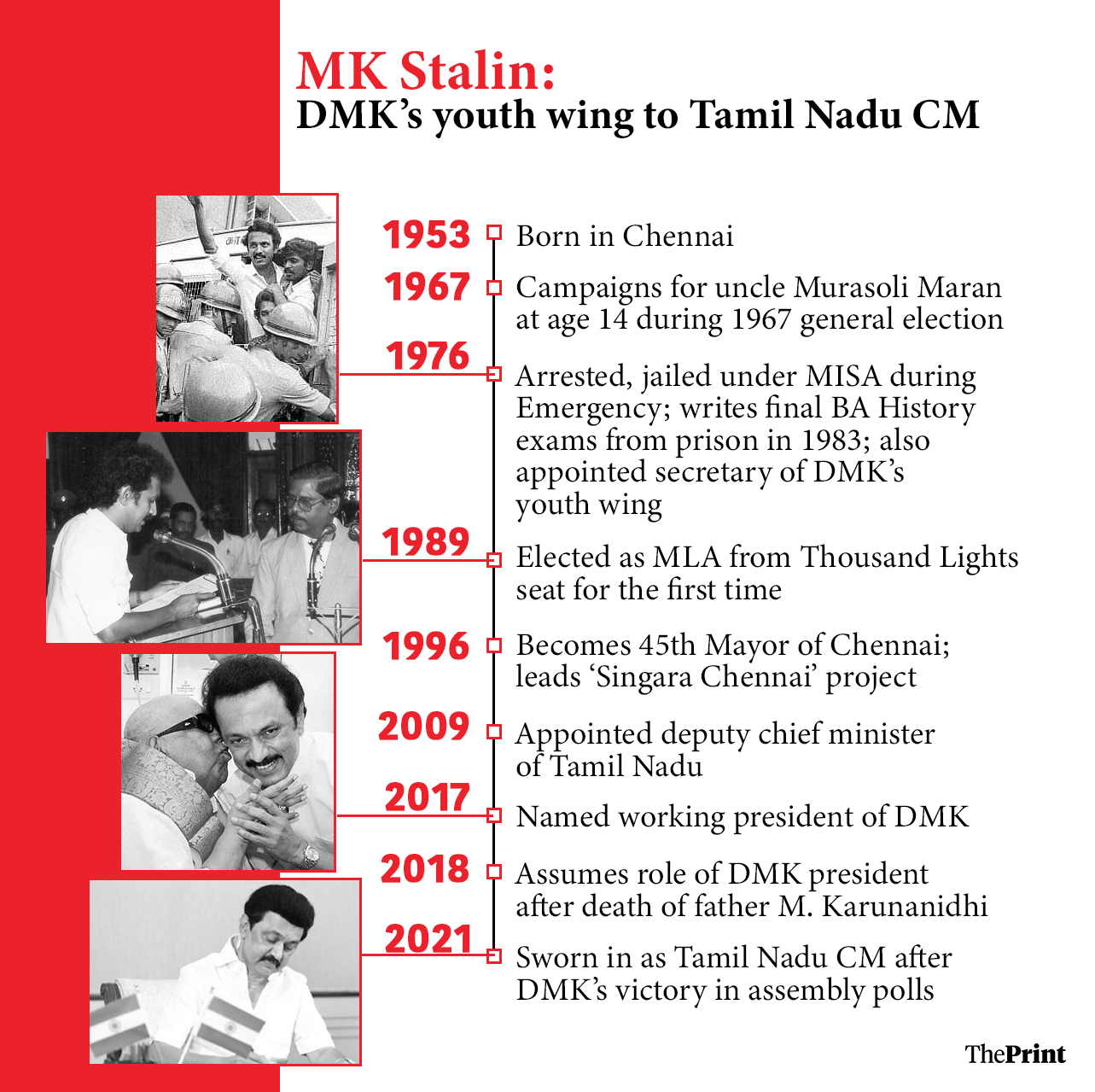
M.K. Stalin grew up steeped in Dravidian politics. As a teenager, he campaigned for his cousin Murasoli Maran in 1967. At 23, during the Emergency, he was arrested under the Maintenance of Internal Security Act and imprisoned. He ended up giving his final BA History exams from jail.
Later, he immersed himself in organisational work as the leader of DMK’s youth wing, helping him to gain the experience of a team leader. Those skills are seen as an advantage even in today’s political scenario as he keeps his hold strong across all districts through secretaries and district heads, right from his first major administrative role that came in 1996 when he became Chennai’s 45th mayor.
Leading the ‘Singara Chennai’ project, Stalin undertook construction of flyovers, bridges, modernising garbage collection and revived parks. He operated in the shadow of his father, the Kalaignar (artist), organising rallies and events, managing ticket distribution, alliances and internal discipline.
Stalin’s patience and grip on the organisation made him the clear successor, even as other leaders, including his brother M.K. Muthu and M.K. Alagiri, remained active. He was named working president in 2017 and full party president in 2018 after Karunanidhi’s death. Under his leadership, the DMK swept the 2019 Lok Sabha polls and returned to power in 2021 with 133 seats.
Sunilkumar V.M., a political science faculty member at a Chennai-based private university says, “M.K. Stalin had the privilege to be the son of Kalaignar Karunanidhi but not everything came for Stalin in a silver spoon typically. There were others including M.K. Muthu or M.K. Alagiri who could have succeeded Karunanidhi but they did not have the field experience that M.K. Stalin did.”
Sunil says that Stalin used to associate with the functionaries, district secretaries and other party workers across all age groups even during Kalaignar’s regime which gave him the experience of working at the grassroots level and a youth following.
“Before social media became popular, the political parties used to stage theatrical drama with social or political messaging; Stalin used to organise them in the 60s and 70s. He had his own struggle to climb up the ladder, with the support of prominent leaders from various districts, because the local leaders also have their own autonomy. He used to travel and slowly his young following helped him grow the youth wing and establish his presence in all the districts,” Sunil told ThePrint.
Despite widespread support for the AIADMK in districts like Erode and Salem, the party proved capable of establishing a presence. Party functionaries say that Stalin was trained by Karunanidhi and other senior leaders for several years, and that the opportunity to be chief minister for Stalin came after a lot of testing and proving himself.
“It is because of working at the grassroots level even in the districts where opposition was stronger; he had our local cadres in his support because of connecting with them since a young age. There were others who could have succeeded Karunanidhi even from his own family—even Vaiko had a growing support but Stalin established himself, and now his leadership is accepted by all, including senior leaders within the party or those in coalition,” said a senior DMK functionary.
Also Read: TVK chief Vijay jumps into fray from Perambur, Trichy East; tells Gen-Z, ‘Your duty to vote for whistle’
His own style
Karunanidhi built the DMK as a mass movement powered by oratory, writing and regional leaders. Stalin had to develop and consciously reshape it into an election machinery that functions on specific targets and projects.
Political analyst Ramu Manivannan said that years of waiting in the power structure helped Stalin in understanding the politics at various levels including panchayat, corporation, districts and at the Secretariat.
Beyond Tamil Nadu, he has extended his presence by calling for unity within the INDIA bloc, participating in the Social Justice Summit, standing firmly for southern states’ solidarity against Central overreach, and extending support to the Bharat Jodo Yatra. “These actions position him in the mould of Karunanidhi while establishing him as a prominent face from the South, opposing the NDA,” he said.
Analysts see this as an evolution that blends regional roots with national outreach, strengthening alliances and projecting the DMK as a defender of federalism and social justice beyond Tamil Nadu. “Unlike his father, Stalin uses a very consultative method, making cautious decisions with input from administrative officers as well. His experience has helped in understanding the different government ministries and making appropriate decisions. He has established himself as one of the strong opponents of the National Democratic Alliance (NDA),” Ramu Manivannan told ThePrint.
Within Tamil Nadu, DMK’s review meetings include consultation with district secretaries and ministers who present booth-level data, grievance redressal reports and membership figures. However, key decisions on candidates, alliances and discipline within the party rest solely with Stalin. The consultative mechanism is taken up at state and national level regarding decisions on planning, policy, economic and investments.
“He is very consultative but the decisions are made independently on his own. For example, there were many inputs coming on the DMK-Congress alliance for seat allocation but it was the chief minister who made the final decision. The system of DMK is accommodative of all the leaders across age groups, there is a grooming of people in a systematic manner. When Kalaignar had seniors in the Cabinet, Chief Minister Stalin was groomed to lead the party in the coming years. Stalin is continuing that legacy,” said a functionary close to the DMK government.
The succession also came with critical analysis of his work style and Stalin was constantly compared with his father. While Karunanidhi was known for being a great communicator and writer, Stalin did not have a similar style of public appeal or communication.
“His work style has evolved to be more process-based and that’s his individual approach in governance. Stalin has become more accessible. We can see that he is making a conscious attempt to be present at all major events including sports, technology, social media and others to be more friendly with the youngsters. These attempts are very calculated decisions. The comparison with his father need not be done because every individual brings their own caliber and style to the leadership. It can be different even between a son and his father,” added Ramu Manivannan.
The dynastic transition has been seamless, with Stalin’s son Udhayanidhi serving as Deputy Chief Minister and being seen as the future of the party.
Crisis management
Karunanidhi, known for his immediate and promptness in case of crisis would handle crises through a mix of decisive organisational action, public defiance, and long-term political manoeuvring. For example, in the 2G spectrum scam case that implicated DMK leaders, including Kanimozhi and ally A. Raja, Karunanidhi publicly downplayed the issue and maintained that it brought no disrepute to the party. He stood firmly by his family members and allies, framing the allegations as politically motivated attacks by rivals.
In case of internal party rifts, Karunanidhi acted swiftly and shrewdly, even during family or factional conflicts. For instance, he removed Dayanidhi Maran from the Union Cabinet over indiscipline and later expelled elder son M.K. Alagiri when internal challenges arose. In response to caste violence in the southern districts during the late 1990s, he treated outbreaks primarily as law-and-order problems, ordering police transfers, establishing zonal offices, and appointing commissions while selectively accepting recommendations.
On the contrary, Stalin makes team-based collaborative decisions based on the internal discussions with the chief secretaries, senior officials and other team members. While he takes swift departmental action, he also understands the need for personal outreach to victims’ families, and accountability measures such as immediate official suspensions, compensation packages, and referrals to the Central Bureau of Investigation (CBI) or judicial probes.
Just that was witnessed in the case of 27-year-old temple security guard Ajith Kumar who died in police custody at the Thirupuvanam police station in Sivagangai district after he was detained for questioning in connection with a jewellery theft. The case sparked widespread outrage over alleged torture, with the autopsy reportedly showing multiple injury marks.
Stalin personally reached out to the victim’s family, spoke to his mother and brother, and expressed his condolences, and directly apologised, saying “I am very sorry”. He assured them that the government would take strict action, ensure punishment for those responsible, and provide full support, including arranging a government job for a family member. He ordered the case to be transferred to the CBI for a transparent probe. Six police personnel were suspended and later arrested on murder charges.
However, Opposition leaders from the AIADMK and BJP as well as actor-politician Vijay have accused Stalin of allowing custodial deaths to rise sharply. Critics slammed the government for delayed or insufficient remorse, for transferring cases to the CBI (which Stalin had earlier criticised when in Opposition), and for failing to reform a police force accused of unchecked torture and fake encounters, despite the government’s Dravidian social justice claims. Human rights groups like People’s Watch have highlighted a continuing ‘culture’ of custodial deaths and questioned Stalin’s 2022 Assembly promise that such atrocities would not recur.
On caste violence, even DMK ally Viduthalai Chiruthaigal Katchi (VCK) has criticised the alarmingly low conviction rates under the SC/ST (Prevention of Atrocities) Act. Critics say that despite announcements of commissions, increased compensation, and claims of reduced atrocity-prone areas, the government’s response was politically calibrated rather than transformative.
In custodial death cases, Stalin had personally expressed condolences, ordered strict warnings to police, and directed compliance with Supreme Court guidelines on custody. He increased victim compensation, acknowledged the incident as “a mistake that no one could justify,” assured strict punishment for those responsible, and guaranteed the family full government support. However, in cases such as that of 26-year-old Dalit man R. Akash Delison, the family refused to accept his body after nearly 20 days, alleging inaction.
BJP state president K. Annamalai’s also made constant allegations of governance failures, poor quality in the rollout of various schemes, a Rs 77-crore scam and claims detailed in the ‘DMK Files’, but they were treated as politically motivated attempts to deflect from the real benefits reaching lakhs of citizens. Stalin has not directly responded to the corruption claims against the party and its leaders, but has signalled them as being ‘fabricated’ or ‘cheap politics’.
“Both leaders ensured controversies did not derail the party’s morale or affect the welfare agenda, but Stalin understands today’s media and the need for rapid administrative actions and data-backed responses in a crisis. The chief minister ensured none of these issues gained traction during election cycles, with everything dealt in a way that reinforced public confidence and kept the spotlight firmly on delivery of schemes rather than distractions,” A senior DMK functionary said. “His approach has always been to resolve matters internally while redirecting attention to tangible outcomes for the people.”
Governing Tamil Nadu
Since assuming office in May 2021, Stalin expanded the Dravidian Model through various welfare schemes including Magalir Urimai Thogai, free bus travel for women, Chief Minister’s Breakfast Scheme, Pudhumai Penn, and Naan Mudhalvan.
Other programmes include 48-hour free emergency trauma care, appointment of temple priests from all castes, Makkalai Thedi Maruthavam and others. On the economic side, the government has emphasised single-window clearances, new IT infrastructure and an advisory council with global experts.
It’s not just new schemes. Party functionaries say that Stalin is known for keeping a check on these initiatives with surprise inspections by himself or other key ministers in his Cabinet. “We have seen the government prepare to counter issues like delimitation two years ahead. There’s always foresighted approach in the governance with focus on remaining inclusive,” a senior bureaucrat said to ThePrint.
Commenting on the success of Naan Mundhalvan scheme, which helped many students qualify in the Civil Services Examination, Stalin said to successful candidates at Chennai that 60 candidates from Tamil Nadu have been selected, and it gives him special happiness that 56 of them have benefited from the Naan Mudhalvan scheme. “In my view, this number should increase even further. You may also serve as Indian ambassadors in foreign countries and strengthen the relationships between nations,” he said.
Besides welfare schemes, the DMK government has adopted firm positions on federalism by opposing the National Eligibility cum Entrance Test (NEET), Hindi imposition, asking for pending funds for Union government schemes and challenging certain Central policies in court. Stalin frequently positions Tamil Nadu as a defender of state rights and social justice. “He monitors major projects and issues affecting state rights closely and if something upsets him, he makes a close observation of it. The chief minister focuses on positive, and inclusive approach, especially women upliftment within the party and in general,” Dr S A S Hafeezullah, Deputy Secretary, DMK told ThePrint.
Socio-economic observers point out that Stalin has successfully translated core Dravidian ideology into everyday governance. “The principles of social justice, self-respect and sustainable development that defined the Dravidian movement now find concrete expression in Stalin’s administration through inclusive welfare programmes that empower the marginalised and promote equity across castes and communities,” observed Dr. S. Ayyampillai, Professor, Economics, Bharathidasan University.
He adds that the Dravidian model is reflected in the education sector, which empowers the “downtrodden” population. Increased student enrollment, including that of students from backward classes and women, enables inclusive societal growth. “The state’s growth is not centred only on the capital city, Chennai; the state has seen overall growth and development across various sectors even in smaller towns and cities. Irrespective of the party, AIADMK or DMK, we can see that social reform has surged in the last few decades after leaders like Arignar Anna and Periyar started it. Dravidian parties have translated the Dravidian model into governance,” he told ThePrint.
Also Read: Seat-sharing deal sparks unease in DMK alliance, allies grumble about ‘big brother’ ahead of TN polls
Internal rifts
While Dravida Munnetra Kazhagam (DMK) is accused of nepotism and dynasty politics, there are once again signs of an undercurrent of friction in the first family.
Naam Tamilar Katchi (NTK) chief coordinator Senthamizhan Seeman recently ignited a political storm as he accused the DMK of deliberately sidelining Lok Sabha MP Kanimozhi from contesting in the polls, claiming she is viewed as a direct threat to Deputy Chief Minister Udhayanidhi Stalin’s position as the heir apparent.
Earlier party indications suggested that Kanimozhi was likely to contest from the Thiruchendur constituency in southern Tamil Nadu, a move that would mark her debut in state Assembly polls. When Kanimozhi was asked about the same, she did not deny the possibility.
Sources close to the DMK have also confirmed that Kanimozhi, who is a two-time MP from Thoothukudi and one of the party’s prominent faces, had expressed interest in contesting the Assembly polls from coastal pockets and playing a more active role in state politics. However, the party high command was reportedly not inclined to facilitate her entry at this stage.
Kanimozhi, widely regarded for her strong appeal among the DMK’s ideological and intellectual base as well as its most prominent female leader, has not publicly commented on the reports, nor has the DMK issued any official statement refuting or clarifying Seeman’s allegations. Stalin chose to not comment on this but he is not unaware that Kanimozhi could play a more active role in State politics, especially after playing a key role in finalising the party manifesto. When Kanimozhi was questioned after the recent statement by Seeman, she refused to comment.
A faction of DMK functionaries had also appealed to senior leaders, including Stalin, that Kanimozhi be given a ticket to contest in the upcoming Assembly elections. “Close to 200 functionaries in the party had even bought the application form for Kanimozhi and were hopeful of her contesting the elections. But the party seems to have other plans,” said a functionary close to Kanimozhi.
Another mid-level functionary from the southern districts where Kanimozhi enjoys significant support acknowledged her contributions and fieldwork but noted that seat allocations are strategic decisions taken at the highest level, balancing experience, winnability, and alliance arithmetic.
Udhayanidhi Stalin, elevated to Deputy Chief Minister last year and widely seen as his father MK Stalin’s political successor, has been groomed through key party roles as per Stalin’s directives and is viewed as the face of the next generation.
Meanwhile, Kanimozhi had intensified her outreach in southern and coastal districts such as Thoothukudi and Madurai, conducting interactive sessions with students, women’s empowerment, and community programmes on social justice and environmental concerns.
Opposition leaders say there is a possibility of a power tussle in the party if she contests. “It cannot be denied that she has been politically active and raised a lot of important public issues but she had never asked for a seat for the upcoming elections. There is no rift with respect to power in the party and roles of all the party members are differentiated. Her contesting the elections was just a speculation,” said a DMK spokesperson on condition of anonymity.
However, party functionaries say that would Kanimozhi contest, it would only strengthen the stance of the party on women issues and position them strongly against the Opposition. “However, everyone, including her, respects what Chief Minister decides because party comes first and personal ambitions are secondary,” said a DMK functionary.
Analysts observe that even if Kanimozhi is interested in state politics, she cannot be a threat to Udhayanidhi because his succession is certain. “DMK party order is very clear and no one challenges that because the party structure is traditionally in that manner. Udhayanidhi’s succession is very clearly established and giving a ticket to Kanimozhi would not change that. We saw that the party leaders have accepted Udhayanidhi and there are no challenges being made to the party, even within the family. Stalin has kept it very clear from the beginning that the successor is Udhayanidhi, just the way Karunanidhi made it clear that Stalin would succeed him. There is not a challenge from Kanimozhi to Udhayanidhi and she won’t become a threat even if she becomes a minister,” says political analyst Arun Kumar.
Handling of alliances
Analysts see that the inclusive attitude is also seen with the alliances as Stalin has been able to hold them together for many years, which is very unlikely. However, in an attempt to include more parties, there have been rumblings over the fewer number of seats allocated to alliance partners. Besides Tamilaga Valvurimai Katchi, all other parties accepted Stalin’s decision without any open revolt.
“Maintaining the same alliances for more than two-three years is not easy in Tamil Nadu but we have seen that the DMK alliances have been in fact for the last many years since 2017. The coalition has expanded and more partners have been accommodated without leaving anyone out. He maintained that appeal of being the party leader. Unlike his father, when anti-DMK meant anti-Karunanidhi, the sentiments towards him do not reflect the sentiments towards the party,” says Arun Kumar, Assistant Professor, Political Science at VIT Chennai.
Stalin’s Cabinet has a mix of different generations of political leaders, from senior DMK leaders such as Duraimurugan, DMK General Secretary, and T R Baalu, DMK Treasurer, to Anbil Mahesh, School Education Minister, and Palanivel Thiagarajan, Minister for Information Technology & Digital Services.
“Stalin has been accommodating of senior leaders while grooming and accepting the young leaders. He has maintained two generations of politicians but they need to bring in more younger leaders. However, there is a general sentiment that when the functionaries are making mistakes of making comments or insults against women or any other sensitive issue, the reaction is not so strong. Stalin is not so strict and that is one of the problems being noted with his style of work. AIADMK leaders like Jayalalithaa were very strict with the party workers who made sure that any such behaviour was not tolerated,” added Arun, talking to ThePrint.
However, Hafeezullah says Stalin points out mistakes, but does so at the right time so people know nothing goes unchecked.
Also Read: AIADMK’s 297 poll promises: Free fridge, Rs 2,000/month for women & more in Tamil Nadu manifesto
Seeking a second term
With seat-sharing arrangements largely in place and several former AIADMK faces welcomed into the party, Stalin has instructed cadres to channel their energy into welfare outreach rather than personal celebrations. The ‘Vibe With MKS’ interactions form part of a broader youth push at a time when actor Vijay’s Tamilaga Vettri Kazhagam is trying to attract younger voters.
The DMK has also taken a step ahead towards strengthening its organisational machinery with professional inputs from political strategy agencies. Alongside its in-house firm, Populus Empowerment Network (PEN), run by Chief Minister M.K. Stalin’s son-in-law Sabarisan Vedamurthy, there are other strategy teams working for him as well. There are over 500 professionals monitoring governance, working on perception management and election strategy, and new external consultancies engaged to work on social media handling and promotions for the 2026 polls.
The social media connect is one more attempt to ensure relatable connect since the next generation deserve continuation. The AIADMK and the BJP’s still-limited footprint provide an opening even as new challengers emerge.
Indian Political Action Committee (I-PAC), which associated with the party in 2021, focused on social media amplification, youth outreach and counter narratives. The heavy reliance on other political strategy teams is to sharpen Stalin’s public image as a modern, welfare-focused leader, work on data-driven booth-level campaigns, and build stronger connect with younger voters through targeted digital campaigns.
For Stalin personally, a second straight term would be a historic event as he has gradually reinvented himself as focused on welfare as well as a modern communicator. Stalin is seeking a rare consecutive second term, something even his father M. Karunanidhi never achieved after the AIADMK was formed.
Resharing a video of a user on X, who stated that he never voted for DMK but the schemes by Stalin have been a success, he wrote on X, “It’s not just about making those who voted for us happy; I will provide governance that makes even those who didn’t vote for us think, ‘Oh no, we should have voted for them!’ As long as we stand united on this single path, this journey of achievement will continue! Tamil Nadu will keep marching on the path of progress.”
Critics, however, argue that the DMK’s heavy reliance on multiple external strategy teams reflects a deeper weakness in its grassroots machinery and an over-dependence on professional PR agencies rather than organic cadre-driven politics. It is alleged that after failure to connect to ground realities through their own workers, DMK is turning elections into a battle of paid strategists and data analytics instead of ideology and mass mobilisation.
Stalin has his hands full. The challenges of allegations of unfulfilled promises, ineffective implementation of the welfare schemes, corruption and dynasty politics lie straight ahead, and the leader will have to prove his strength yet again in the coming days.
(Edited by Nardeep Singh Dahiya)
Also Read: DMK’s reel politik: Tamil Nadu CM’s ‘Vibe with MKS’ is reaching out to young voters, with a selfie and strategy
 20
20 584226
 20
20
 20
20