Advocate who devoted life to justice for 1984 riot victims joins BJP, trains guns at AAP
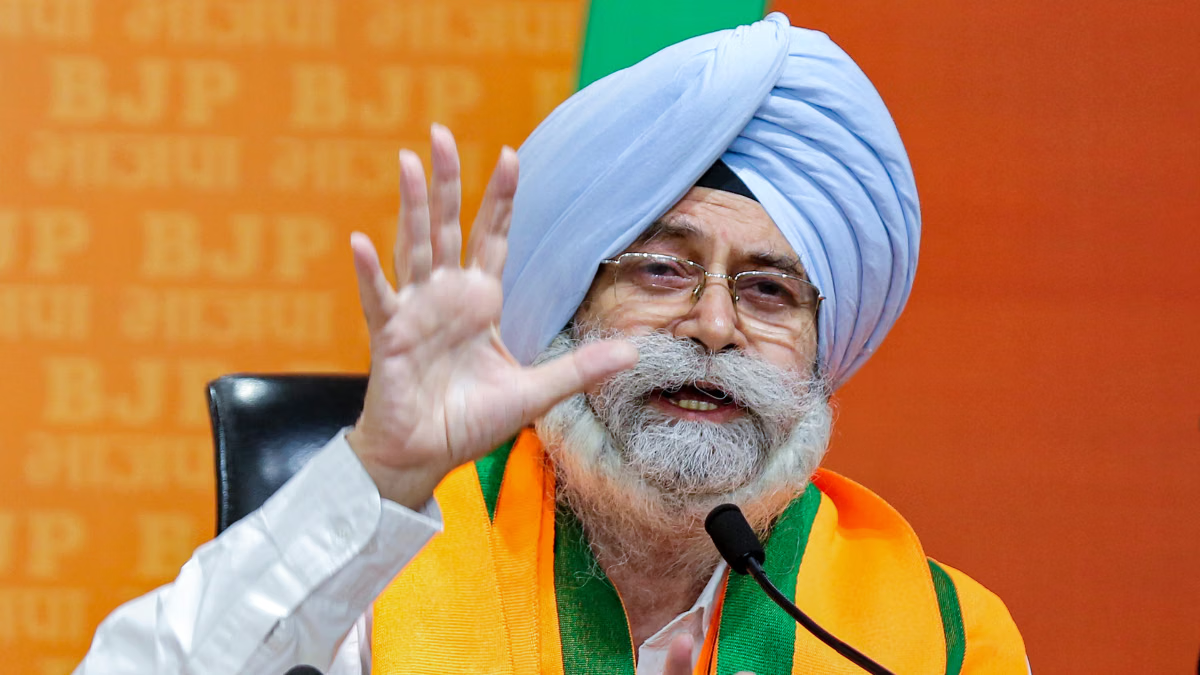
New Delhi: Senior advocate Harvinder Singh Phoolka has spent the better part of his professional life in courtrooms, arguing those cases that most lawyers dared not touch. On Wednesday, his entry to the Bharatiya Janata Party (BJP) had a link with his battle lasting over four decades.
“My close association has been with the BJP since the beginning,” Phoolka said, among other things, at a press conference. “There was no better party to return to.”
That instant felt less like a political move, and more like an old acquaintance finally shaking hands properly. The event was attended by Union Minister Hardeep Singh Puri, Delhi Minister Manjinder Singh Sirsa, and BJP national general secretary Tarun Chugh.
People acquainted with Phoolka, or have covered him for long, know the story of 2 November, 1984. For those unaware, it was the turbulent day—two days after the assassination of Prime Minister Indira Gandhi by her Sikh bodyguards—that laid the foundation of everything that followed for the soft-spoken sardar.
Phoolka was driving home with his four-month pregnant wife, Maninder Kaur, on a motorbike. A friend had stopped him to warn that mobs were attacking the Sikhs. To reach their home in Delhi’s South Extension, Phoolka had to change routes through the slums of Kotla Mubarakpur, as mobs were already out on main roads.
But, the danger was far from over. The couple was left scurrying for cover as a mob tried to barge into the building where he rented a first-floor flat. His wife moved frantically from room to room. The Punjab Hindu landlord, a BJP supporter, and his family came to their rescue. The landlady blocked the staircase with her body. Her daughter-in-law pushed the Phoolkas into a storeroom and turned the key.
“They are the reason I am here today,” Phoolka said at the press conference, returning to that episode.
What he built on from that night is without parallel in Indian legal history. Phoolka took up the cases of 1984 riot victims pro bono, accumulating files, chasing witnesses, filing petitions, and confronting a legal system that, at various points, seemed more interested in burying the matter than resolving it.
He helped found the Citizens Justice Committee in 1985. The lawyer-activist launched a documentation website in 2001. He also wrote a book, ‘When a Tree Shook Delhi’, a title that took swipe at Rajiv Gandhi’s infamous quote—“When a big tree falls, the earth below shakes.”
The book reconstructed the violence and the official indifference that followed it. He pursued his targets with specificity: H.K.L Bhagat, Sajjan Kumar, Jagdish Tytler. Bhagat died in 2005. While Tytler is doing the rounds of the court, Kumar is serving life sentence in one of the riot cases.
“What happened in 1984 wasn’t riots,” Hardeep Puri said at Wednesday’s event. “It was a cold-blooded killing of 2,300 members of my community.”
Also Read: ‘Crimes against humanity’ override delay—Allahabad HC refuses to close 1984 Kanpur anti-Sikh riot cases
AAP: A detour acknowledged
In 2014, Phoolka made his first run at electoral politics under the Aam Aadmi Party (AAP) banner, contesting from Ludhiana’s Lok Sabha seat. He lost to the Congress’ Ravneet Singh Bittu, who has since crossed over to the BJP and is now a Union minister, lending a certain irony to Wednesday’s proceedings.
Three years later, Phoolka won from Dakha assembly constituency in Punjab’s Ludhiana district. The AAP appointed him the Leader of the Opposition. What looked like a late-career reinvention did not hold.
Within months, disillusionment had set in with the AAP’s functioning, with the wider political culture, and specifically with the erstwhile Congress state government’s handling of the Ranjit Singh Commission report on sacrilege incidents.
In October 2018, he resigned as MLA in protest. The Punjab Assembly sat on the resignation for ten months before accepting it. By January 2019, he was out of the AAP entirely, telling anyone who asked that politics had been a miscalculation.
The Modi government gave him the Padma Shri that same year for his legal battle and social work involving the riot victims, a recognition that seemed to confirm what the courts had already established.
He went on to pursue the cases that had defined his life. Punjab would not be the last chapter, as it turned out.
The Punjab angle
Asked why he is re-entering politics, Phoolka pointed, with visible frustration, at what Punjab has become under its current dispensation.
The state, he describes, is one of institutional rot, extortion rackets allegedly run with impunity, gangsters reportedly issuing threats to businessmen from foreign soil, agricultural land being poisoned by overuse and government neglect.
“The land of Punjab is going to turn barren in 13 to 14 years,” he said at the press conference. “But, the government is least bothered.”
“Institutional corruption, state-led extortion calls, a lack of concern for farmers. The situation is really bad.”
At the press briefing, Chugh situated Phoolka’s arrival within the party’s established narrative of 1984, a narrative in which it positions itself as the Sikh community’s long-standing defender against the Congress’ culpability.
The BJP national general secretary recalled that former Prime Minister Atal Bihari Vajpayee had stood in Parliament during the violence, presenting a list of the dead. He noted that when Madan Lal Khurana became Delhi’s chief minister in 1993, one of his early acts was appointing Phoolka as legal advisor. “This was the first time,” Chugh said, “when I could feel that Sikhs and Punjabi language had gained respect in Delhi.”
Puri spoke of Phoolka as someone who had transcended domestic recognition to become a figure of significance among the Sikhs worldwide due to his unbroken commitment to a cause.
Both BJP leaders invoked the Kartarpur Corridor, Prime Minister Narendra Modi’s personal rapport with the Sikh community, and the broader framing of the BJP as a party of social transformation. Whether that case lands in Punjab, where the party has struggled, is a separate question.
As for Phoolka, Punjab Chief Minister Bhagwant Mann had a word of caution. “I have never seen a person who breaches the trust of those who elected him ever win again in elections,” the AAP leader said. Then, with the elaborate courtesy of political combat, Mann signed off: “But, all the best to him.”
(Edited by Tony Rai)
Also Read: ‘Another outsider’: TMC snipes as Leander Paes joins BJP weeks ahead of West Bengal polls
 20
20 584226
 20
20
 20
20