India’s richest civic body spent Rs 200 crore on trees, can’t spot the rot | Mumbai News
Three people died and more than 12 were injured after 1,856 trees collapsed across Mumbai between June 30 and July 10, an average of more than seven every hour during one of the city’s most destructive spells of tree falls in recent years.
Among the dead was 11-year-old Vihaan Srivastava, who was killed in Chembur after a peepal tree crashed onto his school bus. The tree’s entire base had been concretised, and the BMC’s own garden department had twice flagged unscientific excavations around it, The Indian Express had earlier reported.
The Brihanmumbai Municipal Corporation (BMC) has attributed the recent spate of tree falls largely to unusually strong winds. Municipal Commissioner Ashwini Bhide said wind speeds during the recent spell were nearly three times the normal velocity and announced that experts from IIT Bombay and the University of Mumbai would study how Mumbai’s tree cover could coexist with rapid urbanisation and infrastructure expansion.
But an examination of civic records by The Indian Express suggests the recent surge in tree falls cannot be viewed only through the lens of extreme weather.
The records show that the BMC still has no system for conducting periodic scientific assessments of tree health, relying instead on visual inspections and complaints from citizens to identify hazardous trees. They also show that before the city’s ambitious road concretisation project began in 2023, the roads department neither consulted the civic tree department nor sought the views of the statutory Tree Authority. The authority itself had not been constituted then because the civic body was functioning under an administrator after the expiry of the elected corporation’s term.
Between October 2023 and March 2026, the tree department issued more than 400 notices after recording over 2,600 instances of damage to tree roots during infrastructure works.
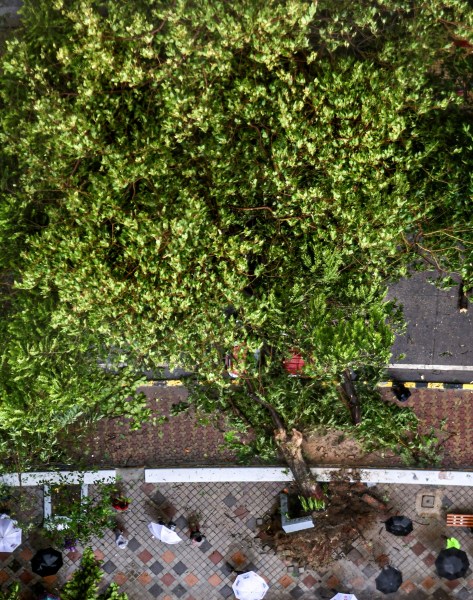 An aerial view of a tree that collapsed at Shivaji Park after heavy rain. Experts say damage to root systems, often caused by excavation and concretisation, can leave trees vulnerable to collapse during the monsoon. (Express photo Akash Patil)
Tree experts say those findings point to a deeper problem.
Story continues below this ad
“I don’t think this is purely a weather-related problem,” said veteran botanist Dr Rajendra D. Shinde, former principal and head of the Botany Department at St Xavier’s College, Mumbai, who also coordinated the BMC’s first tree census in 1998.
“Every year a few trees fall during the monsoon, but this year’s numbers are unusually high. The heavy rainfall coincided with several pre-existing problems, including weakened tree health, structural defects, concretisation around tree bases and extensive digging for infrastructure projects. Together, these factors have made many trees unstable.”
A system built around maintenance, not diagnosis
Mumbai has around 29.75 lakh trees, including nearly two lakh avenue trees lining roads, footpaths and public spaces. Their structural health is therefore critical from a public safety perspective.
According to civic officials, the city’s annual tree management programme largely revolves around two exercises: the Vriksha Sanjeevani Abhiyaan, under which obstructions such as concrete, cables, hoardings, nails and encroachments are removed from around trees, followed by the annual pre-monsoon pruning drive to reduce canopy weight. The tree department also conducts visual inspections of ageing trees and visits sites when residents complain about hazardous trees.
Story continues below this ad
“As of now, only visual inspections are being carried out,” a tree department official said. “Decay and cavities can be identified from the outside. However, if a fungal infection is affecting the tree internally, we cannot detect it unless we have modern equipment such as a Resistograph.”
That limitation lies at the heart of the city’s tree management challenge.
Despite being the country’s richest civic body with an annual budget of Rs 80,952 crore, the BMC has no dedicated programme for scientific tree-risk assessment. Although Rs 200 crore has been allocated to the tree and garden department this year, down from Rs 220 crore last year, much of it is earmarked for parks, gardens and routine maintenance rather than scientific monitoring of tree health.
“There is a need to maintain the health record of every tree in Mumbai,” said city-based biologist and horticulturist Prakash Sharma.
Story continues below this ad
“Pest attacks and changing climatic conditions often cause internal decay that cannot be detected externally. By the time the damage becomes visible, the tree has already weakened. Scientific assessments can identify such problems early and allow preventive treatment.”
Experts say several Indian cities have already moved in that direction.
Hyderabad has empanelled certified arborists to inspect hazardous trees before the monsoon and after storms, while Chandigarh maintains GIS-based tree inventories and periodically assesses ageing and heritage trees through formal tree-risk assessment programmes.
Scientific evaluations are commonly carried out using technologies such as Resistographs, which measure internal wood density without significantly damaging the tree, and sonic tomography, which uses sound waves to detect hidden decay and cavities. Civic officials confirmed that the BMC possesses neither.
Story continues below this ad
“Usually, the BMC carries out specialised studies through third-party agencies. Therefore, there is no requirement to purchase such equipment because contractors are required to have their own instruments,” a civic official said.
The absence of scientific assessments has been flagged before.
In 2021, the BMC appointed an arborist to scientifically examine around 150 ageing trees in the Peddar Road and Walkeshwar areas. Although the assessment was completed, the report was never made public. Queries sent to civic officials and the arborist did not elicit a response.
A year later, the civic body announced that tree surgeons would be appointed across all municipal wards to conduct scientific tree-risk assessments. The proposal never materialised.
Mumbai also went 15 years without a tree census. The previous census was completed in 2011, although the next was due in 2016. The fresh exercise began only in May this year and is expected to continue until early 2028.
Story continues below this ad
Sharma, however, said counting trees alone will not make them safer. “A tree census tells us how many trees exist. It does not tell us whether they are healthy or structurally stable. At a time when the city is witnessing large-scale road concretisation, assessing the condition of tree roots has become equally important.”
Concrete threat
The recent spate of tree falls has also renewed scrutiny of Mumbai’s road concretisation project.
Civic records show that when the project was launched in 2023, no formal consultation took place between the roads department and the tree department because the statutory Tree Authority had not been constituted.
“As the Tree Authority did not exist then, there was no formal consultation between the roads department and the tree department before the project began. Consequently, the roots of several trees were damaged during the works,” a civic official said.
Story continues below this ad
“Roots are the lifeline of a tree. They absorb water, oxygen and nutrients while anchoring the tree firmly to the ground. Damaging them through excavation or concretisation weakens that support system and increases the risk of collapse,” the official added.
Dr Shinde said road excavation and concretisation can weaken trees long before they show visible signs of distress.
“Concrete around the tree base prevents proper aeration and compacts the soil, reducing oxygen available to the roots and eventually causing root decay. Excavation for utilities such as gas pipelines, electricity cables and other civic works often cuts major roots. Exposed roots become vulnerable to fungal infections and decay, weakening the tree’s anchorage and making it more susceptible to collapse,” he said.
Environmentalist Stalin D, director of NGO Vanashakti, said Mumbai’s approach to road construction has further compounded the problem.
Story continues below this ad
“These kinds of incidents happen only in Mumbai because no other city concretises tree basins. As a result, trees are left with barely two square metres of exposed soil. Their roots cannot expand, soil moisture reduces and the trees gradually lose their structural balance, making them far more vulnerable during heavy rain and strong winds,” he said.
While climate change may be contributing to more intense rainfall, Shinde believes it is only one part of the story.
“Climate change may contribute indirectly. Prolonged heat can dry and compact the soil, while sudden heavy rainfall and waterlogging can reduce a tree’s stability. But most tree falls are caused by human interference, including root damage, digging, concretisation and injuries to trees. These man-made factors play a much greater role than climate change alone.” He said healthy trees are naturally capable of withstanding the kind of winds Mumbai witnessed earlier this month.
“Healthy, deep-rooted trees can generally withstand such winds unless conditions become cyclonic. Wind alone rarely brings down a tree. Trees usually fall when strong winds act on root systems that have already been weakened by decay or human activity.”
Drawing a comparison with forests, Shinde said the contrast was telling. “If you compare urban areas with forests such as Tadoba or Sanjay Gandhi National Park, some trees fall there too—but generally only those that are naturally old or decayed. That comparison clearly shows the extent to which human interference contributes to tree falls in cities.”
What next?
Following the recent fatalities, the BMC has begun considering changes to the way it manages the city’s trees.
An expert committee constituted after the June 30 Chembur tragedy has recommended that future civic tenders include mandatory provisions making contractors and executing departments responsible for protecting trees near project sites. It has also proposed compulsory pre-assessment of the impact of roadworks and utility projects on tree roots by empanelled experts before work begins.
The civic body is also considering empanelling certified arborists and biologists, introducing scientific tree-risk assessments, launching a “Vriksha Mitra” programme involving citizen groups and commissioning experts from IIT Bombay and the University of Mumbai to recommend long-term measures for protecting Mumbai’s urban tree cover.
For Shinde, however, the biggest change has to be in the city’s approach to trees.
“Visually identifying a dead tree is easy, but recognising an unhealthy tree that still appears green is much more difficult,” he said. “The BMC should conduct regular scientific risk assessments before and during the monsoon using technologies such as sonic tomography, which can detect internal decay that is invisible from the outside.”
He also said contractors carrying out civic works should work under expert supervision and at least two feet of open soil should be left around every tree to improve aeration, drainage and root growth.
For now, Mumbai has nearly 30 lakh trees, but no scientific system to identify which ones are most at risk of collapse before the next spell of heavy rain.
 20
20 584226
 20
20
 20
20