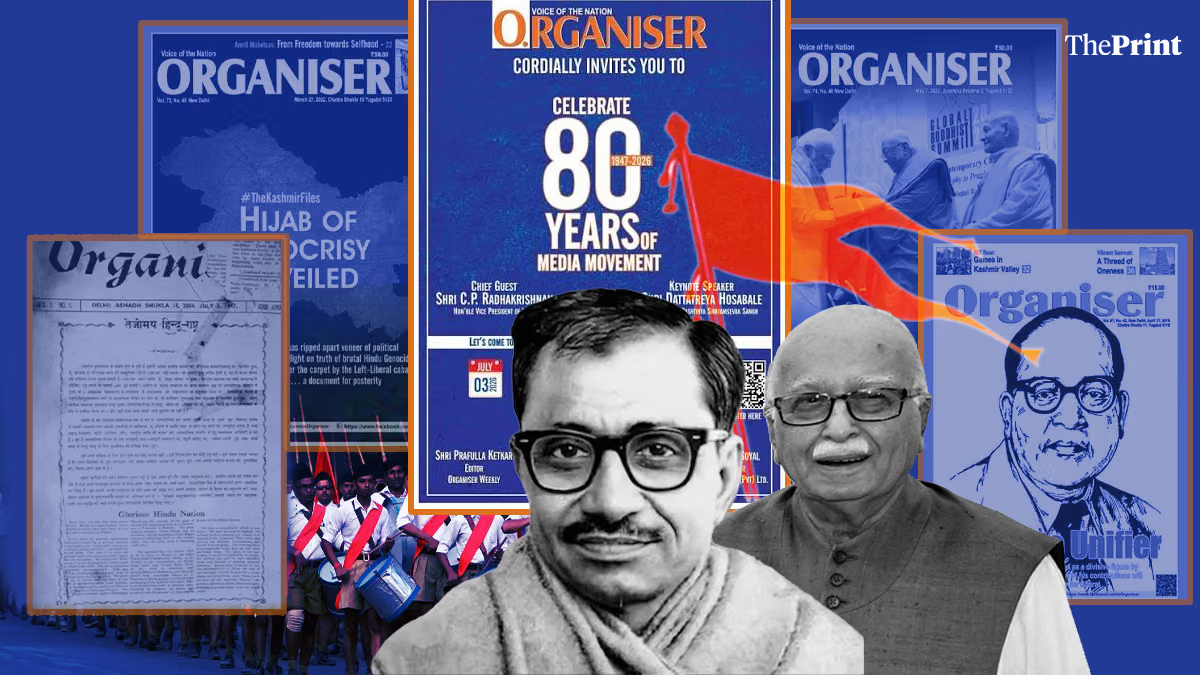
Advani wrote for it on cinema: 80-yr journey of Organiser Weekly
Published by Bharat Prakashan (Delhi) Ltd, with its headquarters in New Delhi, the publication covers politics, national security, culture, and societal issues. Bharat Prakashan was registered in 1946, holds annual AGMs and is governed by a Board of Directors elected by shareholders on a rotational basis.
What sets it apart from other family-run media houses is that it began “with contributions from more than 14,000 shareholders across the country, making it the only media house not owned by an individual or a corporate house”.
“Hence, no official relationship with the RSS. We have around 50,000 readership base, besides around 1 million unique visitors to the website,” Prafulla Ketkar, editor of Organiser Weekly, told ThePrint.
Explaining its history, Ketkar added that when the publication started as a weekly newspaper in 1947, there was no space for cultural nationalism with a strong Bharatiya perspective in the English media. “The Hindu spiritual point of view had suddenly become ‘communal’ with the rise of the Muslim League. When Independence was around the corner, there was confusion and uncertainty among the English-speaking intelligentsia about who we are and what the process of national reconstruction would entail. Most policymakers were influenced by the British way of perceiving Bharatiya socio-cultural and economic realities.”
In their 2022 book, The Rise of the BJP: The Making of the World’s Largest Political Party, Union Minister Bhupender Yadav and economist Ila Patnaik dwell on the significance of Organiser Weekly. According to them, the RSS had by 1948 “established an English weekly, Organiser, to obtain greater reach for its ideas”.
“While launching it, Golwalkar said, ‘For clear, straightforward, impartial views on subjects of national and international importance and for imbibing unadulterated patriotism, it is useful to read Organiser. It will fulfil the expectations for correct guidance in all current affairs’,” they recorded in their book.
Ketkar said the idea was to fill this gap and provide a platform for diverse indigenous perspectives based on Bharatiya civilisational experiences.
Arun Anand, author and research director with Delhi-based RSS-affiliated think-tank Vichar Vinimay Kendra, emphasised that the first amendment to the Constitution, brought in by the Nehru government, was “an outcome of the Nehru government’s intent to clamp down on voices critical of the government”.
And Organiser Weekly was one of them. The other was the Communist-leaning journal CrossRoads, founded and edited by Romesh Thapar.
“Incidentally, one of the immediate triggers for restricting freedom of expression by Nehru was primarily the battle between him and Organiser, an English weekly backed by Rashtriya Swayamsevak Sangh (RSS),” Anand argued in ThePrint.
Organiser Weekly eventually moved the Supreme Court which on 26 May, 1950, delivered two landmark judgements: Brij Bhushan v. State of Delhi and Romesh Thappar v. State of Madras. The top court ruled that the “imposition of pre-censorship on a journal is a restriction on the liberty of the press which is an essential part of the right to freedom of speech and expression”.
But censorship was not the only challenge. Ketkar recalled Advani telling him how at one point resources were meagre and some eminent writers had to contribute without their byline. “They used to secretly give the handwritten articles, without visiting the office. Building a distribution channel was a big challenge. Good journalists were fearful about being associated with Organiser,” said Ketkar.
A writer with Organiser Weekly was one of the many hats Advani donned.
The swayamsevak and lawyer who went on to become one of the co-founders of Bharatiya Janata Party (BJP) and later Deputy Prime Minister of India, worked there as an assistant editor from 1960 till 1967.
Also Read: RSS chief Mohan Bhagwat set to visit US & Canada later this year as part of Sangh’s centenary outreach
‘It is our own journal’—what Upadhyaya told Advani
In 2020, in an article published by Organiser Weekly—headlined, “The Organiser Years: LK Advani recalls his stint as a journalist”—Advani explained how after choosing to lead the life of a pracharak-cum-political activist and having migrated to Kutch, he now had to take care of his father and elder cousin.
Advani said he shared his predicament with Jana Sangh leader Deendayal Upadhyaya who then advised him to take up a job with Organiser Weekly.
“It is our own journal,” Upadhyaya reportedly told Advani.
Advani was quoted as saying in the article that his days with Organiser Weekly “necessitated a change in my sartorial appearance. Ever since I started working as an RSS pracharak in Rajasthan, I had stopped wearing trousers and shirt and, instead, switched over to the Indian-style dhoti and kurta.”
Advani eventually began writing a regular cinema column under the pen name ‘Netra’ (eye) and in that capacity attended several international film festivals and other cinema-related events in New Delhi.
In 1977, after Advani was given charge of the Ministry of Information and Broadcasting in Morarji Desai’s government he started interacting with renowned filmmakers and was recognised by Khwaja Ahmad Abbas and Prithviraj Kapoor who said to him: “I have seen you before somewhere but I can’t figure out where? I had to remind them that, as film critic of the Organiser, I had attended their press conferences at their film releases, and both of them, separately, remarked: ‘I am pleasantly surprised that we have a Minister who has earlier been a film critic’.”
‘Discourse in favour of Hindu politics’
Articulating the cornerstone of Organiser Weekly, its former editor R. Balashankar told ThePrint that in the period immediately following the Partition there was a dearth of publications giving adequate information about the Hindu Right.
Though the publication started before the Partition, he said it was very different in the sense that most mainstream dailies only carried pro-establishment information. “So there was a lack of information basically on the Hindu side of this story on the Partition, the Hindu side of the story on freedom, and the Independence movement etc. So basically, the space for the opposition was vacant at the time,” he said.
Balashankar recalls receiving feedback and advice from senior RSS functionaries including Mohan Bhagwat, who is now sarsanghachalak.
Increasing circulation, said Balashankar, proved to be a difficult task given that the UPA was in power when he assumed charge as editor. The overall atmosphere was not as conducive for the BJP as it is now, he added.
Balashankar also pointed out that their focus was furthering discourse in favour of ‘Hindu politics’. For instance, they brought out thematic specials on issues such as the Ram Setu and Ram Janmabhoomi, among others.
Vice President C.P. Radhakrishnan, who addressed the 80th Foundation Day event, while referring to himself as a swayamsevak, said Organiser Weekly actively participated in national debates on unity, integrity, security, culture and governance. He cited its engagement with the discourse over J&K, the Praja Parishad movement, wars with China and Pakistan, and the concept of Swadeshi.
Describing the publication’s journey as one of “continuity, resilience and sustained commitment to public discourse across generations,” he said the legal challenge mounted against pre-censorship became a milestone in the evolution of media freedom in independent India, reinforcing the importance of a free press.
RSS general secretary Dattatreya Hosabale, who was also present at the 80th Foundation Day event, said Organiser Weekly ‘shaped’ his ideological understanding, especially in the 1970s when he was studying in Bengaluru.
It was common for activists to read publications such as Blitz and Organiser which came in handy while preparing for debates on nationalism, socialism among others, he said, claiming that it is the most quoted periodical in the Indian Parliament. “What Organiser writes is the voice of a major nationalist view of this country. This is known in the political media and administrative circles and even in the international arena; even the ambassadors who sit in Chanakyapuri are trying to know what the Organiser says, to know the other viewpoint. So the Organiser has become a part of the thought movement of the country,” Hosabale said.
Ketkar acknowledged that Organiser Weekly takes inspiration from the RSS but maintained that RSS officebearers are in a way not responsible for editorial content unlike mouthpieces of the Communist Party of India (Marxist) and Shiv Sena (Uddhav Balasaheb Thackeray) where party chiefs dictate editorial policy.
“Every media house has an ideology and editorial line. Organiser, in its first edition, declared that we are not a mouthpiece of any party or organisation, but we stand for ‘Tejomay Hindu Rashtra’ (Glorious Hindu Nation). The publication took inspiration from RSS and was never ashamed of it. But none of the RSS officebearers is responsible for the editorial content, unlike, say, Peoples Democracy or Samana, where the party head is the editor. We enjoy absolute autonomy in our operations,” he added.
Also Read: At heart of RSS-linked tribal body’s pushback on ST benefits for converts, an Indira-era Congress minister
Serving an ideology, not persons
What sets Organiser Weekly apart, according to Balashankar, is that most media organisations are profit-driven and have other obligations. “It is basically their business. They are earning profit from it. The Organiser is not. There is a need for promoting certain vested interests. It could be business interest, etc. but the Organiser is very different from that because this is basically an ideological publication. This is not owned by a particular person or a group of people.”
Those who invested in the publication or buy its subscription are ordinary swayamsevaks, he said, adding that profits are only used for capital formation. “Nobody is going to take it. Even the shareholders will not ask for a share of the profit,” said Balashankar.
He also explained that the publication serves not persons, but an ideology—cultural nationalism. “It is for the country, what is best for the country and the country’s interest. Ideologically, we have now become a very prominent ideological formation, national acceptability has increased. So the organisation has a bright future, and it will continue to grow.”
Ketkar said every editor who took charge of Organiser Weekly faced their own share of challenges. “In the beginning, A.R. Nair, who had worked in China and did not come from an RSS background, took over as the founding editor. During the difficult times of the Partition, he consistently followed up on the refugee crisis.”
K.R. Malkani, he said, was in a different league and became a ‘warrior for media freedom’ when censorship was imposed or when the Emergency was proclaimed.
According to Ketkar, Malkani was the one who convinced Deendayal Upadhyaya to write a regular column, ‘political diary’, for Organiser Weekly. “He encouraged Advani ji to write on films and the way the Cold War was depicted in Hollywood movies. Advani brought an international perspective and contributed immensely during the China war with his analysis and forthright views,” Ketkar added.
During the tenure of V.P. Bhatia, the publication introduced a satirical column, Ketkar added while pointing out that under Seshadri Chari ‘colour’ was added to ground reporting, especially during the Ram Janmabhoomi and Swadeshi movements. “He also started a special focus on our neighbourhood policy. R. Balashankar ji vociferously exposed corruption and anti-Hindu policies of the Sonia Gandhi-led UPA government.”
Ketkar, who took charge in July 2013, said transforming the weekly newspaper from tabloid to a magazine format was a critical step, and the entire management supported that editorial effort, he said.
He also said that the publication is trying to keep pace with technology. “With changing technology, algorithm-based media, and the changing pattern of news consumption, Organiser has also transformed itself. Through the website, social media and YouTube channel, we are trying to catch up with this trend.”
Ketkar said at a time when the digital space is being used to create or further fault-lines in society, Organiser Weekly is trying to address them from a ‘Bharatiya’ perspective. “The foundational ideas will remain the same, but as times change, so do the issues and the editorial content. We will continue to uphold the same spirit and conviction to celebrate diversity amidst the inherent unity of this ancient Rashtra,” he said.
This is an updated version of the report.
(Edited by Amrtansh Arora)
Also Read: RSS isn’t Indian version of Ku Klux Klan, Hindus have nothing to apologise for—Dattatreya Hosabale in DC
 20
20 584226
 20
20
 20
20