Akal Takht gives Punjab govt 1 month to change anti-sacrilege law
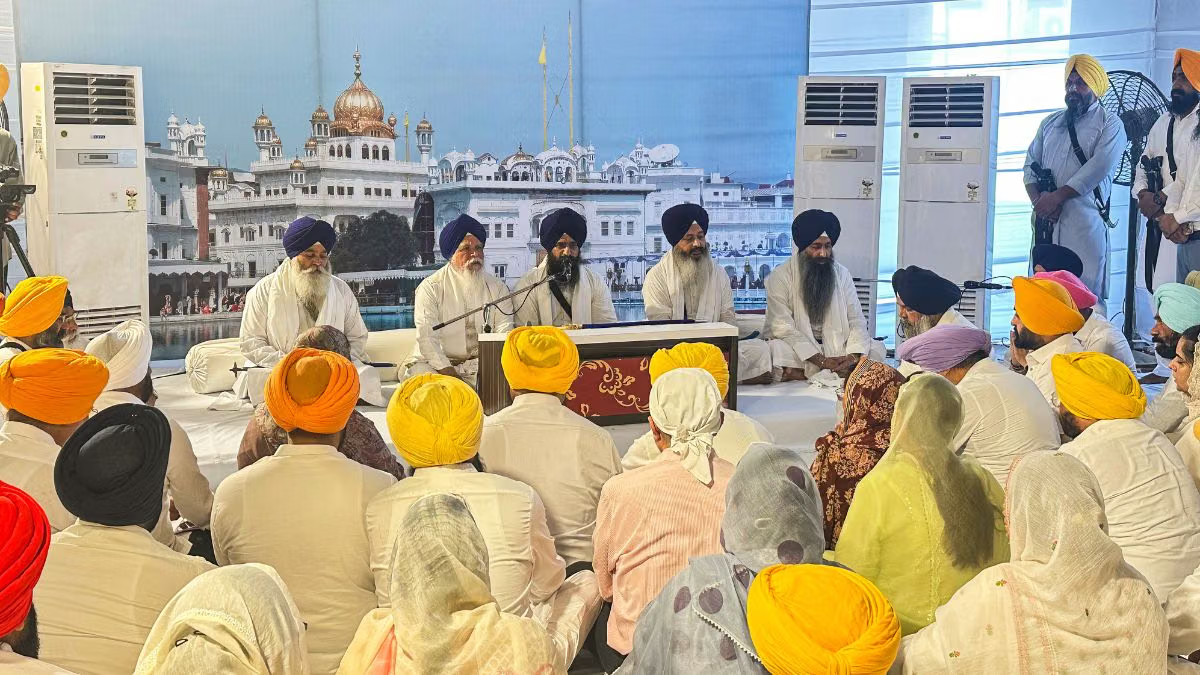
At the end of nearly two hours of deliberations, Akal Takht Jathedar Giani Kuldip Singh Gargajj said all legislators who attended the meeting had “admitted” that a mistake had been committed while passing the legislation and had accepted the directions of the Akal Takht.
Addressing the media after the meeting, Punjab Finance Minister Harpal Singh Cheema and state assembly Speaker Kultar Singh Sandhwan stopped short of committing to implementing the changes. They said the changes conveyed by the Akal Takht would be considered by the government, which would then take a final decision.
The Punjab assembly had on 13 April, during the special session called on Baisakhi, passed the Jaagat Jot Sri Guru Granth Sahib Satkar (Amendment) Bill, which provides for strict punishment for the sacrilege of the Guru Granth Sahib, considered to be a living guru by the Sikhs. A week later, Punjab Governor Gulab Chand Kataria gave his assent to the anti-sacrilege Bill.
The passing of Bill was hailed as a “game-changer” by the ruling AAP ahead of the assembly elections expected early next year.
Monday’s proceedings marked an extraordinary assertion of the Akal Takht’s authority over legislation relating to Sikh religious affairs.
Never before has the Akal Takht summoned almost the entire Sikh political leadership of Punjab—including ministers, the Assembly Speaker, ruling party MLAs, opposition legislators and independent members—over a legislation enacted unanimously by the Punjab assembly.
CM Mann was not called to the meeting, having been declared “anti-Guru” and “anti-Khalsa Panth” in connection with the controversy surrounding the alleged sacrilege video.
According to the list released by the Secretariat of the Akal Takht, 69 AAP MLAs and ministers attended the hearing. Fifteen Congress legislators, two Shiromani Akali Dal MLAs and independent MLA Rana Inder Partap Singh were also present. Four non-Sikh ministers submitted written explanations while two non-Sikh legislators attended voluntarily.
Also Read: What Akal Takht declaring Bhagwant Mann ‘anti-Guru’ means for him & AAP in the sole state it rules
‘Government encroached on Akal Takht’s authority’
Opening the proceedings, Jathedar Gargajj explained why the Akal Takht considered itself duty-bound to intervene despite the issue involving legislation passed by an elected assembly.
Invoking the Sikh principle of Miri-Piri, he said the Akal Takht represented the temporal as well as spiritual authority of the Sikh Panth and could not remain silent when politics encroached upon matters relating to the Guru Granth Sahib.
He told the legislators that no government could legislate on matters concerning Sikh religious traditions without consulting representative Sikh institutions.
He also reminded the gathering that everyone present shared the same Guru and urged members to maintain decorum, speak truthfully and respect the sanctity of the Akal Takht.
MLAs questioned over provisions of the Act
The hearing then turned into what resembled a clause-by-clause examination of the amended legislation.
At the outset, the Jathedar played two video clips of the chief minister in which he had spoken about bringing stringent legislation against sacrilege.
In one of the videos, Mann is heard saying that those accused of sacrilege are often described as mentally disturbed and questioning why such persons invariably target gurdwaras. He also says that under the proposed legislation, even the parents of such persons would be held accountable.
After playing the clip, the Jathedar asked the legislators whether that provision had eventually found a place in the Act. Several MLAs said they were unsure. Shiromani Akali Dal MLA Manpreet Singh Ayali also said he was not certain.
The questioning then shifted to one of the Akal Takht’s principal objections—the use of the word “custodian” in the Act. The Jathedar asked legislators what the expression meant. Some said they did not know. The Jathedar then said that this itself reflected the lack of understanding surrounding the provision.
The Akal Takht has consistently maintained that no individual can be described as the “custodian” of the Guru because, according to Sikh belief, the Guru is the custodian of the Sikhs and they are merely sevadars.
‘Did you even read the Act?’
The Jathedar asked members whether they had actually read the legislation before supporting it.
Akali MLA Jagroop Singh replied that he had not.
AAP MLA Kulwant Singh also said that he had not read the Bill because it had been circulated at the last minute.
Leader of Opposition Partap Singh Bajwa said the Bill had been supplied to members only shortly before it was taken up in the House, leaving little opportunity for a detailed reading. He read out his speech in the Vidhan Sabha to highlight that he had suggested that the SGPC be consulted along with Sikh scholars before the Bill is passed. “But my objections were overlooked,” said Bajwa.
Congress MLA Pargat Singh echoed the point, saying there had not been enough time to study the legislation. Congress MLA Sukhpal Singh Khaira said members had received the Bill on the electronic devices installed on their assembly desks while the House was already in session.
At one stage, when Khaira was making his submissions, several legislators interrupted him simultaneously. The exchanges grew loud enough for the Jathedar to intervene sharply.
Reminding members that they were inside the Akal Takht, he asked everyone to maintain discipline, after which the proceedings resumed and he asked Khaira not to politicise the issue.
The Jathedar also questioned Akali MLA Ganieve Kaur Majithia about why she had not attended assembly on the day the Bill was passed. Ganieve Kaur replied that as a woman legislator she found the atmosphere in the assembly humiliating.
She added that since the legislation had not been approved by the Akal Takht, she saw no reason to participate in the proceedings.
2017 Maur blast and 2015 sacrilege investigations
The discussion then moved to pending sacrilege investigations.
The Jathedar referred to the Maur blast in which seven persons, including a child, had lost their lives, and asked why justice had not been served.
Opposition legislators alleged that a file seeking sanction to proceed against Dera Sacha Sauda chief Gurmeet Ram Rahim in connection with the case had been pending with the CM for nearly two-and-a-half years.
The Jathedar also sought an explanation regarding the failure to prosecute the Dera chief in the 2015 sacrilege cases.
Opposition members argued that several cases had subsequently been transferred outside Punjab because the government had failed to defend them adequately.
AAP MLA Gurpreet Singh responded that chargesheets had already been filed wherever investigations had been completed and that summoning additional accused was a matter for the courts.
‘Akal Takht’s domain’
The Akal Takht reiterated that while it fully supported stringent punishment for sacrilege, several provisions of the amended law were not in the domain of the government but of the Akal Takht and the Sikh panth.
The Jathedar said the replacement of the word ‘bir’ with ‘saroop’ to refer to the Guru Granth Sahib was not acceptable to them. “The bir is a word of great antiquity and it has been used to refer to the Guru Granth Sahib for centuries. Replacing this word with saroop is not appropriate. Saroop word can be used along with bir but cannot replace it,” he said, adding that any change in the use of Sikh terminology can only be done by the Akal Takht or the panth, not a government.
The Jathedar also said that a provision in the amended act made it binding on the SGPC to maintain a central registry of all those to whom the Guru Granth Sahib has been given and make the list public by putting it on the SGPC website. “The SGPC is already maintaining such a register but this list cannot be put in the public domain because that will lead to everyone knowing who has the Guru Granth Sahib, which can further lead to negative consequences.”
He also objected to the law providing for an electronic marking on every Guru Granth Sahib with the unique identification number.
The Jathedar further opposed a clause that provides for punishment up to 5 years to anyone who is otherwise not involved in the act of sacrilege but violated other conditions in the Act. “Who is this provision for? This will be used against those working in gurdwaras and engaged in the care and seva of the Guru Granth Sahib.”
He said that till these changes are made, the law should be kept “on hold”.
On Monday, the Jathedar also proposed an additional amendment, saying that where followers of any anti-Sikh dera commit sacrilege under the influence or directions of its leadership, criminal liability should extend not only to the individual accused but also to the head of the dera concerned.
Akal Takht vs Punjab govt
The current confrontation between the Punjab government and the Akal Takht has its origins in the state’s attempts over the past year to legislate against sacrilege.
The process began in July 2025 when the AAP government introduced the Punjab Prevention of Offences Against Holy Scriptures Bill, 2025, which sought to provide enhanced punishment for sacrilege involving the holy scriptures of all religions. The Bill was referred to a 15-member Select Committee of the Punjab assembly headed by former minister and AAP MLA Inderbir Singh Nijjar for wider consultations with religious bodies, legal experts and other stakeholders. However, the committee did not submit its report before the government decided to take a different legislative route.
In March this year, following meetings with the Sant Samaj and various Sikh religious organisations, CM Mann announced that his government would amend the existing Jaagat Jot Sri Guru Granth Sahib Satkar Act, 2008 by convening a special session of the Punjab assembly on 13 April, coinciding with Baisakhi.
The SGPC during its annual budget meeting on 28 March objected to the proposal as announced by the CM. On 6 April, the SGPC convened a meeting of representatives of Sikh bodies that resolved that while a stricter law should be brought in against sacrilege, it should be based on “panthic consensus”.
The SGPC also shared with the media multiple letters written to the government to clarify the contents of the Bill to which, it said, the government had not responded.
The Jagat Jot Sri Guru Granth Sahib Satkar (Amendment) Bill, 2026 was passed on 13 April and the Governor gave his assent on 17 April. While the original 2008 Act was primarily a regulatory law restricting the printing, publication and distribution of the Guru Granth Sahib to authorised agencies such as the SGPC, the 2026 amendment transformed it into a penal statute prescribing punishment ranging from seven years’ imprisonment to life imprisonment and fines extending to Rs 25 lakh for acts of sacrilege.
The Akal Takht objected to several provisions which it said interfered with Sikh religious practices and had been enacted without consulting the Akal Takht or the SGPC.
On 8 May, the Akal Takht summoned the Punjab Assembly Speaker and sought an explanation on why the legislation had been enacted without consulting the central Sikh institutions. After hearing the Speaker, the Akal Takht formally communicated a detailed list of objections to him on 11 May and directed that the law be amended within 15 days.
When none of the objections was addressed, the five Singh Sahibans met on 15 June and decided to summon all Sikh Cabinet ministers except Mann, and all Sikh MLAs of every political party to appear before the Akal Takht.
(Edited by Gitanjali Das)
Also Read: Mask or masquerade: Oppn wants forensic test of CM Mann’s latest ‘proof’ against sacrilege charge
 20
20 584226
 20
20
 20
20