The man behind 150 lake restoration projects wants to transform Hyderabad’s water bodies
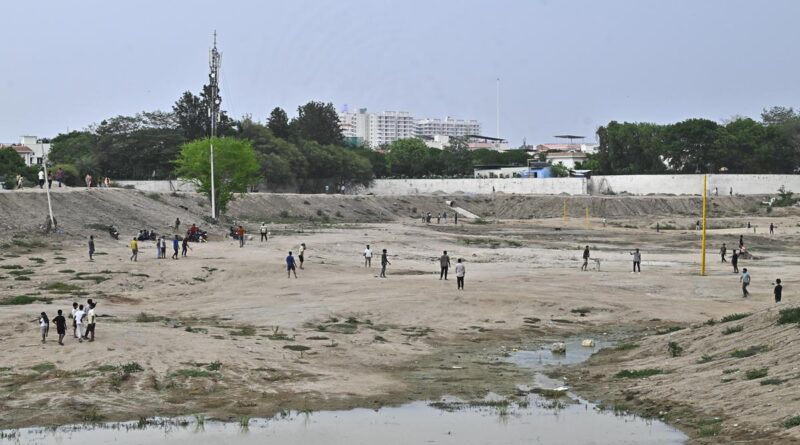
A routine unfolds around the 24-acre Kaidamma Kunta lake in Hyderabad’s Hafeezpet. A man walks his dog along a track while, on the barren lake bed surrounded by apartment complexes, a group of boys turns the open expanse into a cricket ground.
“It used to be a dumpyard, with sewage water and garbage thrown all around. People could not come near it because of the stench. Now, this walking track is used by residents from the neighbourhood,” says Chaitanya of the Malligavad Foundation, an NGO working to revive urban lakes.
“Drainage water once flowed directly into the lake and polluted it. But two inlets and outlets were created to divert sewage away, allowing only rainwater to enter,” he adds.
Lake restoration projects

Anand Malligavad
| Photo Credit:
Special Arrangement
The Bengaluru-based Malligavad Foundation’s journey in Hyderabad began with the restoration of Bakshi Kunta lake in 2022. Supported by HYDRAA (Hyderabad Disaster Response and Asset Protection Agency) and the GHMC (Greater Hyderabad Municipal Corporation), the initiative has since expanded to include the revival of Regula Kunta, Gurunadham Cheruvu and Nayinamma Kunta.
How does it work?
“GHMC gives permission to revive a lake after checking the technicalities and the foundation’s approach,” explains Anand Malligavad. “We bring in the CSR funds but cannot directly begin the work since GHMC is the custodian of these lakes. The department of minor irrigation, under whose jurisdiction these lakes come, have also supported in issues relating to survey and marking the boundaries.”
HYDRAA plays a pivotal part in clearing the encroachments at the lake . “It is only due to HYDRAA’s anti-encroachment operations, all the encroached land worth 100 crores of property is being restored.”
“Our lake restoration work is like a web series — an ongoing endeavour,” says Anand Malligavad, referring to projects lined up at Lingam Gunta, Chakalavani Cheruvu, Devuni Gunta, Medla Kunta, Pragathi Nagar Lake, and Patel Cheruvu.

Residents relax at Kaidamma Kunta lake in Hafeezpet
| Photo Credit:
SIDDHANT THAKUR
For Anand, the Bengaluru-based environmentalist and founder of the foundation, Hyderabad is his janma bhoomi and Bengaluru his karma bhoomi. Hailing from Karmudi village in Karnataka’s Koppal district, historically part of the Hyderabad State under the Nizam before Independence, he feels a strong connection to the city.
June is a crucial month for the conservationist, as pre-monsoon and monsoon rains play a key role in the success of lake rejuvenation efforts. His journey into lake conservation began in Bengaluru in 2017 after he read a newspaper report warning that several cities could run out of water by 2030. While Cape Town topped the list, Bengaluru — the city where he lives and works —was followed by Hyderabad.
“Serilingampally mandal alone has nearly 80 lakes, and I want to revive them,” he says.
Collaboration and more

file photo of Bakshi Kunta lake restored by Malligavad Foundation
| Photo Credit:
Special Arrangement
According to Anand, the foundation’s lake rejuvenation model is a comprehensive, multi-step process driven by collaboration between government agencies and local communities. Once a lake is identified, a detailed project report is submitted to the GHMC and approved by its technical committee. An MoU (Memorandum of Understanding) is then signed to facilitate grassroots participation.
“We discuss the issues with local communities and create a rejuvenation plan,” he says.
The process, which typically spans around 100 days, with occasional pauses due to rain and logistical challenges, involves dewatering, deweeding and desilting the lake. Teams also strengthen the bund, repair and recondition inlets and outlets, and clear encroachments from the water body. This is followed by the creation of walking tracks, small bird islands and tree plantations.
The idea, Anand says, is to revive lakes ecologically through Nature-based solutions, without using concrete or steel. “We have implemented this model in 150 lakes across the country,” he says.
“There is no problem if a lake dries up. The real issue begins when untreated sewage enters it. That leads to eutrophication and eventually methanogenesis, the process that generates methane gas. Methane is a potent greenhouse gas that affects air and groundwater quality, disrupts ecosystems, destroys flora and fauna, and poses risks to public health,” he explains.

File photo of Regula kunta lake
| Photo Credit:
Special Arrangement
CSR initiatives play a vital role in funding the revival of these urban water bodies. “We spend nearly 90% less than what authorities typically spend on lake rejuvenation, while completing the work in less time and in a more eco-sensitive, self-sustaining manner. Because we rely on eco-friendly methods and natural materials, maintenance requirements are significantly lower, allowing these lakes to remain sustainable for five to 10 years,” he says.
Engaging local community

Children play cricket at Kaidamma Kunta lake in Hafeezpet
| Photo Credit:
SIDDHANT THAKUR
Fostering community ownership is central to these projects. Residents play a key role in preventing pollution, monitoring lake health and ensuring the long-term survival of revived water bodies.
“We engage citizens — walkers, joggers, pet owners and children — to be more aware of their surroundings. My team is also part of residents’ WhatsApp groups, where locals report plastic waste or civic violations, which are then addressed immediately,” says Anand.
While community participation strengthens long-term protection and management, challenges remain. “I am fed up with open defecation because it is difficult and inhuman for those who have to clean it. People throw plastic and garbage into lakes, cut down newly planted trees or immerse idols in the water, undoing much of the restoration work,” he says.
Restoring ‘nalas’

A man walks his pet at Kaidamma Kunta lake in Hafeezpet
| Photo Credit:
SIDDHANT THAKUR
The foundation is credited with reviving around 45 lakes in Bengaluru over the past five years. Yet the city continues to witness monsoon flooding. Anand attributes this to the loss of water bodies and the neglect of the raja kaluve — Kannada for “king’s canal” — the city’s traditional primary stormwater channels.
“Whether it is Bengaluru or Hyderabad, cities have expanded by engulfing surrounding villages and rural landscapes. Most of Bengaluru’s historic lakes have been buried or concretised, which means rainwater can no longer be retained or percolate into the ground,” he says.
Hyderabad, like Bengaluru, was once naturally resistant to flooding because of its valleys, lakes and river systems, he adds. “But the nalas, or stormwater drains, that should be 50 feet wide have shrunk to barely five feet in many places. When these drains are clogged, covered or encroached upon, even a small spell of rain can lead to flooding. Reviving lakes alone is not enough; restoring and protecting nalas is equally critical to preventing urban floods.”
 20
20 584226
 20
20
 20
20