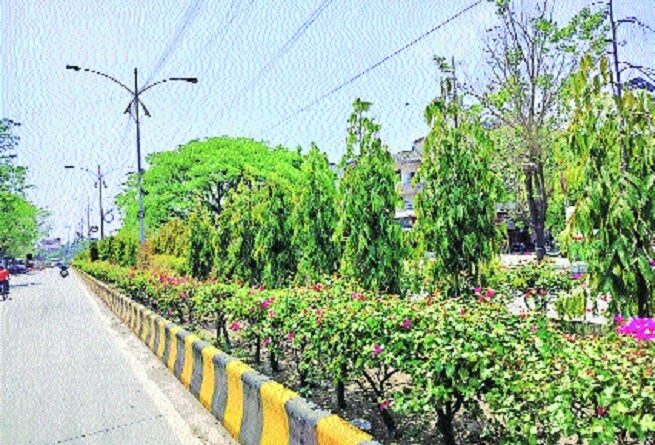
Planting saplings but losing nature: The hidden biodiversity crisis in Nagpur
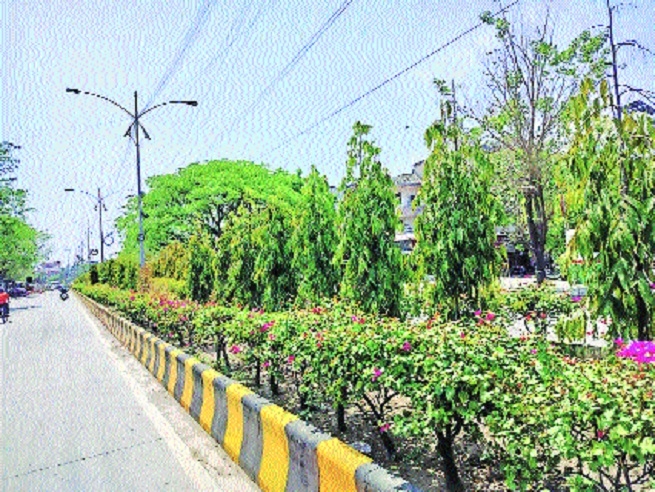
Tree plantations success is frequently measured through plantation numbers and survival rates
rather than biodiversity outcomes
By Simran Shrivastava :
Every monsoon, thousands of saplings are planted across Nagpur. Road medians turn green and traffic corridors bloom with colour and so at a distance, the city appears to be expanding its green footprint. Yet beneath this greening, botanists are raising a less obvious question: What happens when a city gains trees but loses biodiversity?
City plantations are being more focused on a small group of ornamental and exotic species, even as many indigenous trees become rarer. The city might not be totally running out of greenery, but the ecological richness that was earlier embedded within that greenery sure is.
Dr S R Somkuwar, Professor and Head, Department of Botany, Dr Ambedkar College, noted that road widening projects, infrastructure expansion and contemporary plantation practices have contributed to the decline of many indigenous and historically common tree species. He said recent roadside and urban plantations are increasingly
dominated by Gulmohar, Ashoka, Foxtail Palm, Tabebuia (Gulabi Bahar), Shiris, and Bougainvillea.
Dr Somkuwar pointed to the shrinking presence of rare indigenous species as evidence of this shift. Among them is Crataeva religiosa, the medicinal Barni or Varuna tree, now increasingly difficult to find in densely urbanised parts of Nagpur. Mature specimens survive in only a handful of locations, including the College of Agriculture campus adjoining Maharajbagh.
The preference for ornamental species, according to Dr Somkuwar, is often driven by practical considerations such as lower maintenance requirements, controlled growth patterns and immediate visual appeal. However, he warned that excessive dependence on such species can create what he described as ‘ecological deserts’ – landscapes that remain green but support limited biodiversity.
Large residential developments and increasing concretisation continue to consume natural habitats, according to Dilip Chinchmalatpure, Senior Botanist. While residents often cultivate diverse plants within private spaces, public landscaping and institutional plantation programmes frequently favour exotic species over indigenous ones.
He specifically identified Conocarpus, Alstonia scholaris (Saptaparni), Gulmohar and Gliricidia as species that should be avoided because of concerns regarding their ecological suitability and contribution to local biodiversity.
Dr Somkuwar noted that even in urban plantation planning, success is frequently measured through plantation numbers and survival rates rather than biodiversity outcomes.
Environmental activist Alka Chaturvedi linked the issue to another challenge confronting the city: rising temperatures. She said only native perennial species can provide the long-term ecological resilience required to withstand increasingly severe heat while sustaining biodiversity.
To reverse the trend, Chinchmalatpure advocated greater use of indigenous species in future plantation programmes. He recommended native trees such as Arjun, Neem, Kadamb, Palas, Mahua, Wad, Pipal, Umber, Kusum, Kachnar, Kanak Champa, Bakul and Karanj, along with native shrubs and climbers that support pollinators and wildlife. Ecological restoration, he said, requires rebuilding entire native plant communities rather than planting isolated species.
Perhaps the most significant warning from experts is that green cover and biodiversity are not synonymous. A city can add trees while losing ecological complexity.
Naag river aquatic life dies as it turns into drain
Dilip Chinchmalatpure, Senior Botanist, pointed to the Naag River as an example of the effects of biodiversity loss.
According to Chinchmalatpure, stretches of the river that earlier supported native fish species have become drains, which has resulted in the disappearance of much of their original aquatic life. He noted that biodiversity should be understood not as as a web connecting plants, animals, insects and aquatic life. Moreover, sparrows, crows, parrots, squirrels, ants and seasonal insects that were earlier a routine part of the city have become less common in several areas. As native vegetation recedes, many species lose the food sources, nesting habitats and ecological conditions upon which they depend.
 20
20 584226
 20
20
 20
20