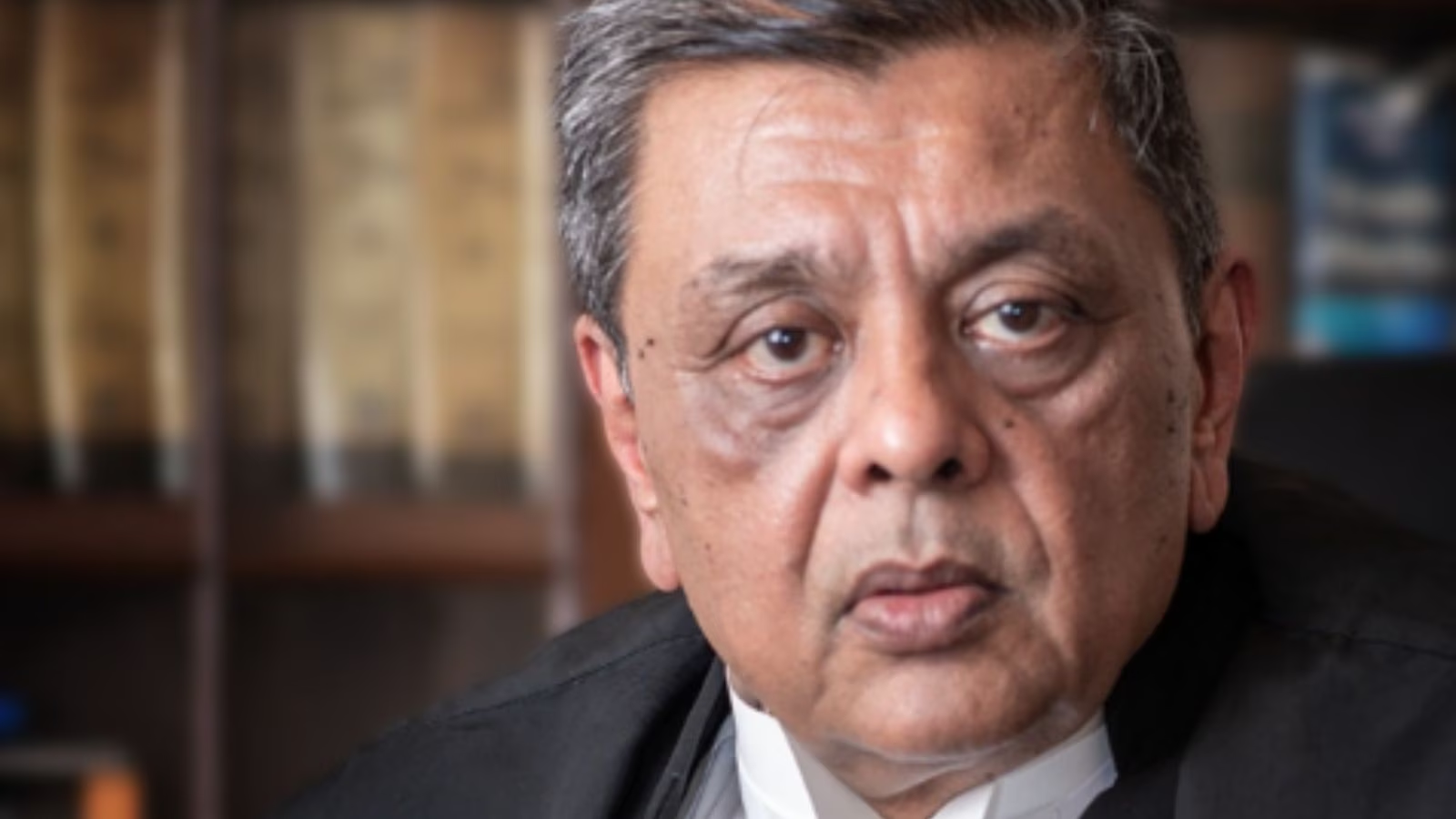
Home invasion, assault, death threats: Why a retired Bombay HC judge’s family is living in fear in London | Mumbai News
For over ten months, retired Bombay High Court judge Justice Gautam Patel and his family have been receiving threats. Last month, his daughter was assaulted by a masked man in London and suffered a fractured nose. The threats are allegedly linked to a verdict Justice Patel delivered two days before his retirement in April 2024. It was a ruling on who should lead the Dawoodi Bohra community, one of India’s most prominent Muslim denominations. Here is what that case was about, and how it led to this.
Q. What happened to the family?
Speaking from the UK, Justice Gautam Patel told The Indian Express that in mid-August 2025, there was an attempted home invasion at their house in a London suburb. Then, on September 3, 2025, a threatening letter arrived. “It’s addressed to my daughter and her husband, and says you have delivered a false, corrupt judgment in the Dawoodi Bohra case, references the case specifically, and says we are a powerful guild of Dawoodi Bohras, and we have engaged a criminal syndicate. A dangerous criminal syndicate,” Patel said.
The letter warned him to comply with its demands by the end of September or “harm” would befall him and his family. “What is demanded is that I leave the country, which means leave India for an unknown destination, make a YouTube video recanting my judgment of April 23, 2024. Now, this is happening in August 2025, a year-and-a-half after I retired,” Patel said. He was also asked to give interviews to bar associations and testify in court calling his own judgment wrong.
His wife, too, received an identical envelope in Mumbai, following which the family alerted local police there as well and sought protection. Justice Patel filed a non-cognisance complaint with Mumbai Police on September 9, 2025.
On April 22 this year, Aditi was assaulted by a masked man in London and suffered a fractured nose. A letter dated June 5, accompanied by an SD card, then claimed responsibility for the earlier break-in and warned, “The next step involves cremation. Yours and your family.” The family chose not to open the SD card.
An official communication from Hertfordshire Constabulary confirmed the investigation to The Indian Express. “These include an attempted burglary and threatening communication reported in August 2025, an assault reported in April 2026 and further threatening communication reported in June 2026. As part of the investigation, safeguarding measures have been provided to the family. As enquiries remain ongoing, we are unable to provide any more detailed information regarding the investigation at this time,” it said.
Justice Patel said the family has pursued every available channel. “We’ve now pursued all the channels with the police, with the Indian High Commission here and everyone. At present, nothing has happened in Mumbai, but it’s all been centred in London. And the group says that it’s a guild of powerful Dawoodi Bohras and specifically demands a recantation of that judgment,” he said.
Story continues below this ad
The retired judge also wrote to the Acting Chief Justice of the Bombay High Court and the Chief Justice of India.
Q. Who are the Dawoodi Bohras?
The Dawoodi Bohras are a denomination among Shia Muslims with over five lakh members in India and more than ten lakh worldwide. Their supreme religious leader, known as al-Dai al-Mutlaq, is based in Mumbai. Under Dawoodi Bohra doctrine, a successor to the Dai is appointed through “divine inspiration,” a process called “nass”. In practice, nass is often conferred on a member of the incumbent Dai’s family.
Q. What was the dispute in court?
When the 52nd al-Dai al-Mutlaq, Syedna Mohammad Burhanuddin, died in 2014, his son Mufaddal Saifuddin succeeded him. But Burhanuddin’s half-brother Khuzaima Qutbuddin challenged the succession, claiming Burhanuddin had privately conferred nass on him, and not his son, back in 1965. After Qutbuddin died in 2016, his son Taher Fakhruddin continued the legal fight.
Saifuddin’s side argued that the 1965 nass cannot be accepted as it lacked witnesses, and that a nass can, in any case, be changed or revoked. They relied on a separate nass conferred on Saifuddin by Burhanuddin in the presence of a witnesses at a London hospital in 2011, where the latter was admitted after suffering a stroke. The suit dragged on for years, weighed down by voluminous evidence, the death of the original plaintiff, and Covid-19 disruptions
Q. What did the court decide?
Story continues below this ad
Two days before his retirement, Justice Patel delivered his verdict on April 23, 2024. He dismissed the suit, holding that the plaintiff had not proved that a valid nass, once conferred, cannot be retracted or superseded. The court also held that Saifuddin had proved a valid nass was conferred on him by the 52nd Dai. Justice Patel said he had decided the dispute “on proof and not faith” and kept the verdict “as neutral as possible.”
Q. What has the reaction been?
The office of Syedna Mufaddal Saifuddin — whose leadership was upheld by Justice Patel’s verdict — was among the first to condemn the threats. “We are deeply shocked and distressed by recent reports of violence, threats and intimidation directed at the Honourable Justice Gautam Patel (Retd.) and his family, and our thoughts and prayers are with them during this difficult time,” it said. The statement called such acts “entirely contrary” to the community’s beliefs and values, adding: “The Dawoodi Bohra community, under the guidance and leadership of His Holiness Syedna Mufaddal Saifuddin, is firmly rooted in the tenets of peace, tolerance, and an unwavering respect for the rule of law.” It advised community members to help authorities in any way they can.
The Bombay Bar Association urged the Ministry of External Affairs to take up the matter with British authorities, warning that such acts “strike at the very heart of judicial independence.” The Bar Association of India said “the demand that a judge disown a verdict by video, under coercion, is an attempt to substitute intimidation for adjudication, and can have no place in a civilised society.”
Former Supreme Court judge Justice Abhay S Oka called it “a direct attack on the independence of the judiciary” and said the High Court may want to consider taking suo motu action.
 20
20 584226
 20
20
 20
20