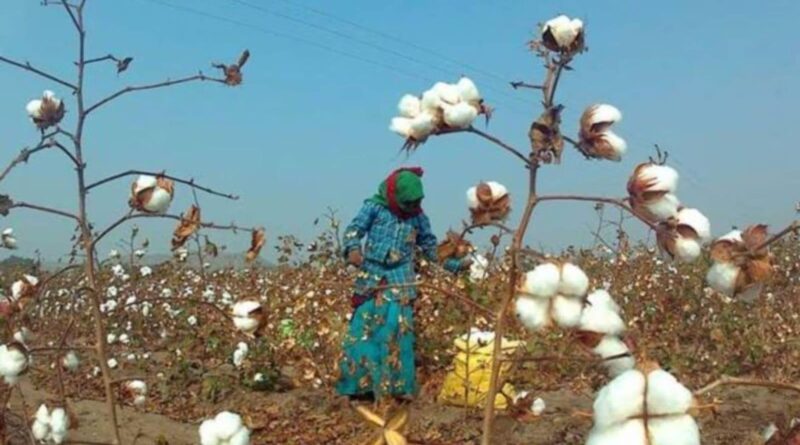
Cotton sowing area likely to rise by 10-15% this kharif season: Officials | Mumbai News
A sharp rise in cotton prices in domestic and international markets is expected to drive a 10-15 per cent increase in cotton cultivation areas in Maharashtra during the 2026-27 kharif season, agriculture department officials said.
Early trends suggest farmers, particularly in Vidarbha and Marathwada, are allocating more land to cotton at the expense of soybean, the state’s other major kharif crop.
Senior agriculture department officials said higher market demand and better price realisation are encouraging farmers to shift back to cotton.
“Compared to soybeans, cotton currently offers better demand and higher returns. Farmers are factoring in the recovery of cultivation costs, especially when several crops have failed to fetch even the minimum support price (MSP). This is likely to result in more acreage being brought under cotton,” a senior official said.
At Yavatmal, farmer Ashok Bhutada, who owns 24 acres, has already decided to increase cotton cultivation this year.
“Last kharif season, I cultivated cotton on 16 acres. This year, I plan to increase it to 20-21 acres. The remaining area will be used for tur,” he said.
Explaining the shift, Bhutada said cotton is perceived as less risky than soybean under increasingly erratic weather conditions.
“Soybean requires timely rainfall from sowing to flowering and harvest. With changing weather patterns, rainfall has become unpredictable. Secondly, soybean prices crashed this year, causing heavy losses. Many farmers could not even recover their investment costs,” he said.
Story continues below this ad
Agriculture officials say Bhutada’s decision reflects a broader trend across the 14 agrarian distress-hit districts of Vidarbha and Marathwada, where farmers are increasingly favouring cotton.
The shift follows a disappointing season for soybean growers. Against an MSP of Rs 5,328 per quintal, farmers were forced to sell soybean at Rs 4,000-4,500 per quintal across many markets. Although the Centre has increased the MSP for soybean to Rs 5,708 per quintal for 2026-27, farmer confidence remains weak.
Cotton, on the other hand, witnessed a sharp rally in April and May, with prices touching Rs 9,000-9,500 per quintal in several markets, significantly higher than the MSP of Rs 7,710 for medium-staple and Rs 8,110 for long-staple cotton. For 2026-27, the Centre has raised the MSP to Rs 8,267 and Rs 8,667 per quintal, respectively.
Maharashtra accounts for nearly a quarter of India’s cotton production. Cotton has traditionally been the main cash crop for farmers in Vidarbha and Marathwada, particularly small and marginal cultivators. However, repeated pest attacks, rising input costs and poor MSP procurement had pushed many growers towards soybean in recent years.
Story continues below this ad
Despite renewed interest in cotton, production figures from the previous season highlight the risks associated with the crop.
The area under cotton cultivation declined from 41 lakh hectares in 2024-25 to 38.55 lakh hectares in 2025-26.
Production witnessed an even steeper fall, dropping by 47.4 per cent from around 90 lakh metric tonnes to 51 lakh metric tonnes, according to agriculture department data.
Officials attributed the decline largely to excess and unseasonal rainfall, as well as hailstorms, which adversely affected the crop.
Maharashtra received 109 per cent of its normal rainfall last year. Of the state’s 355 talukas, 149 received excess rainfall, 189 recorded normal rainfall and 25 remained rain deficient.
Story continues below this ad
Weather forecasts for the coming season have also raised concerns. Preliminary estimates indicate that nearly 18 of Maharashtra’s 36 districts could face deficient rainfall, potentially affecting crop yields.
During a kharif review meeting last month, Chief Minister Devendra Fadnavis directed departments and district administrations to issue regular advisories to farmers based on weather forecasts and crop conditions.
While weather alerts are being sent to more than 50 lakh farmers, many cultivators complain that they receive little practical support from local agriculture offices and Krishi Kendras regarding crop planning and soil health management.
“Given the shortage of manpower and logistical constraints, it is difficult to provide the kind of handholding expected by the government. During summer, staff strength is further reduced because of leave and other administrative commitments,” the officer said.
Story continues below this ad
Farmer activist Vijay Jawandhia cautioned against the assumption that current cotton prices would remain stable by the time the crop reaches the market.
“In the absence of a structured support system, farmers often make decisions based on prevailing prices and demand. Naturally, many are moving towards cotton because prices have risen sharply. But the current rally is driven by international developments. Cotton sown in June and July will arrive in markets only by October-November. It is impossible to predict how global demand and prices will behave by then,” he said.
Agriculture experts warned higher prices alone do not guarantee better returns.
“Farmers are opting for cotton expecting better procurement and higher prices. However, procurement agencies often reject produce citing quality issues, forcing farmers to sell to private traders at lower rates. Unless the government puts in place a robust mechanism to prevent exploitation and ensure fair prices, farmers’ financial security will remain elusive,” an agriculture expert said.
 20
20 584226
 20
20
 20
20